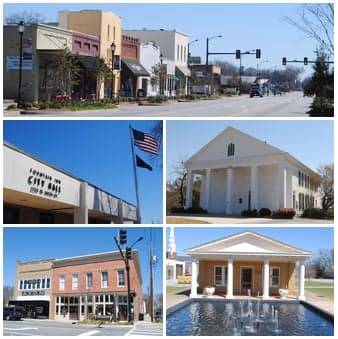
Photo: Wikipedia
Demographics of Fountain Inn, SC
Affluence Level in Fountain Inn, SC
A below-average socioeconomic profile. Incomes, home values, and educational attainment trail the U.S., with higher poverty and unemployment.
People of Fountain Inn, SC
Fountain Inn, South Carolina, is a small city of 11,307 residents with a distinctly Southern character, shaped by a history of textile manufacturing and recent suburban growth from Greenville. The population is predominantly White (55.9%) and Black (29.0%), with a growing Hispanic community (9.8%) and a very low foreign-born rate of 1.4%. The city retains a tight-knit, family-oriented feel, with 30.8% of adults holding a college degree, reflecting a mix of longtime locals and newer professionals drawn by affordable housing and proximity to the Upstate's job market.
How the city was settled and grew
Fountain Inn's population history begins not with colonial settlement but with the railroad. The city was founded in the 1830s as a stop on the Columbia-to-Greenville rail line, named for a local inn with a natural spring. The original population was a mix of Scots-Irish and English farmers who settled the surrounding rural areas, with a small number of enslaved Black laborers working on cotton plantations. After the Civil War, freed Black families established their own communities, notably in the Eastside neighborhood near the railroad tracks, where many built homes and churches. The city's first major growth wave came with the textile boom of the late 19th and early 20th centuries. The Fountain Inn Cotton Mill (later known as the Fountain Inn Plant of J.P. Stevens) opened in 1892, drawing White mill workers from the surrounding countryside and Appalachian foothills. These workers settled in company-built housing in the Mill Village district around the plant, creating a dense, working-class enclave. By 1920, the population had reached roughly 1,500, almost entirely White and native-born, with Black residents largely confined to the Eastside and a smaller settlement known as Freetown on the city's western edge. The Great Depression and World War II paused growth, but the post-war textile expansion brought a second wave of White rural migrants into the 1950s, filling new subdivisions like Hillcrest and Oakwood on the north side.
Modern era (post-1965)
The post-1965 era brought significant demographic change, though not through foreign immigration. The Immigration and Nationality Act of 1965 had little immediate effect on Fountain Inn; the city's foreign-born population remains just 1.4% today, far below the national average. Instead, the major shift was domestic: the decline of the textile industry in the 1970s and 1980s led to job losses and out-migration, particularly among White mill workers. The mill finally closed in 1999, leaving the Mill Village district in decline. Meanwhile, Black residents began moving into previously White neighborhoods as segregation eased, with families settling in the Westside area around Main Street and into newer subdivisions like Brookfield on the south side. The Hispanic population began to grow in the 1990s and 2000s, driven by construction and service jobs in the booming Greenville metro area. Today, Hispanic residents (9.8%) are concentrated in the South Main corridor and parts of the Mill Village, where affordable housing and proximity to work sites are key draws. The Asian population is effectively zero (0.0%), and the Indian-subcontinent population is also zero (0.0%), making Fountain Inn one of the least diverse cities in the Upstate in terms of Asian or immigrant presence. The most recent wave, beginning around 2010, has been White and Black professionals and retirees moving from Greenville and Simpsonville, attracted by lower home prices and a slower pace of life. These newcomers have settled in newer subdivisions like Fox Run and Hunters Creek on the city's northern and eastern edges, gradually raising the college-educated share to 30.8%.
The future
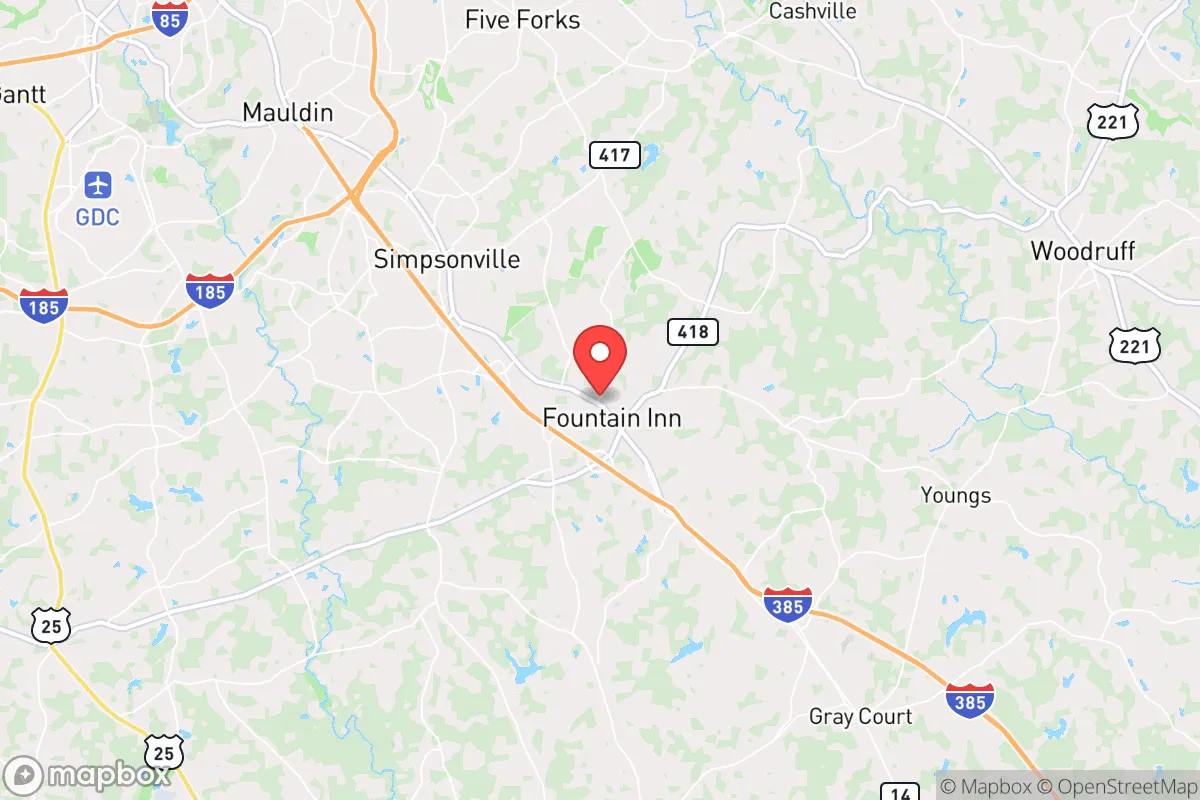
The population of Fountain Inn is heading toward greater homogenization in terms of race and class, but with a growing internal divide. The Hispanic community is likely to continue growing slowly, as families already settled in the South Main corridor and Mill Village attract relatives and new arrivals from Mexico and Central America. However, the very low foreign-born rate (1.4%) suggests this growth will remain modest, and assimilation into the broader White and Black population is likely over the next generation. The Black population (29.0%) is stable, with no major in-migration or out-migration trends, and is concentrated in the Eastside and Westside neighborhoods. The White population (55.9%) is the most dynamic group, split between older, working-class families in the Mill Village and Hillcrest and newer, college-educated arrivals in Fox Run and Hunters Creek. This is creating a subtle class divide within the White population, with the newer subdivisions becoming more affluent and politically conservative, while the older neighborhoods remain more moderate. Over the next 10-20 years, Fountain Inn will likely become more suburban and less distinctively mill-town, as Greenville's sprawl pushes further south. The city's population may reach 15,000 by 2040, with growth concentrated in the northern subdivisions and along the I-385 corridor. The Eastside and Mill Village will likely see gradual reinvestment as housing prices rise, but the city will remain overwhelmingly native-born and Southern in character.
For someone moving in now, Fountain Inn offers a stable, family-oriented community with a clear sense of its own history. The city is becoming more suburban and professional, but it retains a working-class backbone and a racial composition that is distinctly biracial (White and Black) with a small Hispanic minority. The lack of Asian or Indian populations means the city is not a destination for high-tech or global professionals, but it is a solid choice for those seeking affordable housing, good schools, and a slower pace within commuting distance of Greenville's jobs.

* Values derived from national, state, county, city and local statistics and may differ in a specific area. Last updated: 2026-04-30T00:28:31.000Z
Narrative content on this page is AI-generated and may contain mistakes. Verify any details that matter before acting on them.
ReloMaps may earn a commission from affiliate links at no extra cost to you.

