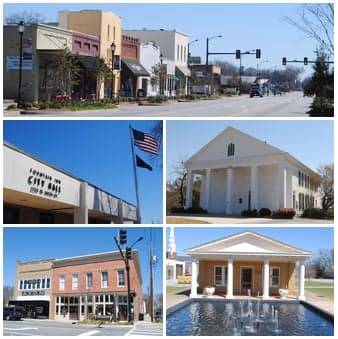
Photo: Wikipedia
Strategic Assessment of Fountain Inn, SC
Meaningful friction. Expect exposure to either population pressure, blast zones, or natural disaster risk. Consider buying a retreat property.
What does the Strategic Assessment tell us?
Our Strategic Assessment grades tactical survivability of an area. Major population centers, military targets, fallout zones, natural disasters, and border exposure all drive risk — lower exposure means a more defensible position in a crisis.
This is heavily inspired by Joel Skousen's Strategic Relocation book. Highly recommended you checkout the book ($)What does this tell us?
Our Strategic Assessment grades tactical survivability of an area. Major population centers, military targets, fallout zones, natural disasters, and border exposure all drive risk — lower exposure means a more defensible position in a crisis.
This is heavily inspired by Joel Skousen's Strategic Relocation book. Highly recommended you checkout the book ($)Strategic Pillars

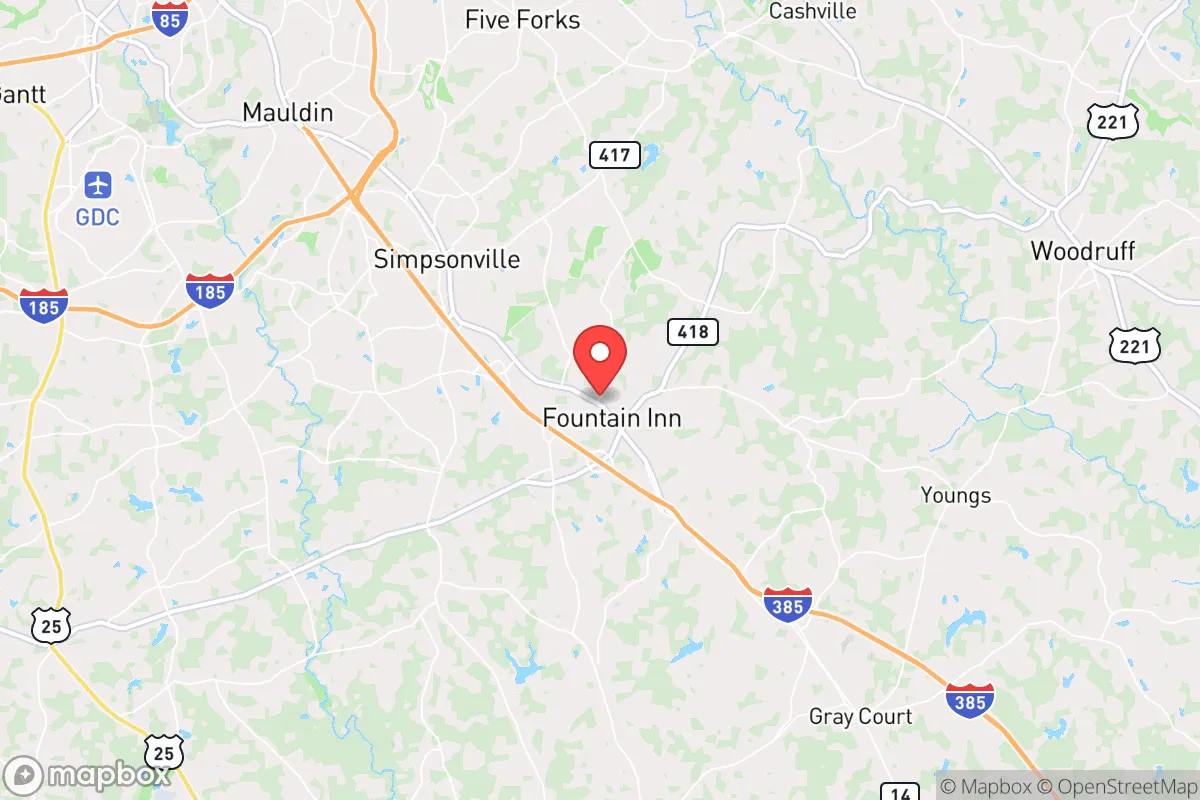
Key Distances
Regional Safe Places
Below is our recommended "safe zones" in South Carolina and the surrounding area based on our strategic heuristics. For most people, it's unrealistic to live in a “safe zone” full-time due to work, family or other personal reasons. They tend to be more rural. However, many of these areas are perfect for second homes and retreat properties that double as a vacation home or even a short-term rental.
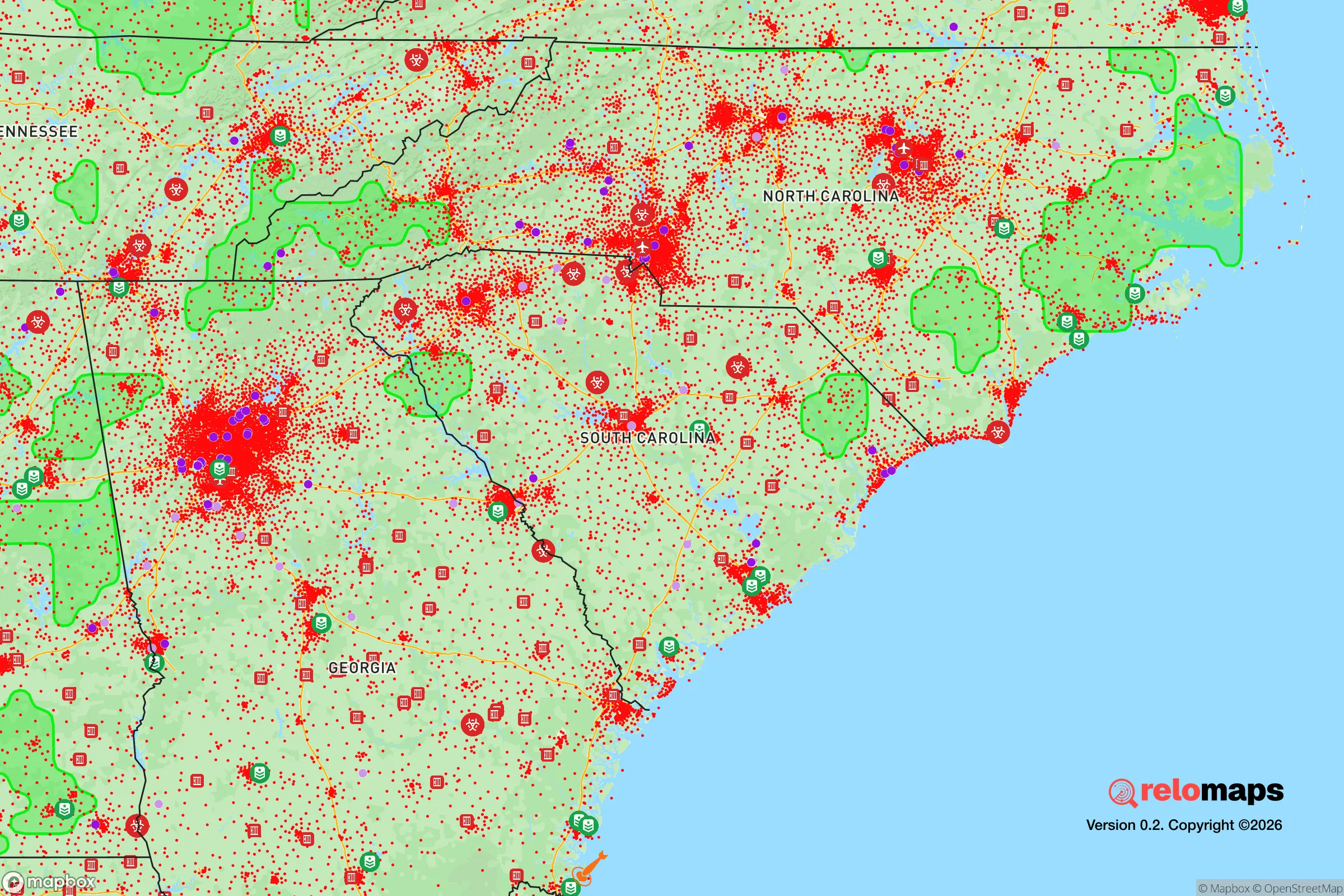
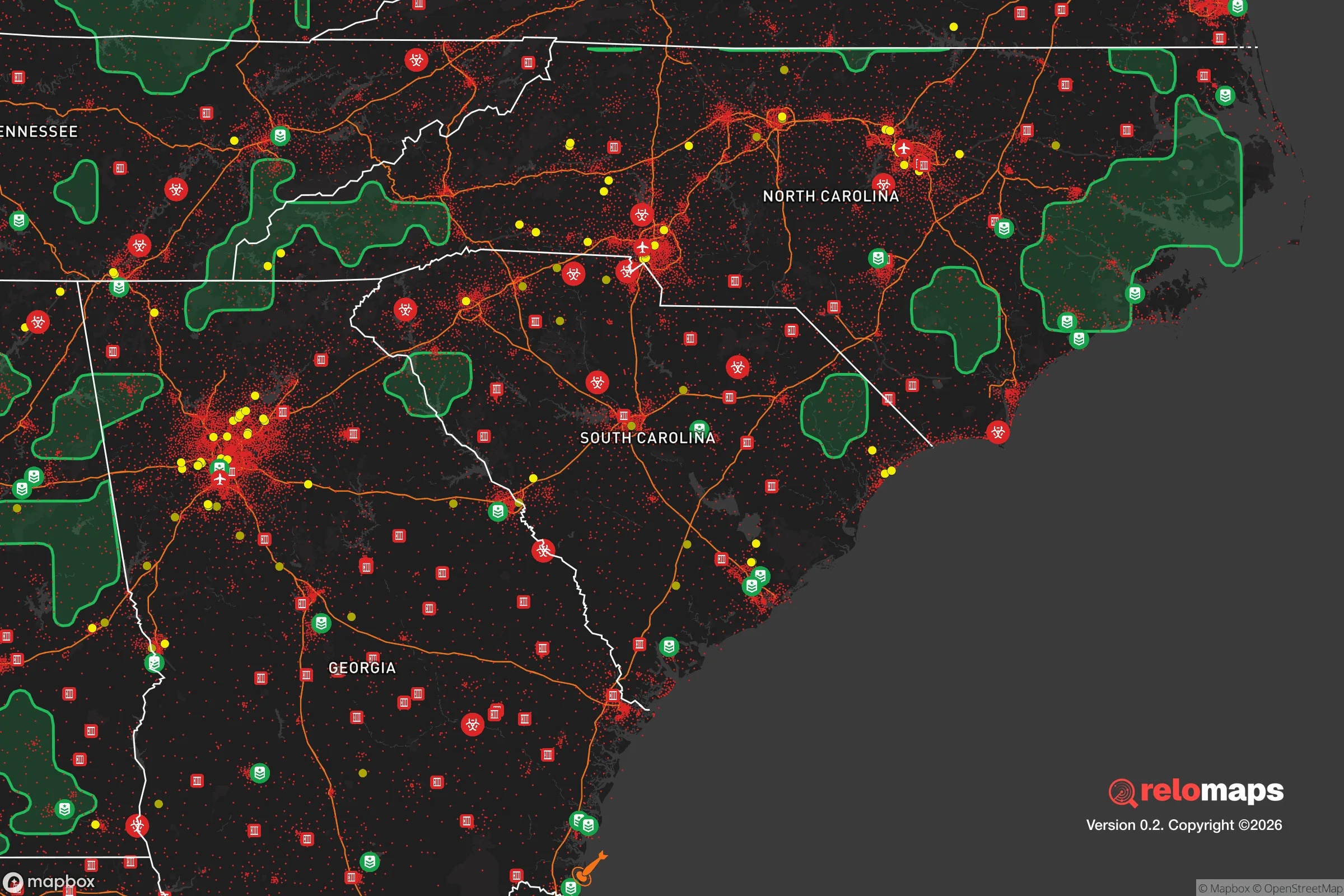


Important Note: For informational purposes only. This does not mean nothing bad ever happens in the green zones. Please use common sense. This is based on public data and modeled with AI. We tried to take a conservative approach but mistakes happen. We update this regularly as new information becomes available.
Solar Generator Recommendations
Backup power matters more here than in safer locations. We've picked three solar generators across budgets and capacity tiers — start with the budget unit if you only need a few essentials, or step up if you want to run a fridge and HVAC for days at a time.

Jackery Portable Power Station Explorer 300
Budget OptionPower on the Go: Weighing only 11 lbs, it's convenient to set up and store with book-sized foldable solar panels

BLUETTI Portable Power Station AC180
Designed for both indoor and outdoor scenarios, AC180 is highly capable as it has a robost capacity and continuous output power.

EF ECOFLOW DELTA Pro Ultra Power Station
Upgraded PickEcoFlow DELTA Pro Ultra is a whole-home energy system designed to grow with your family. Integrated with the Smart Home Panel 2, it scales to meet your evolving energy needs — keeping your home powered, intelligent, and secure through every stage of life.
We earn a commission, at no additional cost to you.
Strategic Assessment Analysis
Fountain Inn, South Carolina, occupies a strategic sweet spot in the Upstate region that resilience-minded relocators should take seriously: it sits roughly 15 miles from Greenville and 25 miles from Spartanburg, close enough to access major infrastructure but far enough to avoid the immediate blast radius, traffic gridlock, and civil unrest that would plague those urban cores during a crisis. The town’s population hovers around 12,000, giving it a small-town feel with a growing tax base, and its position along Interstate 385 provides a direct evacuation route toward the less-dense rural counties to the south and east. For a conservative-leaning individual or family looking to balance economic opportunity with physical security, Fountain Inn offers a credible base of operations—provided you understand both its natural advantages and its exposure to the risks that come with proximity to larger targets.
Geographic position and natural advantages for long-term security
Fountain Inn’s location in the Piedmont region gives it several natural advantages that a prepper or survivalist should factor into a relocation decision. The area sits on a plateau of rolling hills with elevations around 900 feet, which provides decent drainage and reduces flood risk compared to coastal or river-bottom communities. The climate is humid subtropical, with hot summers and mild winters—meaning you can grow food year-round with a simple cold frame, and you won’t face the extreme cold that complicates off-grid heating in northern states. The soil in the Upstate is primarily clay-loam, which is workable for gardening once amended, and the region receives about 50 inches of rainfall annually, so water availability is generally good if you have catchment or well access. The surrounding landscape is a mix of second-growth forest and farmland, offering ample cover and resources for hunting, foraging, and timber for construction or fuel. Critically, Fountain Inn is not situated on any major fault line, and the area rarely experiences tornadoes of the intensity seen in the Plains or hurricanes of the severity that hit the coast—though you should still plan for occasional severe thunderstorms and the rare ice storm that can knock out power for days.
Risks, exposures, and proximity to fallout-relevant landmarks
The most significant risk for a Fountain Inn relocator is its proximity to Greenville-Spartanburg International Airport (GSP), located about 20 miles north. In a major conflict or terrorist event, GSP would be a high-value target for air assault or sabotage, and the fallout zone from a conventional bomb or dirty bomb at that location could affect Fountain Inn depending on wind direction. The town is also within 30 miles of the BMW manufacturing plant in Spartanburg County and the Michelin North America headquarters in Greenville—both industrial facilities that could be secondary targets or sources of hazardous material releases during a crisis. On the plus side, Fountain Inn is far enough from the Savannah River Site (about 90 miles southwest) and the Duke Energy nuclear plants along the Catawba River (about 70 miles northwest) that a catastrophic failure at those facilities would likely not pose a direct lethal threat, though you’d want to monitor wind patterns and have potassium iodide on hand. The I-385 corridor itself is a double-edged sword: it provides a quick escape route south toward Laurens and Clinton, but it would also become a chokepoint during an evacuation, with the potential for gridlock and civil disorder. A savvy relocator should identify secondary routes—like SC-418 or SC-14—that bypass the interstate and connect to smaller county roads leading into the rural areas around Gray Court and Hickory Tavern.
Practical resilience for a relocator: food, water, energy, and defensibility
For a family or individual serious about self-sufficiency, Fountain Inn offers a workable foundation but requires deliberate investment. The town has municipal water from the Greenville Water System, which draws from the Table Rock Reservoir in the mountains—a relatively secure source, but one that could be compromised by a cyberattack or physical sabotage on the treatment plants. A well is the better long-term play: the water table in the Piedmont is generally accessible at depths of 100-300 feet, and a hand-pump or solar-powered pump can keep you operational when the grid goes down. The local soil supports a wide range of crops—tomatoes, peppers, beans, squash, and leafy greens do well—and the growing season runs from April to October, with a mild enough winter that you can extend it with hoop houses. Livestock is feasible on parcels of 5 acres or more; chickens, goats, and rabbits are common in the surrounding county. Energy resilience is more challenging: Duke Energy provides the grid, and outages are frequent during storms, but solar is viable with average daily insolation of 4.5-5 kWh/m². A 5kW solar array with battery storage can cover basic needs for a family of four, and the lack of state-level net metering restrictions (South Carolina has a net metering policy, but it’s not as generous as some states) means you can still sell excess back to the grid during normal times. Defensibility is moderate: Fountain Inn is a typical small town with a police force of about 20 officers, so you cannot rely on law enforcement for protection during a widespread breakdown. Your best bet is a property on the outskirts—preferably with a long driveway, natural tree cover, and a clear line of sight to the road—and a neighborhood watch or mutual-aid network with like-minded neighbors. The local gun culture is strong, and South Carolina is a shall-issue state for concealed carry, so you can legally arm yourself without bureaucratic hurdles.
The overall strategic picture for Fountain Inn is one of cautious optimism for the prepared relocator. It’s not a hardened bunker location—it’s a working-class Southern town with decent infrastructure, a growing economy, and a population that leans conservative and self-reliant. The risks are real but manageable: proximity to Greenville and GSP means you need a bug-out plan and a go-bag ready, but the surrounding rural counties offer a deep buffer zone that many other towns in the Southeast lack. If you’re looking for a place to establish a long-term base where you can work a remote job, raise a family, and gradually build your resilience without living in a constant state of alert, Fountain Inn deserves a spot on your short list. Just don’t expect the government to save you—plan like you’re on your own, and you’ll be fine.

* Values derived from national, state, county, city and local statistics and may differ in a specific area. Last updated: 2026-04-30T00:28:31.000Z
Narrative content on this page is AI-generated and may contain mistakes. Verify any details that matter before acting on them.
ReloMaps may earn a commission from affiliate links at no extra cost to you.

