Demographics of Franklin, WI
Affluence Level in Franklin, WI
An upper-middle-class area. Household wealth, education levels, and homeownership run ahead of national benchmarks.
People of Franklin, WI
The people of Franklin, Wisconsin, today number 35,751 and form a predominantly white, family-oriented suburban community with a notably high proportion of college-educated residents (45.4%). The city’s character is defined by its blend of established single-family home neighborhoods and newer subdivisions, attracting families seeking good schools and lower crime rates than nearby Milwaukee. While the population is 82.0% white, Franklin has seen modest growth in its Hispanic (6.1%) and Indian-subcontinent (3.3%) communities, creating a quietly diversifying suburb that remains culturally conservative and community-focused.
How the city was settled and grew
Franklin’s original population was drawn by the promise of fertile farmland and the expansion of the railroad in the mid-19th century. The area was first settled in the 1830s and 1840s by Yankee farmers from New England and New York, who established the agricultural character that would define the town for over a century. These early settlers built their homes and farms in what is now the Historic Franklin Village district, centered around the intersection of Rawson and Loomis Roads, where the original town hall and several 19th-century homes still stand. A second wave of German and Polish immigrants arrived in the late 1800s, drawn by affordable land and work on the railroad lines that cut through the area. These groups established tight-knit farming communities in the Oakwood and Pleasant View neighborhoods, where many of their descendants still live today. Franklin remained a small, rural farming town through the mid-20th century, with a population that barely exceeded 5,000 as late as 1960.
Modern era (post-1965)
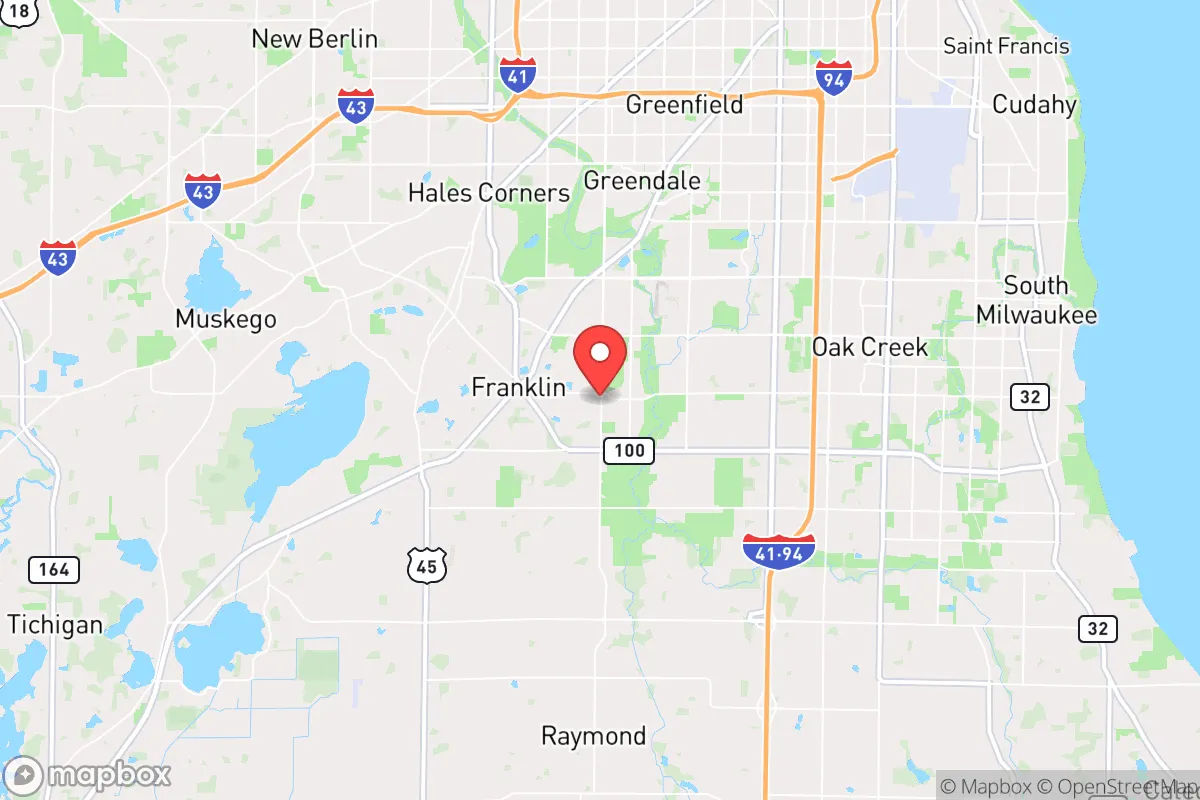
The post-1965 era transformed Franklin from a sleepy farming village into a growing suburban city. The construction of Interstate 43 and the expansion of Highway 100 made the city accessible to commuters working in Milwaukee and Racine, triggering a wave of domestic in-migration from the city and other Midwestern states. Developers built large subdivisions of single-family homes, attracting white, middle-class families seeking larger lots and newer schools. The Forest Hill neighborhood, developed in the 1970s and 1980s, became a primary landing spot for these families, with its ranch-style homes and cul-de-sacs. The Woodland Creek subdivision, built in the 1990s and 2000s, attracted a second wave of domestic migrants, including many empty-nesters and professionals from the Chicago suburbs. The city’s foreign-born population remains low at 2.9%, but the Indian-subcontinent community (3.3%) has grown noticeably since 2010, with families settling primarily in the newer Prairie Hills and Willow Creek subdivisions, drawn by the Franklin Public Schools system and proximity to tech and healthcare jobs in Milwaukee’s southern suburbs. The East/Southeast Asian population (2.3%) is smaller and more dispersed, with no single concentrated neighborhood.
The future
Franklin’s population is projected to continue slow, steady growth, likely reaching 38,000–40,000 by 2040, driven by infill development and the construction of new subdivisions on remaining farmland. The city is not homogenizing into a single demographic block; rather, it is tribalizing into distinct enclaves based on housing age and price. The older Historic Franklin Village and Oakwood neighborhoods remain overwhelmingly white and aging, while the newer Prairie Hills and Willow Creek subdivisions are attracting younger families, including a growing share of Indian-subcontinent and Hispanic households. The Hispanic population (6.1%) is expected to grow modestly as service-sector employment expands, but Franklin lacks the industrial base that draws larger immigrant populations to nearby cities like Milwaukee or Racine. The Black population (2.9%) has remained stable for a decade, with no signs of rapid increase. The city’s high college-education rate and strong school system will continue to attract professionals, but the low foreign-born share suggests Franklin will remain a predominantly native-born, English-speaking suburb.
Franklin is becoming a quietly diversifying, family-oriented suburb where established white homeowners coexist with a growing number of Indian-subcontinent and Hispanic families in newer subdivisions. For someone moving in now, the city offers stable property values, strong schools, and a conservative-leaning community that is slowly becoming more diverse without losing its suburban character. The key trade-off is between the established, older neighborhoods with deep local roots and the newer developments where newcomers are reshaping the city’s demographic future.

* Values derived from national, state, county, city and local statistics and may differ in a specific area. Last updated: 2026-04-21T10:38:37.000Z
Narrative content on this page is AI-generated and may contain mistakes. Verify any details that matter before acting on them.
ReloMaps may earn a commission from affiliate links at no extra cost to you.

