 Popular
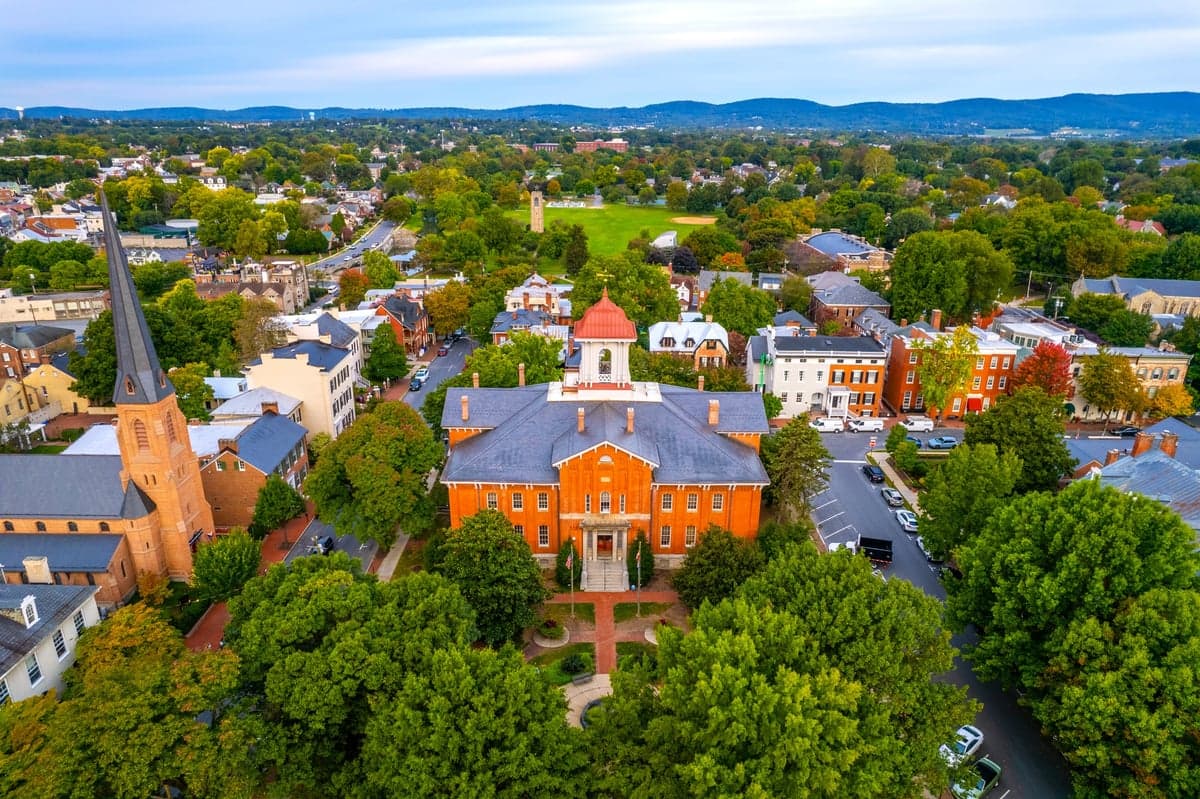
Photo: Wikipedia
Demographics of Frederick, MD
Affluence Level in Frederick, MD
A middle-class area roughly in line with national averages across income, home values, education, and employment.
People of Frederick, MD
Frederick, Maryland, is a city of roughly 80,600 residents that has transformed from a historic German and Scotch-Irish crossroads into a diverse, politically mixed hub where no single ethnic group holds a majority. The city’s character today is defined by a 51.5% white population, a 20.5% Hispanic share, a 16.7% Black population, and growing East/Southeast Asian (3.6%) and Indian-subcontinent (1.9%) communities, all within a city where 41.8% of adults hold a college degree. Its distinctive identity blends a preserved historic core with modern suburban growth, attracting both conservative-leaning families and professionals seeking proximity to Washington, D.C., and Baltimore.
How the city was settled and grew
Frederick was founded in 1745 on a land grant along Carroll Creek, drawing its earliest European settlers—primarily German and Scotch-Irish farmers—who built the stone houses and churches that still line Downtown Frederick and the Historic District. The German population, in particular, established the city’s early character, with neighborhoods like Baker Park and the area around Market Street becoming centers of German-language churches, breweries, and trade. The National Road (now U.S. Route 40) arrived in the early 1800s, turning Frederick into a key transportation and milling hub and attracting a small but established free Black community, which concentrated in All Saints Street and the South End neighborhoods. The 19th century saw waves of Irish immigrants arriving to work on the railroads and canals, settling near the railroad corridor along East Patrick Street. By the early 20th century, Frederick remained a predominantly white, Protestant city with a significant Black minority, but its population grew slowly until the post-World War II era, when suburbanization began to reshape the city’s edges.
Modern era (post-1965)
The 1965 Hart-Cellar Act and the subsequent expansion of the Washington, D.C., metropolitan area fundamentally altered Frederick’s population. The city’s location along the I-270 corridor made it a bedroom community for federal workers and professionals, driving a wave of domestic in-migration from the D.C. suburbs and beyond. This influx, combined with the construction of the Westview and Ballenger Creek subdivisions in the 1980s and 1990s, attracted a more educated, racially diverse population. The Hispanic population grew rapidly from the 1990s onward, driven by both direct immigration from Central America and secondary migration from other U.S. cities, with many families settling in the West Frederick area and along the Rosemont Avenue corridor. The Black population, which had historically been concentrated in the South End and Downtown, began to spread into newer subdivisions like Monocacy Village and Linganore as housing options expanded. East/Southeast Asian communities—primarily Chinese, Korean, and Vietnamese—arrived in smaller numbers, often drawn by professional opportunities in the biotech and healthcare sectors, and are dispersed throughout the city, with a slight concentration near the Fortunes Ridge area. The Indian-subcontinent population, while still small at 1.9%, has grown steadily since 2000, with many families settling in the newer developments around Urbana and Jefferson Technology Park.
The future
Frederick’s population is trending toward greater diversity, but the city is not homogenizing into a single melting pot. Instead, distinct enclaves are solidifying: the Historic District and Baker Park areas remain predominantly white and affluent, while West Frederick and the Rosemont Avenue corridor are becoming increasingly Hispanic. The South End retains a strong Black identity, though it is seeing modest white and Hispanic in-migration. The East/Southeast Asian and Indian-subcontinent communities are growing but remain small and geographically dispersed, likely assimilating into the broader professional class rather than forming concentrated ethnic neighborhoods. The foreign-born share stands at 9.5%, below the national average, suggesting that immigration is not the primary driver of change; instead, domestic migration from the D.C. metro area is the dominant force. Over the next 10–20 years, Frederick is likely to become slightly more Hispanic and Asian, while the white share continues to decline gradually. The city’s college-educated rate (41.8%) will probably rise as the biotech and cybersecurity sectors expand, attracting more professionals.
For someone moving in now, Frederick is becoming a moderately diverse, politically mixed city where neighborhood choice strongly correlates with income and ethnicity. The city offers a stable, family-oriented environment with good schools and a strong sense of local identity, but it is not a place where ethnic groups are rapidly blending—rather, it is a city of distinct, stable enclaves. This makes it a practical choice for conservative-leaning families who value community cohesion and predictable demographics, while still offering exposure to a range of cultures and lifestyles.

* Values derived from national, state, county, city and local statistics and may differ in a specific area. Last updated: 2026-04-22T01:52:17.000Z
Narrative content on this page is AI-generated and may contain mistakes. Verify any details that matter before acting on them.
ReloMaps may earn a commission from affiliate links at no extra cost to you.

