 Popular
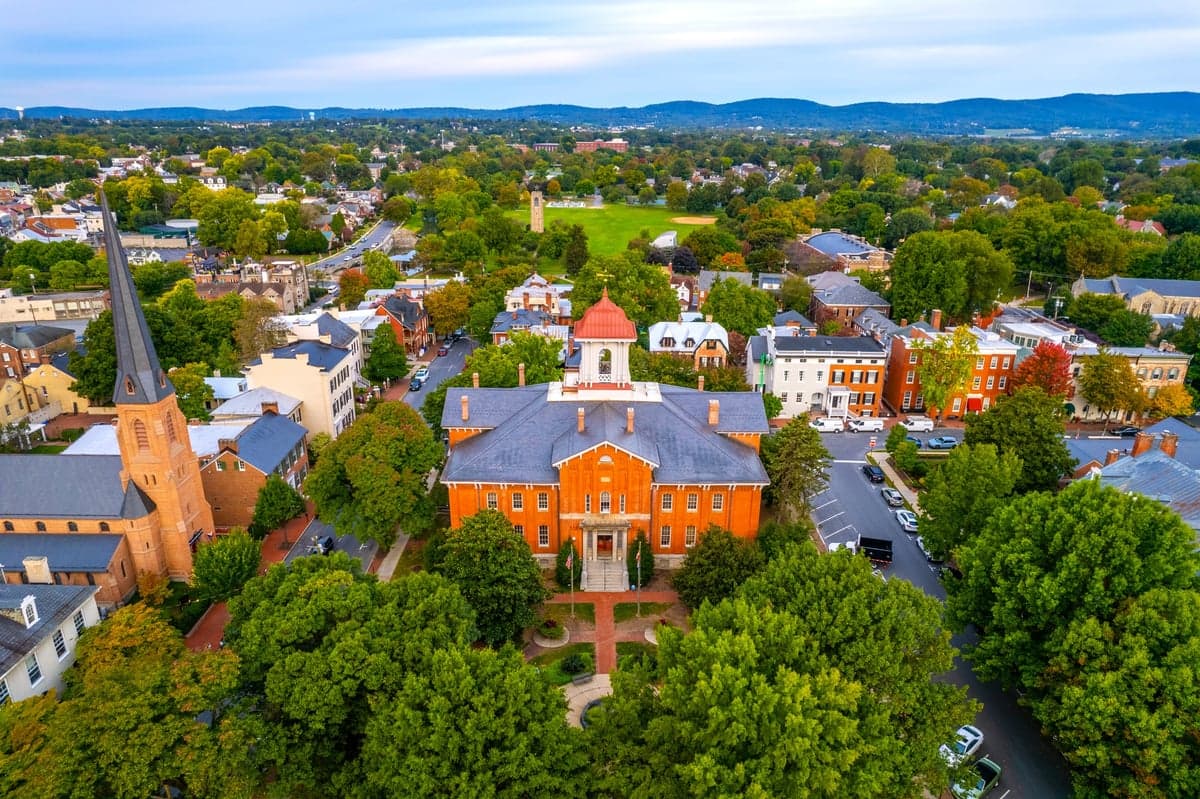
Photo: Wikipedia
Personal Sovereignty in Frederick, MD
Viable for self-reliance. Generally workable, though some barriers may limit total independence.
What does Personal Sovereignty tell us?
Personal Sovereignty measures your capacity for self-reliance and independence with minimal government friction. Higher scores mean fewer barriers between you and the way you want to live... but it assumes you have the space you need and good neighbors.
What does this tell us?
Personal Sovereignty measures your capacity for self-reliance and independence with minimal government friction. Higher scores mean fewer barriers between you and the way you want to live... but it assumes you have the space you need and good neighbors.
State Policy
Energy independence: Importer (8% of energy produced in-state)
Personal Liberty
Homesteading

Personal Liberty Analysis
Frederick, Maryland, presents a complex landscape for personal sovereignty, where a historically independent-minded community exists within a state government increasingly inclined toward regulatory expansion. For the strategic relocation researcher with a conservative, survivalist mindset, the city offers a mixed picture: a strong local culture of self-reliance and property rights, but a state-level legal and tax environment that demands careful navigation. The key question is whether the local autonomy and community resilience can outweigh the growing reach of Annapolis into personal freedoms, from gun rights to medical choice and parental authority.
Tax burden and regulatory posture: How Maryland’s policies affect your autonomy
Maryland’s tax burden is among the highest in the nation, and Frederick residents feel it directly. The state’s progressive income tax, with rates ranging from 2% to 5.75%, combines with a county income tax of 3.2% in Frederick County, creating a combined top marginal rate near 9%. Property taxes are also significant, with Frederick County levying roughly $1.01 per $100 of assessed value, plus city taxes for those within Frederick city limits. This fiscal environment directly reduces the capital available for personal preparedness, land acquisition, and off-grid investments. From a regulatory standpoint, Maryland’s posture is interventionist. The state imposes strict environmental regulations, including the Maryland Department of the Environment’s oversight of well and septic systems, which can complicate homesteading plans. Building codes are uniformly enforced, and the state’s energy policies, such as the Renewable Portfolio Standard, add compliance costs. For the prepper, this means that while Frederick County itself is more permissive than Montgomery or Prince George’s counties, the state’s regulatory hand is heavy, particularly for anyone seeking to live truly off-grid or with minimal government interaction.
Self-defense and gun law specifics: What the Second Amendment landscape looks like in Frederick
This is the most critical sovereignty issue for many conservative relocators, and the news is sobering. Maryland is a “may-issue” state for concealed carry, though the Supreme Court’s Bruen decision (2022) forced a shift to “shall-issue” in practice. However, the state legislature has aggressively pushed back. In 2023, Maryland passed a law banning the carry of firearms in a wide range of “sensitive places,” including any location where alcohol is sold, public transportation, and even private property without the owner’s explicit permission. This law is currently being litigated, but it creates a chilling effect. Furthermore, Maryland maintains a ban on “assault weapons” and standard-capacity magazines (over 10 rounds), a law upheld by the Fourth Circuit. Frederick County itself is more gun-friendly than the state average, with a strong local gun culture and multiple shooting ranges, but you are still subject to state-level restrictions. For the survivalist, this means that while you can own firearms for home defense and hunting, your ability to carry for personal protection in public is heavily restricted, and your choice of defensive weapons is limited. The state’s background check system is also among the most comprehensive, including a 7-day waiting period for handguns. This is a significant erosion of the right to keep and bear arms compared to states like West Virginia or Pennsylvania.
Self-reliance and homesteading viability: Lot sizes, zoning, and off-grid feasibility
Frederick County offers more room for self-reliance than the densely populated Baltimore-Washington corridor, but it is not a frontier. Zoning in the county’s Agricultural (A) and Rural Residential (RR) districts allows for larger lot sizes—typically 2 to 5 acres minimum for new subdivisions—which is viable for substantial gardens, small livestock, and even a few head of cattle. However, within Frederick city limits, lot sizes shrink to standard suburban parcels (0.25–0.5 acres), limiting homesteading potential. Off-grid feasibility is legally difficult. Maryland requires connection to the electrical grid for new construction in most areas, and while solar panels are permitted, net metering policies are state-controlled. Rainwater harvesting is legal but regulated; you cannot collect unlimited amounts without a permit. Composting toilets are allowed under certain conditions but require Maryland Department of the Environment approval. The state’s strict well and septic regulations mean that drilling a well and installing a septic system on a rural property is expensive and subject to rigorous testing. For the serious prepper, the best strategy is to purchase land in the county’s Agricultural zone, at least 5 acres, and build a conventional home with a backup generator, large garden, and rainwater collection system—a “grid-tied but resilient” approach rather than true off-grid independence. The local Amish and Mennonite communities in northern Frederick County demonstrate that self-reliant living is possible, but they operate under religious exemptions that most newcomers cannot claim.
Personal liberties: Parental rights, medical autonomy, speech, and property
Parental rights in Maryland are under increasing pressure. The state’s public school system, including Frederick County Public Schools, has implemented policies on gender identity and curriculum that many conservative parents view as infringing on their authority. Maryland law does not have a strong parental bill of rights, and school boards have significant discretion. For families, this means that opting out of certain lessons or activities can be a confrontational process. Medical autonomy is similarly constrained. Maryland has strict vaccine mandates for school attendance, with limited philosophical exemptions, and the state’s COVID-19 response included broad emergency powers for the governor. The state also has a “red flag” law (Extreme Risk Protective Order) that allows for the temporary seizure of firearms based on a petition from family or law enforcement, a tool that critics argue can be abused. Free speech is generally protected, but Maryland has laws against “harassment” and “disorderly conduct” that can be applied broadly. Property rights are relatively strong in Frederick County compared to the state, with a more conservative Board of County Commissioners that has resisted some state-level mandates on zoning and development. However, the state’s ability to preempt local decisions on issues like rent control and environmental regulations remains a concern. For the individualist, the overall trend in Maryland is toward reduced personal autonomy, with the state asserting authority over medical decisions, education, and self-defense.
In the broader context of the Mid-Atlantic, Frederick offers a better sovereignty profile than the inner suburbs of Washington, D.C., but it falls short of the constitutional carry and low-tax environments of West Virginia or Pennsylvania. For the strategic relocator, Frederick is a compromise: a place with a strong local community, decent land for homesteading, and a culture of independence, but within a state that is actively hostile to many core conservative principles of personal liberty. The calculus comes down to whether the economic opportunities and community resilience of Frederick County outweigh the growing reach of Annapolis into your life. For those willing to fight for their rights at the local level and navigate state regulations, it can work. For those seeking maximum personal sovereignty with minimal government interference, the answer is to look further west.

* Values derived from national, state, county, city and local statistics and may differ in a specific area. Last updated: 2026-04-22T01:52:17.000Z
Narrative content on this page is AI-generated and may contain mistakes. Verify any details that matter before acting on them.
ReloMaps may earn a commission from affiliate links at no extra cost to you.

