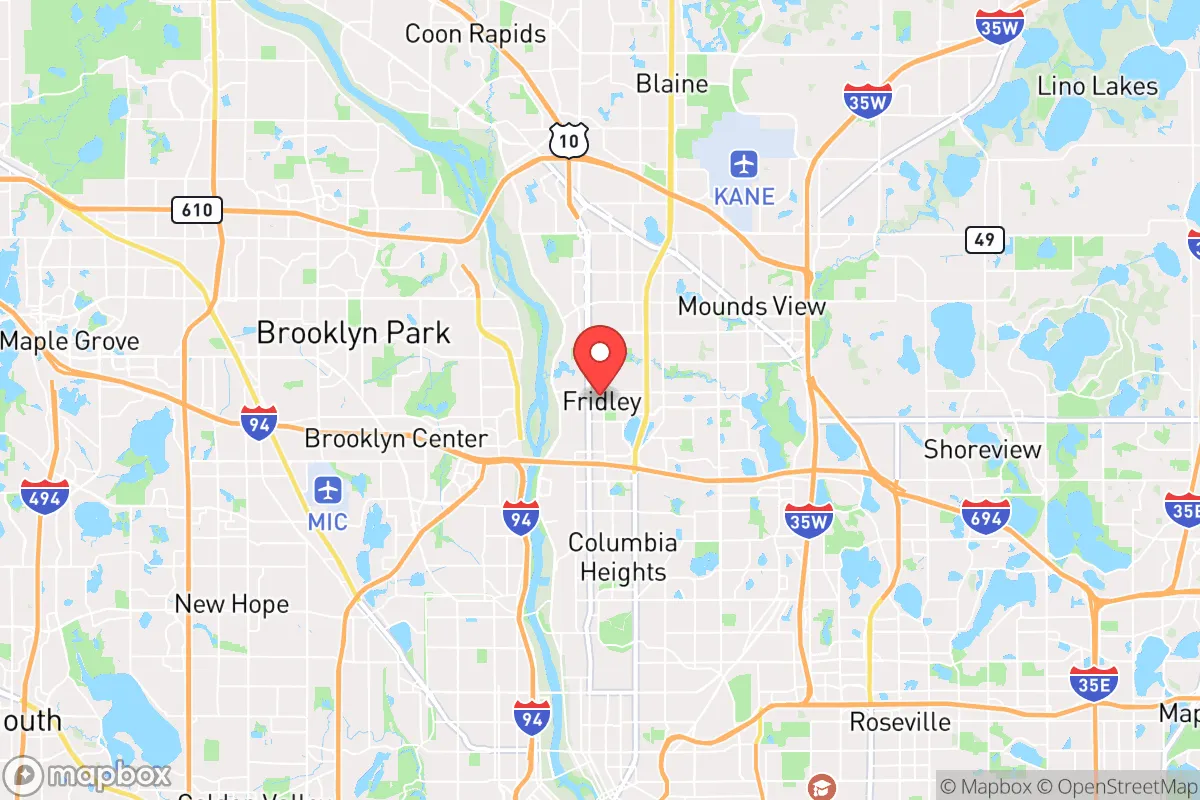
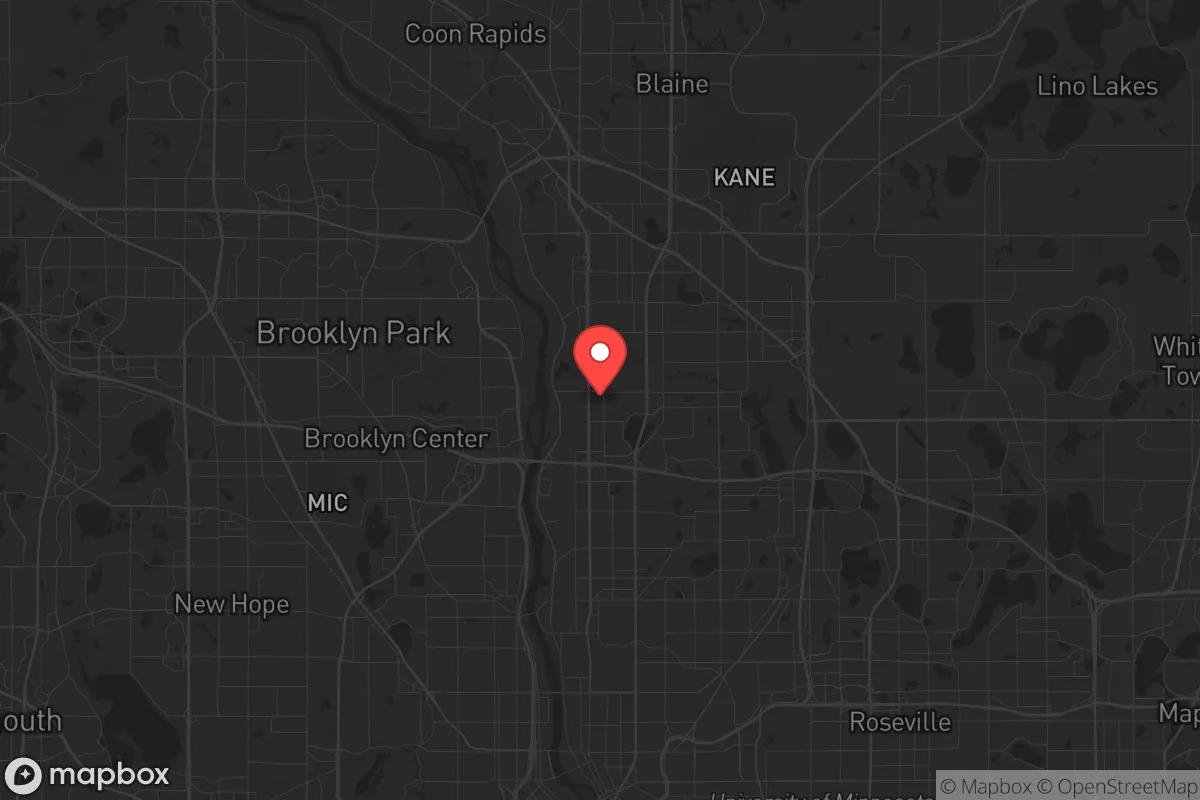
Strategic Assessment of Fridley, MN
Multiple tactical vulnerabilities. Population density, target proximity, or disaster risk are likely compounding. A retreat property and exit planning is required.
What does the Strategic Assessment tell us?
Our Strategic Assessment grades tactical survivability of an area. Major population centers, military targets, fallout zones, natural disasters, and border exposure all drive risk — lower exposure means a more defensible position in a crisis.
This is heavily inspired by Joel Skousen's Strategic Relocation book. Highly recommended you checkout the book ($)What does this tell us?
Our Strategic Assessment grades tactical survivability of an area. Major population centers, military targets, fallout zones, natural disasters, and border exposure all drive risk — lower exposure means a more defensible position in a crisis.
This is heavily inspired by Joel Skousen's Strategic Relocation book. Highly recommended you checkout the book ($)Strategic Pillars

Key Distances
Regional Safe Places
Below is our recommended "safe zones" in Minnesota and the surrounding area based on our strategic heuristics. For most people, it's unrealistic to live in a “safe zone” full-time due to work, family or other personal reasons. They tend to be more rural. However, many of these areas are perfect for second homes and retreat properties that double as a vacation home or even a short-term rental.
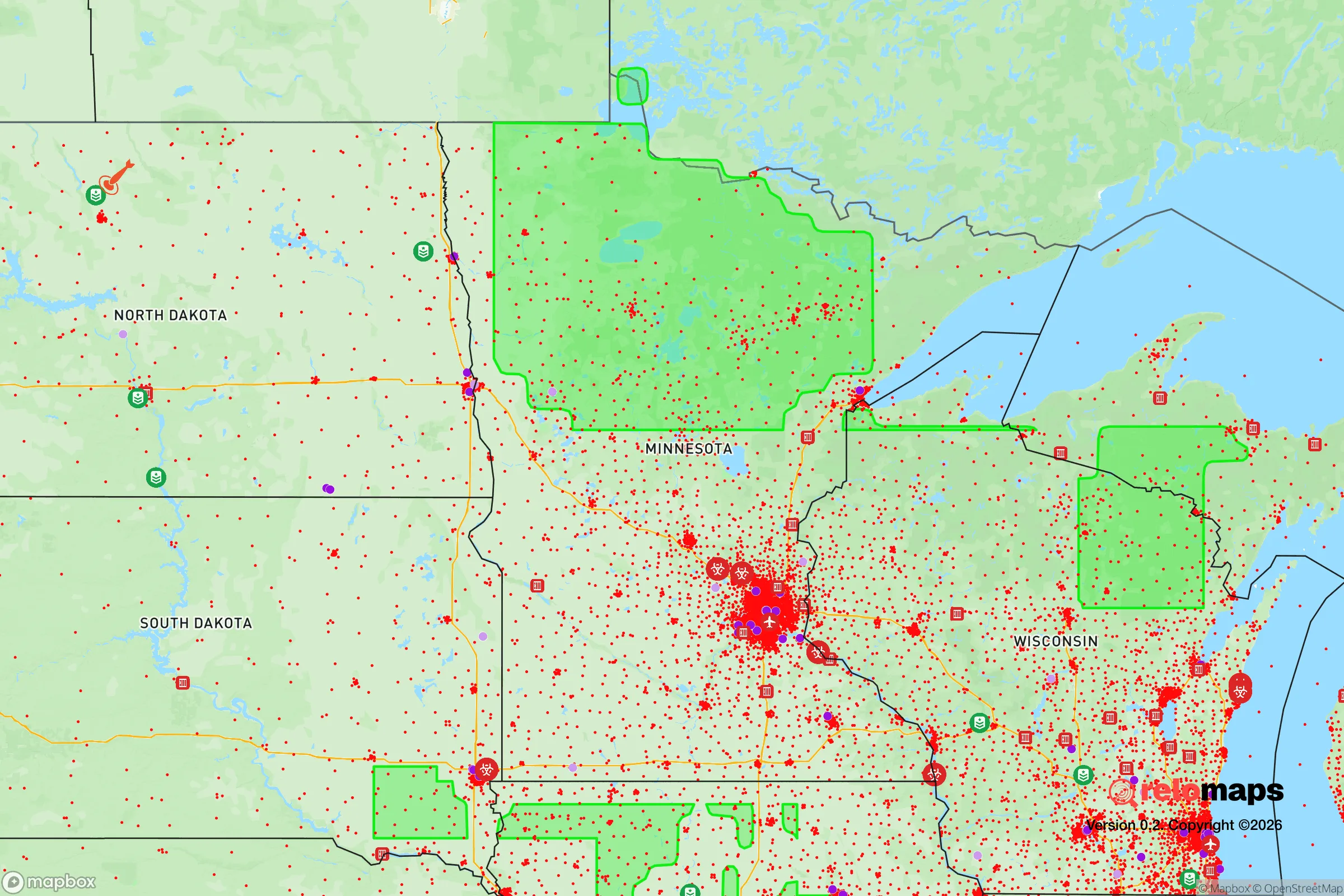
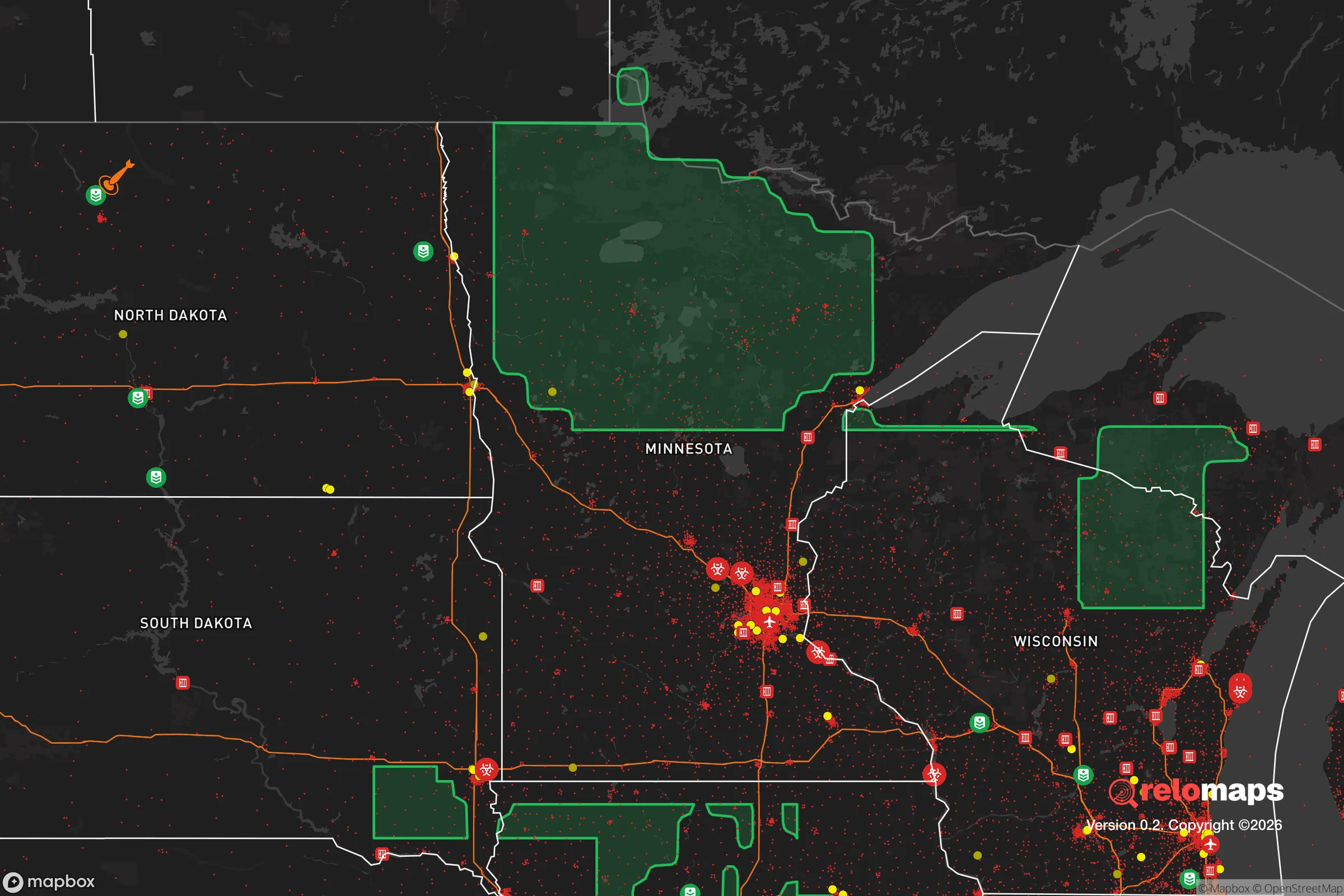


Important Note: For informational purposes only. This does not mean nothing bad ever happens in the green zones. Please use common sense. This is based on public data and modeled with AI. We tried to take a conservative approach but mistakes happen. We update this regularly as new information becomes available.
Solar Generator Recommendations
Backup power matters more here than in safer locations. We've picked three solar generators across budgets and capacity tiers — start with the budget unit if you only need a few essentials, or step up if you want to run a fridge and HVAC for days at a time.

Jackery Portable Power Station Explorer 300
Budget OptionPower on the Go: Weighing only 11 lbs, it's convenient to set up and store with book-sized foldable solar panels

BLUETTI Portable Power Station AC180
Designed for both indoor and outdoor scenarios, AC180 is highly capable as it has a robost capacity and continuous output power.

EF ECOFLOW DELTA Pro Ultra Power Station
Upgraded PickEcoFlow DELTA Pro Ultra is a whole-home energy system designed to grow with your family. Integrated with the Smart Home Panel 2, it scales to meet your evolving energy needs — keeping your home powered, intelligent, and secure through every stage of life.
We earn a commission, at no additional cost to you.
Strategic Assessment Analysis
Fridley, Minnesota, sits in a precarious but potentially advantageous position for a relocator with a survivalist mindset: close enough to a major metropolitan area to access resources, yet far enough to offer a buffer against the worst of urban collapse. Its location along the Mississippi River and its industrial backbone give it a resilience profile that is neither rural sanctuary nor urban death trap, but something in between—a strategic node that could function as a staging ground or a fallback position, provided you understand its risks. For a conservative-leaning individual or family looking to weather civic unrest, mass casualty events, or natural disasters, Fridley offers a mix of hard infrastructure and soft vulnerabilities that demand careful consideration.
Geographic position and natural advantages for long-term survival
Fridley’s geography is its strongest card. The city sits on the east bank of the Mississippi River, roughly 10 miles north of downtown Minneapolis, placing it within the Twin Cities metro but on the fringe. This proximity gives you access to the river as a water source—critical if municipal systems fail—and to the surrounding farmland of Anoka County, which remains agricultural enough to support local food production even in a grid-down scenario. The Mississippi River corridor also provides a natural transportation and escape route: you can move north toward less populated areas like St. Cloud or the Brainerd lakes region, or south toward the river’s industrial infrastructure. The terrain is relatively flat, which is a double-edged sword—easy to traverse but harder to defend. However, the city’s network of parks, including Rice Creek Chain of Lakes Park Reserve to the north, offers wooded cover and potential foraging grounds. For a prepper, the key advantage is that Fridley is not a primary target for a first-strike event; it lacks the symbolic or military value of downtown Minneapolis or the Air Force Reserve base at Minneapolis-St. Paul International Airport. That said, its industrial base—including a major rail yard and the Medtronic campus—could become a secondary target or a looting magnet during civil unrest.
Risks, exposures, and proximity to fallout-relevant landmarks
The biggest risk for a Fridley-based relocator is its proximity to high-value targets in the Twin Cities. Minneapolis is home to the Federal Reserve Bank, the U.S. Bank Stadium (a potential mass-casualty target), and the headquarters of several Fortune 500 companies. St. Paul hosts the state capitol and the Xcel Energy Center. In a major conflict or terrorist event, these are prime targets for conventional or asymmetric attacks. Fridley is within the blast-radius fallout zone of a hypothetical dirty bomb or conventional strike on downtown Minneapolis—roughly 10 miles away, which is well within the range of radioactive debris dispersal patterns. Additionally, the city is bisected by Interstate 694 and U.S. Highway 10, major evacuation routes that could become clogged or contested during a crisis. The rail yard in Fridley is a double-edged sword: it provides logistical access but also makes the area a potential chokepoint for rail-borne hazardous materials. A derailment or sabotage event could release toxic chemicals, as seen in the 2023 East Palestine disaster. Flooding is another recurring risk—the Mississippi River has historically flooded low-lying areas of Fridley, particularly near the riverfront and the industrial park. The 1965 flood, for example, inundated parts of the city, and climate models suggest increased precipitation could make such events more frequent. For a prepper, the takeaway is that Fridley is not a bug-out location; it’s a location that requires a solid bug-out plan to the north or west, where population density drops and defensible terrain increases.
Practical resilience for a relocator: food, water, energy, and defensibility
Fridley’s practical resilience is mixed. On the water front, the Mississippi River is a reliable surface water source, but it requires treatment—boiling, filtration, or chemical purification—before consumption. The city’s municipal water system draws from the Mississippi, so in a prolonged grid-down scenario, you’d need a backup plan. Well water is not common in Fridley’s suburban neighborhoods, but some older homes near the river have private wells; check property records before buying. For food, the city has several grocery stores (Cub Foods, Aldi) and a farmers market in the summer, but these are vulnerable to supply chain disruptions. A better bet is to establish relationships with local farmers in Anoka County—there are several u-pick operations and CSA farms within a 15-minute drive. Energy resilience is a weak point. Fridley is served by Xcel Energy, and the grid is aging. Power outages during storms are common, and the city has no municipal backup generation for residential areas. Solar panels are permitted but not widespread; a generator and fuel storage are essential. Defensibility is the hardest factor. Fridley is a typical suburban grid of cul-de-sacs and arterials, which makes it easy to navigate but hard to secure. Your best bet is a property on the northern edge, near the Rice Creek corridor, where wooded lots and limited access points offer some natural chokepoints. Avoid properties near the rail yard or the major highways—those will be the first areas to see looting or military checkpoints. For a family, the schools (Fridley High School, Hayes Elementary) are adequate but not exceptional; in a crisis, they’d likely be used as emergency shelters, which could be a security risk. Overall, Fridley is a location for a prepper who wants to stay connected to urban resources while maintaining a low profile—but it requires active preparation, not passive reliance on infrastructure.
The strategic picture for Fridley is one of calculated risk. It offers the logistical advantages of a river city with industrial capacity, but those same assets make it a potential target or chokepoint in a major crisis. For a conservative relocator who values community resilience and self-reliance, Fridley is not a destination—it’s a base of operations. You can stockpile supplies, establish a network of like-minded neighbors, and maintain a vehicle capable of a northward retreat. The city’s demographic mix (roughly 60% white, with significant Hmong and Somali populations) means you’ll need to build trust across cultural lines, but that can be a strength in a disaster scenario where cooperation trumps ideology. The bottom line: Fridley is a solid choice for a prepper who wants to be near the action without being in the kill zone, but only if you’re willing to invest in hardening your property, securing alternative water and power, and having a clear evacuation route to the north. If you’re looking for a rural fortress, look farther out. If you want a toehold in the metro with a fighting chance, Fridley could work—but don’t mistake it for a safe haven. It’s a chess piece, not a castle.

* Values derived from national, state, county, city and local statistics and may differ in a specific area. Last updated: 2026-04-30T08:29:21.000Z
Narrative content on this page is AI-generated and may contain mistakes. Verify any details that matter before acting on them.
ReloMaps may earn a commission from affiliate links at no extra cost to you.

