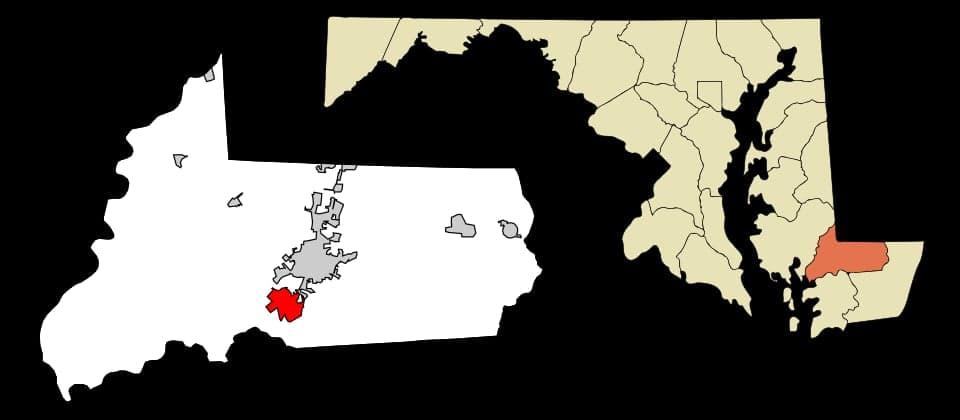
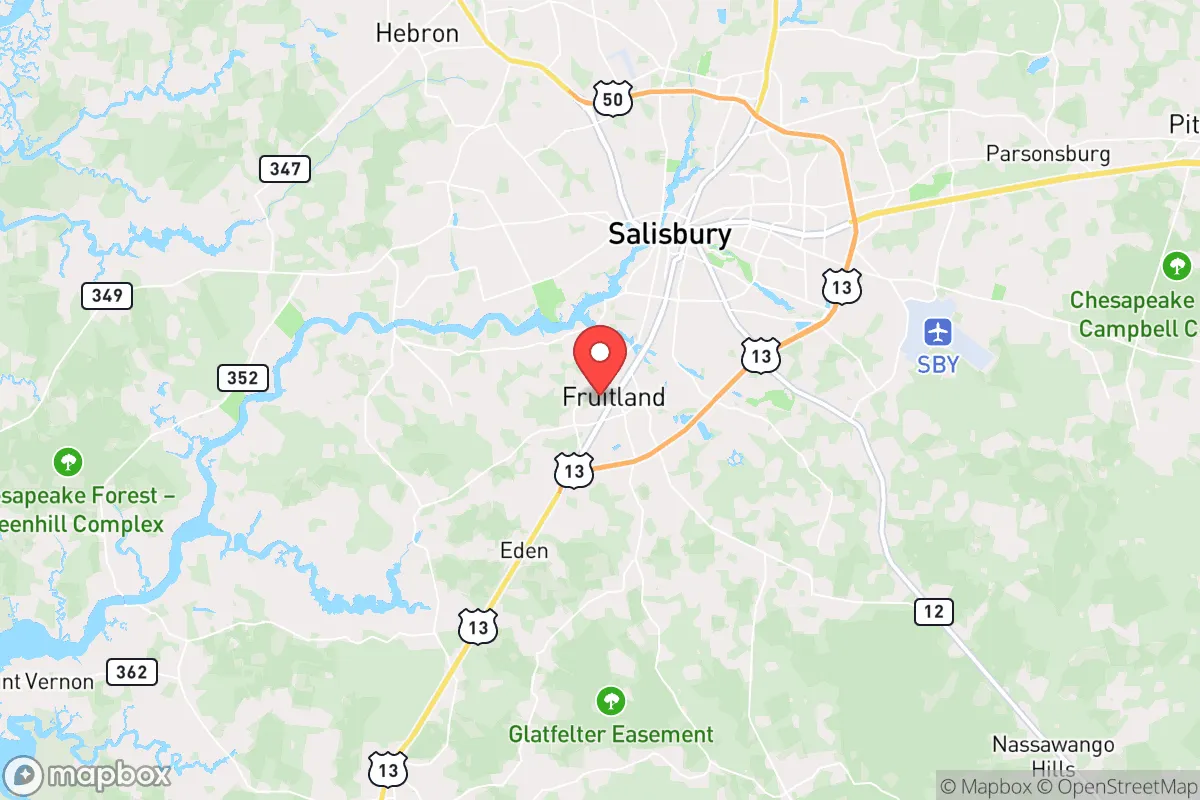
Photo: Wikipedia
Political ClimatePolitical Climate in Fruitland, MD
District shown is the primary district for this city’s centroid. Cities may span multiple districts.
Local Political AnalysisPolitical Analysis of Fruitland, MD
Fruitland, Maryland, sits firmly in conservative territory, with a Cook PVI of R+8 that reflects a community where traditional values and limited government are still the default setting. For decades, this small city in Wicomico County has been a place where folks expect to be left alone to run their businesses, raise their families, and worship as they see fit—without a lot of interference from Annapolis or Washington. That said, like a lot of small towns along the Eastern Shore, you can feel the political winds shifting a bit, especially as new folks move in from more progressive areas and bring different ideas about how things ought to run.
How it compares
If you drive ten miles north to Salisbury, you’ll notice a different vibe—Salisbury University and a younger, more transient population have nudged that city noticeably leftward, with local elections often turning on issues like zoning density and police funding. Head west toward Princess Anne, and you’re back in deep-red territory, where the R+8 of Fruitland actually looks moderate compared to some precincts that vote closer to R+15 or R+20. The real contrast, though, is with the state capital. Annapolis and the D.C. suburbs have been pushing progressive policies—like stricter gun laws, higher property taxes, and energy mandates—that feel foreign to Fruitland’s way of life. Locals here watch those trends warily, knowing that what passes in Montgomery County often ends up as a one-size-fits-all rule for the whole state.
What this means for residents
For the average Fruitland resident, the political climate means you can still count on a few things: your local government is less likely to meddle in how you run your small business or what you do on your own property. The city council and county commissioners have historically been skeptical of new regulations, whether it’s mask mandates, business closures, or land-use restrictions. That’s a big deal for folks who value personal freedom over government “solutions.” The downside? As the state legislature in Annapolis gets more progressive, Fruitland finds itself fighting an uphill battle to preserve local control. You see it in things like school curriculum battles and housing density fights—state-level mandates that override what the community actually wants. Long-term, if the trend toward centralized decision-making continues, residents here worry they’ll lose the very character that makes Fruitland a good place to live: self-reliance and a government that stays out of the way.
Culturally, Fruitland still holds onto distinctions that set it apart from the more progressive pockets of Maryland. You won’t find a lot of talk about “equity” initiatives or climate emergency declarations at town hall meetings—instead, the conversation is more likely to be about keeping taxes low, maintaining good roads, and making sure the police have the resources they need. The local churches and volunteer fire departments are the real social glue, not government programs. That said, there’s a quiet concern among longtime residents that the next decade could bring more pressure to conform to state-level progressive norms, especially on issues like zoning for affordable housing and environmental regulations on farms. For now, though, Fruitland remains a place where a conservative worldview isn’t just tolerated—it’s the air most people breathe.

State Political ClimatePolitical Climate in Maryland
State Political AnalysisPolitical Environment in the State
Maryland has long been a solidly blue state in federal elections, with Democrats holding every statewide office and a supermajority in the General Assembly for over a decade. However, that blue veneer hides a deeply fractured political landscape: the state’s partisan lean is driven almost entirely by the densely populated Washington, D.C., suburbs and Baltimore City, while the rest of the state—especially the Eastern Shore, Western Maryland, and much of Southern Maryland—votes reliably Republican. Over the past 20 years, the Democratic coalition has consolidated power through aggressive gerrymandering and a steady influx of D.C.-area transplants, pushing the state further left on taxes, regulation, and social policy, even as rural and exurban counties have grown more conservative in reaction.
Urban vs. rural divide
The political map of Maryland is a tale of two worlds. The Democratic stronghold is anchored by Montgomery County and Prince George’s County, which together cast nearly a third of the state’s votes and routinely deliver 75-85% margins for Democrats. Baltimore City adds another deep-blue bloc, while Howard County and Anne Arundel County have trended blue as D.C. commuters push outward. On the other side, the Eastern Shore—places like Queen Anne’s County, Talbot County, and Wicomico County—votes Republican by double digits, as does Western Maryland’s Garrett County and Allegany County. Frederick County, once a conservative stronghold, has flipped purple-to-blue as D.C. exurbs expand north, while Harford County remains a reliable red anchor in the Baltimore suburbs. The divide isn’t just geographic—it’s cultural and economic, with rural and small-town Marylanders feeling increasingly alienated from the Annapolis power structure that prioritizes urban and suburban interests.
Policy environment
Maryland’s policy environment is among the most progressive in the nation, and it shows in the tax code. The state has a graduated income tax that tops out at 5.75% for most earners, but counties add their own piggyback taxes, pushing combined rates above 9% in Baltimore City and Montgomery County. Property taxes are high, and the state’s estate tax kicks in at $5 million, with no portability for spouses. On regulation, Maryland has some of the strictest environmental rules in the country, including a statewide ban on fracking and aggressive renewable energy mandates. Education policy is dominated by the Blueprint for Maryland’s Future, a massive funding plan that pours billions into public schools but has done little to close achievement gaps in Baltimore City and Prince George’s County. Healthcare is heavily regulated, with a state-based insurance exchange and Medicaid expansion under the Affordable Care Act. Election laws are among the most permissive: no-excuse mail-in voting, same-day registration, and automatic voter registration are all in place, which critics argue opens the door to fraud, though no major scandals have emerged.
Trajectory & freedom
Maryland is becoming less free by almost any measure, especially for conservatives. The state has some of the strictest gun laws in the country, including a ban on “assault weapons,” a handgun permit requirement that was recently tightened further, and a magazine capacity limit of 10 rounds. In 2023, the legislature passed a law requiring a background check for rifle and shotgun purchases, closing a loophole that had existed for long guns. On parental rights, Maryland has moved aggressively in the opposite direction: the state passed a law in 2022 that allows minors as young as 12 to consent to gender-affirming care without parental notification, and schools are required to affirm a student’s chosen name and pronouns even if parents object. Medical autonomy took a hit with the state’s strict COVID-19 vaccine mandates for healthcare workers and school employees, which were among the most rigid in the nation. Property rights are constrained by the state’s powerful planning and zoning apparatus, especially in Montgomery County and Howard County, where downzoning and growth boundaries limit development. Taxation is a constant drag: Maryland’s gas tax is indexed to inflation, and the state has a “millionaire’s tax” that pushes top earners to consider leaving. The trajectory is clear: more regulation, higher taxes, and less personal freedom, especially for those who don’t align with progressive orthodoxy.
Civil unrest & political movements
Maryland has seen its share of civil unrest, most notably the 2015 Baltimore riots following the death of Freddie Gray, which exposed deep racial and economic divides in the city. Since then, organized activist movements have focused on police reform, with the state passing the Maryland Police Accountability Act in 2021, which repealed the Law Enforcement Officers’ Bill of Rights and created a statewide use-of-force standard. Immigration politics are a flashpoint: Maryland is a sanctuary state, with a 2019 law that limits local law enforcement cooperation with federal immigration authorities. This has led to tensions in more conservative counties like Harford and Carroll, where sheriffs have publicly resisted the policy. Election integrity remains a hot-button issue, with Republican activists pointing to the state’s permissive mail-in voting laws and the 2020 election, where widespread ballot drop boxes and lax signature verification were criticized. There have been no major secession movements, but there is a persistent undercurrent of frustration in Western Maryland and the Eastern Shore, where some residents feel their voices are drowned out by the D.C. suburbs. Visible flashpoints include the annual “March for Life” in Annapolis and counter-protests at the state house, as well as ongoing battles over school board policies and library content.
Projection
Over the next 5-10 years, Maryland is likely to become even more blue, driven by demographic trends that favor the D.C. suburbs. The state’s population growth is concentrated in Montgomery, Prince George’s, and Frederick counties, while rural and small-town areas are stagnant or declining. In-migration from the D.C. metro area brings voters who are accustomed to high taxes and progressive governance, further entrenching the Democratic supermajority. The Republican Party in Maryland is increasingly marginalized, with its base confined to the Eastern Shore and Western Maryland, and its influence limited to veto-proof minority status in the legislature. A new resident moving in now should expect to find a state where the political culture is set by Annapolis and the D.C. suburbs, with little room for conservative voices in policy debates. The tax burden will likely increase, gun rights will continue to erode, and parental rights will remain under pressure. For conservatives, the practical takeaway is that Maryland is a state where you can live well if you have the means to absorb the costs, but you will have to fight for your values at every turn—and you may not win.
For a conservative individual or family considering relocation, Maryland offers a mixed bag: excellent schools and job opportunities in the D.C. corridor, but at the cost of high taxes, heavy regulation, and a political environment that is increasingly hostile to traditional values. If you value personal freedom, limited government, and a culture that respects parental rights and the Second Amendment, you will find Maryland a challenging place to call home. The state’s trajectory is clear, and it’s not turning back. Choose accordingly.
* Values derived from national, state, county, city and local statistics and may differ in a specific area. Last updated: 2026-04-22T01:44:57.000Z
Narrative content on this page is AI-generated and may contain mistakes. Verify any details that matter before acting on them.
ReloMaps may earn a commission from affiliate links at no extra cost to you.

