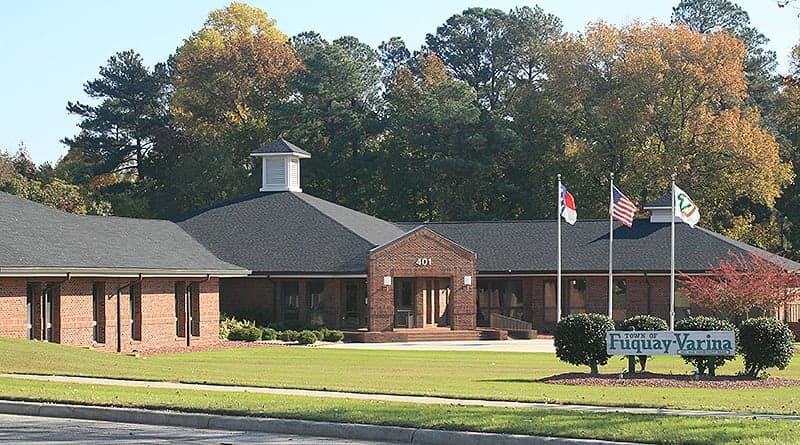
Photo: Wikipedia
Personal Sovereignty in Fuquay Varina, NC
Viable for self-reliance. Generally workable, though some barriers may limit total independence.
What does Personal Sovereignty tell us?
Personal Sovereignty measures your capacity for self-reliance and independence with minimal government friction. Higher scores mean fewer barriers between you and the way you want to live... but it assumes you have the space you need and good neighbors.
What does this tell us?
Personal Sovereignty measures your capacity for self-reliance and independence with minimal government friction. Higher scores mean fewer barriers between you and the way you want to live... but it assumes you have the space you need and good neighbors.
State Policy
Energy independence: Importer (15% of energy produced in-state)
Personal Liberty
Homesteading

Personal Liberty Analysis
Fuquay Varina, North Carolina, offers a notably high degree of personal sovereignty relative to many other fast-growing exurbs in the Southeast, largely due to North Carolina’s strong preemption laws that limit local government overreach and a state-level political climate that has, in recent years, pushed back against federal and municipal encroachment on individual rights. For the strategic-minded individual or family—particularly those with a survivalist or prepper mindset—this means fewer local ordinances dictating how you live, what you can build on your property, and how you can defend yourself. While no location is a libertarian utopia, Fuquay Varina’s position within Wake County, combined with North Carolina’s legal framework, creates a buffer against the kind of hyper-local regulation that chokes autonomy in places like California or the Northeast. The key is understanding where the state’s protections end and where local HOA or county zoning power begins.
Tax burden and regulatory posture: How North Carolina’s fiscal policies affect your autonomy
North Carolina’s tax structure is a net positive for personal sovereignty, especially when compared to high-tax states. The state imposes a flat personal income tax rate of 4.5% as of 2026, with ongoing legislative pressure to reduce it further. Property taxes in Fuquay Varina are levied at the Wake County rate, which hovers around 0.74% of assessed value—moderate by national standards but higher than in rural counties to the west. There is no state-level property tax, and the state’s sales tax is 4.75%, with local options pushing the combined rate to about 7.25% in Fuquay Varina. Critically, North Carolina has a right-to-work law and no state-level occupational licensing for many trades, which reduces bureaucratic friction for self-employed individuals or those looking to start a side business. The regulatory posture at the state level is generally business-friendly, with a streamlined permitting process for new construction and a strong presumption against local governments imposing their own environmental or labor regulations that exceed state minimums. This means that while Wake County does have some zoning and building codes, the state’s preemption laws prevent the kind of patchwork of local bans on short-term rentals, home-based businesses, or energy choices that plague more fragmented jurisdictions. For the prepper, this translates into fewer surprises when you want to install solar panels, build a workshop, or keep a few chickens—though you should still verify HOA covenants if you buy in a planned community.
Self-defense and gun law specifics: What North Carolina’s legal landscape means for your right to keep and bear arms
North Carolina is a shall-issue state for concealed carry permits, meaning that if you meet the statutory requirements—including a background check and a firearms safety course—the sheriff’s office must issue the permit. There is no discretionary denial based on a sheriff’s personal opinion, which is a critical safeguard against local political bias. The state also has a strong preemption law that explicitly prohibits local governments from enacting their own gun control ordinances, so you won’t find the kind of municipal bans on certain firearms or magazine capacities that exist in places like Denver or Seattle. Open carry of handguns is legal without a permit for anyone who can legally possess a firearm, though you must have a concealed carry permit to carry a concealed handgun. Stand-your-ground laws are in effect, with no duty to retreat in any place where you have a lawful right to be. Castle doctrine protections apply to your home, vehicle, and workplace. For the survivalist, the key takeaway is that Fuquay Varina’s legal environment does not add extra layers of restriction beyond state law. However, be aware that Wake County is more politically mixed than rural counties, and the sheriff’s office has historically been professional but not aggressively pro-2A in its public statements. The practical effect is that you can build a firearms collection, train on your own property (subject to local noise ordinances), and carry for self-defense without worrying about a sudden local ordinance change. Magazine capacity is not restricted at the state level, and there is no state-level registry for long guns or handguns.
Self-reliance and homesteading viability: Lot sizes, zoning, and off-grid feasibility in Fuquay Varina
Fuquay Varina’s zoning is a mixed bag for the serious homesteader. The town itself has minimum lot sizes that vary by district, typically ranging from 0.25 acres in suburban subdivisions to 1-2 acres in the more rural fringes. If you buy in an unincorporated area of Wake County outside town limits, you can find lots of 3-5 acres or more, which opens up possibilities for gardening, small livestock, and even limited timber management. However, Wake County does enforce building codes and requires permits for structures over 200 square feet, so you cannot simply throw up a shipping container cabin without inspection. Off-grid feasibility is limited by state and local health regulations: you must have a permitted septic system if you are not connected to municipal sewer, and the county health department requires soil testing and a permit for any alternative wastewater system. Rainwater collection is legal and encouraged, but you cannot rely on it as your sole water source without a well permit. Solar panels are allowed and net metering is available through Duke Energy, but the county does not have a strong “right to solar” ordinance that prevents HOAs from restricting panel placement. For the prepper, the most viable path is to buy a 2-5 acre parcel in the unincorporated area south of town, where you can have a well, septic, solar, and a garden without running afoul of town ordinances. Be prepared for HOA restrictions if you buy in a newer subdivision—many of them prohibit front-yard gardens, clotheslines, and certain outbuildings. The town’s zoning code does allow for backyard chickens on lots of 0.5 acres or more, but no roosters, and you must keep the coop 25 feet from any dwelling. Larger livestock like goats or pigs are generally not allowed within town limits.
Personal liberties: Parental rights, medical autonomy, speech, and property protections
North Carolina has a strong track record on parental rights, with state law affirming that parents have the fundamental right to direct the upbringing, education, and health care of their children. This means that school boards cannot implement curriculum or health policies without parental notification and opt-out provisions, and the state has resisted federal overreach on issues like mask mandates and vaccine requirements for school attendance. Medical autonomy is more nuanced: North Carolina does not have a state-level right-to-try law for experimental treatments, but it does have a robust conscience clause that allows healthcare providers to refuse to participate in procedures they find morally objectionable. For the individual seeking alternative or holistic medicine, the state does not aggressively prosecute unlicensed practitioners unless there is evidence of harm, but you should be aware that the North Carolina Medical Board has broad authority. Free speech protections are strong, with no state-level hate speech laws that could be used to chill political expression, and the state has a public records law that generally favors transparency over government secrecy. Property rights are protected by North Carolina’s eminent domain laws, which require a public purpose and just compensation, and the state has a right-to-farm law that protects agricultural operations from nuisance lawsuits if they were established before nearby residential development. For the prepper, this means you can speak your mind about government overreach, homeschool your children without excessive state interference, and generally expect that your property will not be taken for a private development project. The main vulnerability is that Wake County is growing rapidly, and the local government has shown a willingness to use zoning changes and infrastructure projects to shape development, which can affect property values and the character of your neighborhood over time.
Overall, Fuquay Varina offers a solid baseline of personal sovereignty that is significantly better than what you would find in most coastal metropolitan areas, but it is not a free-for-all. The state’s preemption laws, shall-issue concealed carry, and parental rights protections create a legal environment that respects individual autonomy, while the local zoning and HOA landscape requires careful property selection to avoid restrictions that could hamper self-reliance. For the strategic relocation, the best approach is to buy on the rural fringe, verify HOA covenants, and stay engaged with local politics to ensure that Wake County’s growth does not erode the freedoms that make this area attractive. Compared to places like Austin, Texas, or Boise, Idaho, Fuquay Varina is less libertarian in its regulatory culture but more stable in its legal protections—a trade-off that many preppers will find acceptable given the area’s economic opportunities and relatively low risk of sudden policy shifts.

* Values derived from national, state, county, city and local statistics and may differ in a specific area. Last updated: 2026-05-03T20:27:58.000Z
Narrative content on this page is AI-generated and may contain mistakes. Verify any details that matter before acting on them.
ReloMaps may earn a commission from affiliate links at no extra cost to you.

