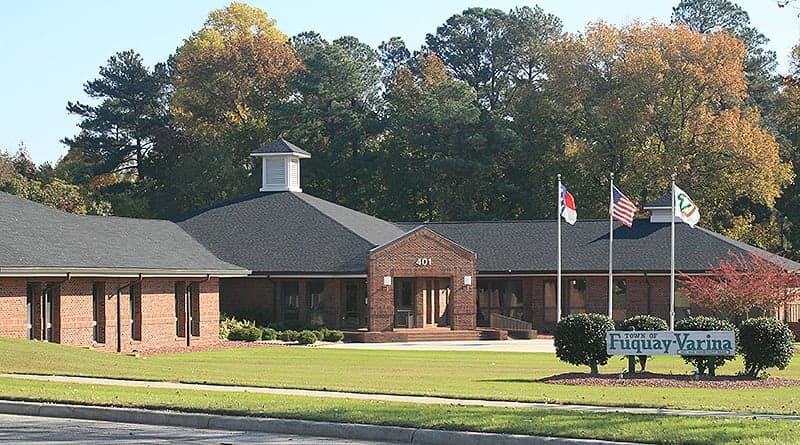
Photo: Wikipedia
Political ClimatePolitical Climate in Fuquay Varina, NC
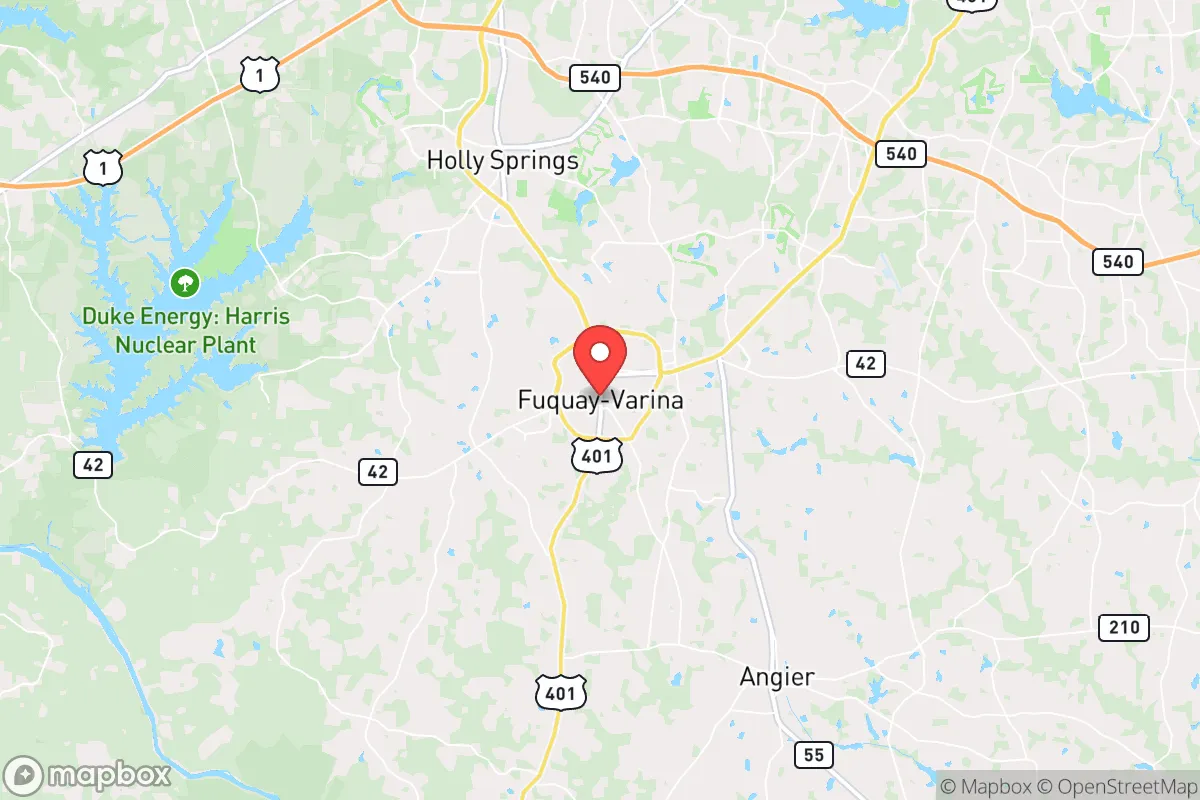
District shown is the primary district for this city’s centroid. Cities may span multiple districts.
Local Political AnalysisPolitical Analysis of Fuquay Varina, NC
Look, I’ve been in Fuquay Varina for over twenty years, and I’ve watched this place change faster than a summer thunderstorm. The political climate here used to be pretty straightforward—solid, common-sense conservative values, where folks minded their own business and didn’t expect the government to run their lives. But the numbers tell a different story now. Wake County as a whole has a Cook PVI of D+23, and while Fuquay Varina still holds onto some of its old-school independence, the tide is definitely shifting. The influx of folks from up north and from the more progressive parts of Raleigh is dragging the local politics leftward, and it’s getting harder to find candidates who respect your Second Amendment rights or your right to run your small business without a stack of new regulations.
How it compares
If you drive ten miles north into downtown Raleigh, you’re in a completely different world—hyper-progressive, with city councils that seem to think every square foot needs a zoning ordinance. Head west to Apex or Cary, and you’ll find the same story: polished suburbs where the HOA rules are stricter than the county’s, and the local elections are dominated by folks who want to raise taxes for bike lanes and “equity” programs. Fuquay Varina used to be the outlier, the place where you could still breathe. But now, we’re getting squeezed. Compare us to a place like Angier, just south in Harnett County, and you’ll see the contrast: Angier still votes red, still keeps its government small, and still lets you put a shed in your backyard without a permit. Fuquay is starting to look more like its northern neighbors every election cycle, and that’s a real concern for anyone who values personal freedom over government overreach.
What this means for residents
For the folks who’ve been here a while, it means you have to pay closer attention to local school board meetings and town council votes. That’s where the rubber meets the road. We’re seeing more talk about “inclusive” policies that sound nice but often come with mandates—like curriculum changes that push a progressive agenda on your kids, or housing ordinances that tell you what you can and can’t do with your own property. The county’s D+23 lean means that state-level representation is also tilting, and that trickles down. If you’re a gun owner, a small contractor, or just someone who doesn’t want the government in your healthcare decisions, you need to be vocal. The quiet, live-and-let-live attitude that made Fuquay great is being replaced by a bureaucratic mindset that wants to manage every aspect of your life.
On the cultural side, you’ll still find pockets of the old Fuquay—the hardware store where the owner knows your name, the barbecue joint that’s been there since the 70s, and the annual festivals that feel like a family reunion. But the new developments are bringing chain stores and a different vibe. The biggest distinction is that personal freedoms are no longer assumed; they have to be defended. If you’re considering a move here, just know that the political winds are blowing in a direction that might not sit well if you believe in limited government. Keep your eyes on the local elections, and don’t assume your vote doesn’t matter—because it matters more now than ever.

State Political ClimatePolitical Climate in North Carolina
State Political AnalysisPolitical Environment in the State
North Carolina has long been considered a quintessential swing state, but over the past decade it has settled into a reliably red-leaning posture, voting for Donald Trump in 2024 by roughly 3 points after a razor-thin 1.3-point margin in 2020. The state’s political identity is a tug-of-war between its booming, left-leaning urban crescent—Charlotte, Raleigh-Durham, Asheville—and a deeply conservative rural and suburban heartland that still controls the legislature and the governor’s mansion is the only statewide office Democrats can reliably win. Over the last 20 years, the GOP has solidified control of the General Assembly, the state Supreme Court, and both U.S. Senate seats, while in-migration from blue states has added thousands of new voters each year, making every election a high-stakes battle over the state’s future direction.
Urban vs. rural divide
The political map of North Carolina is a textbook case of the urban-rural chasm. The state’s three major metro areas—Charlotte (Mecklenburg County), Raleigh-Durham (Wake and Durham Counties), and Asheville (Buncombe County)—are solidly Democratic, with Mecklenburg and Wake each delivering 60-65% of their votes to Joe Biden in 2020. These cities are the engines of the state’s economy, drawing in transplants from New York, California, and Illinois who often bring progressive voting habits with them. Meanwhile, the vast rural and exurban counties east of I-95 and west of the Piedmont Triad are deeply Republican. For example, rural counties like Columbus (southeast) and Mitchell (mountains) routinely give GOP candidates 70-75% of the vote. The suburbs are the real battleground: places like Union County (south of Charlotte) and Johnston County (southeast of Raleigh) have shifted rightward as they’ve grown, while Wake County’s outer suburbs like Apex and Holly Springs are more purple. The result is a state where the legislature draws maps that amplify rural power, keeping the GOP in control even when statewide races are close.
Policy environment
North Carolina’s policy environment is a mixed bag for conservatives, but the trend has been positive in recent years. The state has a flat income tax rate of 4.5% (down from 7% in 2013) and is on a glide path to 3.99% by 2027, making it one of the most tax-friendly states in the Southeast. There is no state tax on Social Security income, and the standard deduction is generous. The regulatory climate is business-friendly, with a right-to-work law and no state-level minimum wage above the federal floor of $7.25. On education, the state has a robust school choice program: the Opportunity Scholarship Program now provides vouchers of up to $7,000 per student for private school tuition, and the program was expanded in 2024 to be universally available regardless of income. Healthcare is a sore spot—the state finally expanded Medicaid in 2023 under a bipartisan deal, which many conservatives opposed as a federal dependency, but it did include work requirements and a sunset clause. Election laws have been a flashpoint: the state requires photo ID to vote (upheld by the courts in 2024), has strict absentee ballot rules, and bans ballot harvesting. The General Assembly also passed a 12-week abortion ban in 2023, overriding the governor’s veto, which remains a major point of contention.
Trajectory & freedom
On the freedom front, North Carolina has been a net positive over the last five years, but the trajectory is fragile. The state expanded gun rights significantly in 2023 with the passage of permitless carry (HB 189), allowing any law-abiding adult to carry a concealed handgun without a permit—a major win for Second Amendment advocates. Parental rights were strengthened in 2023 with the Parents’ Bill of Rights (SB 49), which requires schools to notify parents about curriculum changes and prohibits instruction on gender identity and sexuality in K-4 classrooms. On medical freedom, the state banned COVID-19 vaccine mandates for state employees and contractors in 2022, and in 2024 it passed a law prohibiting mask mandates in public schools and government buildings. Property rights are generally strong, with no state-level rent control and a relatively low property tax burden (average effective rate around 0.75%). However, there are warning signs: the state’s environmental regulations are tightening, particularly around PFAS chemicals and coal ash, which could impact industrial landowners. The biggest threat to freedom is demographic—the influx of out-of-state transplants is slowly shifting the electorate, and if the GOP loses the legislature in a redistricting year, the policy environment could flip quickly.
Civil unrest & political movements
North Carolina has seen its share of political turbulence, but it’s been more institutional than street-level. The 2020 election sparked massive protests in Charlotte and Raleigh over racial justice, but they were largely peaceful compared to Portland or Seattle. The most visible flashpoint in recent years has been the “Let Them Grow” movement—a coalition of parents and conservative activists who packed school board meetings in Wake, Mecklenburg, and Guilford counties from 2021-2023, protesting mask mandates, critical race theory, and LGBTQ curriculum. This movement successfully flipped several school board seats in suburban counties like Union and Johnston. On immigration, the state is not a sanctuary state—in fact, the General Assembly passed a law in 2024 requiring sheriffs to cooperate with ICE detainers (HB 10), overriding vetoes from Democratic Governor Roy Cooper. There have been isolated incidents of election integrity concerns, particularly in Bladen County (the 2018 absentee ballot scandal), but the state’s voter ID law and signature verification requirements have largely addressed those issues. The most organized left-wing activism is centered in Asheville and Durham, where groups like the NC Poor People’s Campaign and the Sunrise Movement hold regular rallies, but they have little influence outside those bubbles.
Projection
Looking ahead 5-10 years, North Carolina is at a tipping point. The state is growing by roughly 100,000 people per year, and the majority of new arrivals are coming from blue states like New York, California, and Illinois. If that trend continues, the urban crescent will expand, and the rural counties will continue to shrink. The 2030 redistricting cycle will be critical—if Democrats win the governorship and the legislature in 2028, they could draw maps that flip the congressional delegation and the state House. However, the GOP has a structural advantage: the state’s rural counties are overrepresented in the legislature due to the 2013 redistricting, and the party has shown it can win statewide races (Trump in 2024, Ted Budd for Senate in 2022). The most likely scenario is that North Carolina remains a lean-red state for the next decade, but with narrower margins. A new resident moving in now should expect a state that is politically competitive but still conservative on taxes, guns, and education, with a growing cultural divide between the cities and the countryside. The key variable is whether the GOP can hold the line on election integrity and school choice while the demographic tide slowly rises.
For a conservative-leaning individual or family considering a move, North Carolina offers a strong combination of low taxes, gun rights, school choice, and a growing economy—but it’s not a safe bet forever. The cities are becoming more progressive, the suburbs are contested, and the rural areas are losing population. If you want to settle in a place where your values are reflected in state policy for the long haul, you’ll want to look at the exurbs and smaller cities like Wilmington, Greenville, or Hickory, where the political culture is more stable. The state’s trajectory is still positive, but it requires active engagement—voting in every election, attending school board meetings, and supporting conservative candidates—to keep it that way. North Carolina is not Texas or Florida in terms of rock-solid conservatism, but it’s a far cry from Virginia or Georgia, and for now, it’s one of the best bets in the Southeast for someone who values personal freedom and limited government.
* Values derived from national, state, county, city and local statistics and may differ in a specific area. Last updated: 2026-05-03T20:27:58.000Z
Narrative content on this page is AI-generated and may contain mistakes. Verify any details that matter before acting on them.
ReloMaps may earn a commission from affiliate links at no extra cost to you.

