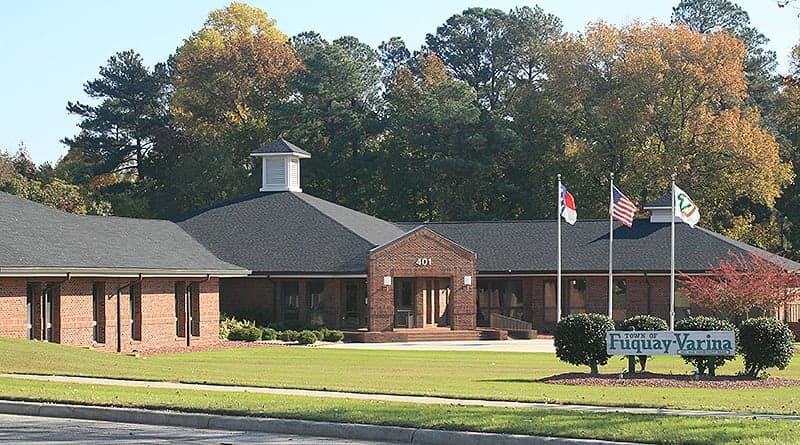
Photo: Wikipedia
Demographics of Fuquay Varina, NC
Affluence Level in Fuquay Varina, NC
An upper-middle-class area. Household wealth, education levels, and homeownership run ahead of national benchmarks.
People of Fuquay Varina, NC
The people of Fuquay Varina, North Carolina, today form a rapidly growing, predominantly white-collar population of 37,749, marked by a notably high college attainment rate of 52.9% and a strong family-oriented character. The city’s identity is shaped by a majority white population (67.2%) alongside a significant Black community (15.2%) and a growing Hispanic presence (8.6%), with smaller but distinct East/Southeast Asian (1.5%) and Indian-subcontinent (1.8%) groups. Despite its expansion, the foreign-born share remains low at 3.3%, indicating that most growth comes from domestic in-migration rather than international immigration, giving the city a distinctly native-born, Southern suburban feel.
How the city was settled and grew
Fuquay Varina’s population history begins not with colonial settlement but with a post-Civil War economic boom. The area was originally farmland, but the discovery of mineral springs in the 1850s and the arrival of the railroad in the 1870s transformed it into a health resort and trading hub. The town was officially formed in 1909 from two separate communities: Fuquay Springs (named for the Fuquay family, who owned the mineral springs) and Varina (named for a local postmaster’s wife). The original white settlers were primarily of English and Scots-Irish descent, drawn by the promise of health tourism and agricultural commerce. The historic downtown Fuquay Springs district became the commercial and social center for these early families, with many of their descendants still residing in the surrounding old Fuquay neighborhoods near Main Street. A small but established Black community grew in the Varina area, centered around the segregated schools and churches that served the African American workforce employed in local hotels, farms, and the railroad. This early pattern—a white commercial core and a Black working-class periphery—set the stage for the city’s 20th-century demographic structure.
Modern era (post-1965)
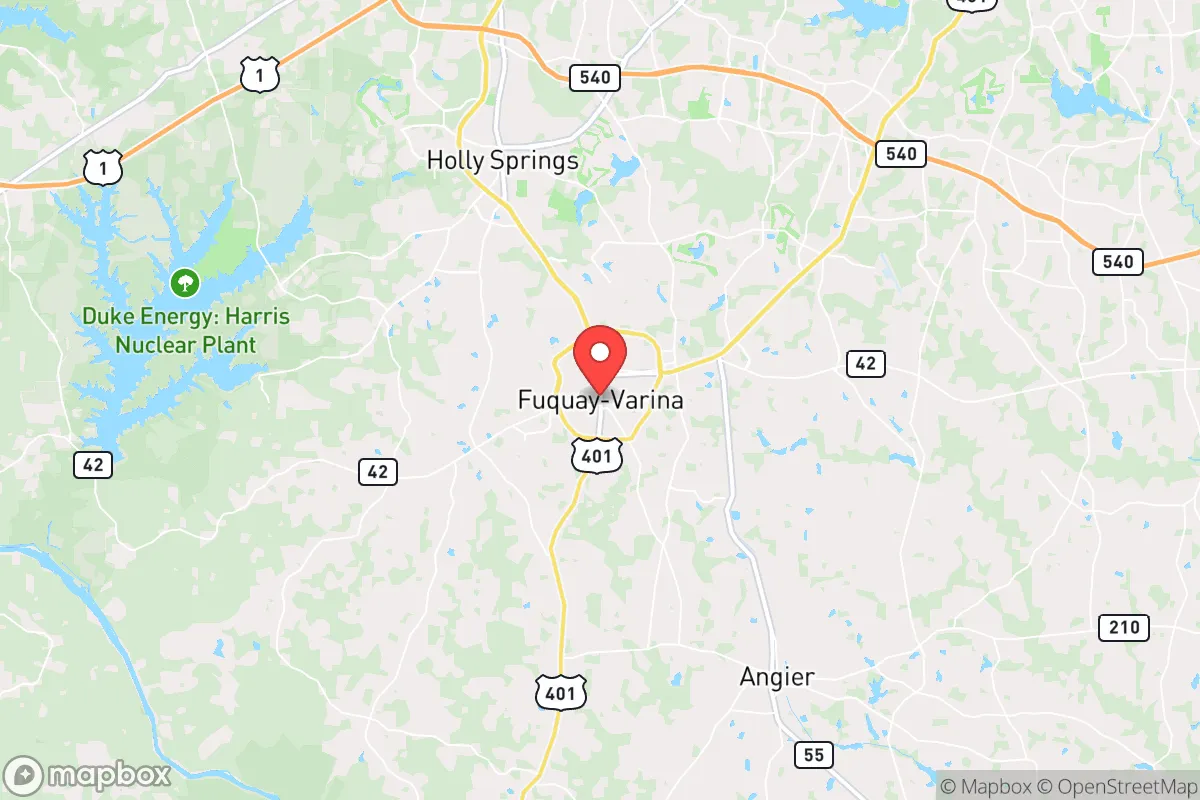
The post-1965 era brought dramatic change, driven not by immigration but by the suburbanization of the Research Triangle region. The completion of the Raleigh Beltline and the expansion of US 401 in the 1980s and 1990s made Fuquay Varina a commuter town for Raleigh and Cary. The population exploded from roughly 3,000 in 1980 to over 37,000 today. This wave of domestic in-migration was overwhelmingly white and college-educated, drawn by affordable housing and good schools. New subdivisions like Sunset Lake and Southall became the landing pads for these families, creating a ring of newer, more affluent neighborhoods around the historic core. The Black population, while growing in absolute numbers, declined as a percentage of the total as white newcomers flooded in. The Hispanic population began to appear in the 1990s and 2000s, primarily as construction and service workers, and today clusters in the Banks Road area and parts of the downtown periphery. The East/Southeast Asian and Indian-subcontinent communities are smaller and more dispersed, often living in the newer subdivisions alongside their white neighbors, reflecting their higher educational and income profiles. The city’s racial geography is thus a clear pattern: an older, more diverse historic core and a newer, whiter suburban fringe.
The future
The future of Fuquay Varina’s population points toward continued, rapid homogenization as a white, upper-middle-class suburb. The city is not tribalizing into distinct ethnic enclaves; rather, the dominant trend is assimilation into a single, largely white, family-oriented culture. The Hispanic population, while growing, remains a small minority and is geographically dispersed, with no signs of forming a concentrated ethnic neighborhood. The East/Southeast Asian and Indian-subcontinent communities are even smaller and highly integrated, often indistinguishable from their white neighbors in terms of housing, schooling, and lifestyle. The Black population is stable but not growing as a share, and the historic Black neighborhoods near Varina are increasingly seeing white in-movers. Over the next 10-20 years, the city will likely continue to attract college-educated families from across the United States, drawn by the same factors that drove the post-1990 boom: proximity to Raleigh, good schools, and relatively affordable single-family homes. The foreign-born share will likely remain low, as the city lacks the industrial or service-sector jobs that attract large immigrant populations. The demographic trajectory is clear: Fuquay Varina is becoming whiter, more educated, and more affluent, with a small but stable minority presence.
For someone moving in now, Fuquay Varina offers a predictable, family-focused suburban environment with a strong sense of local history. The city is not a melting pot of diverse cultures but rather a destination for those seeking a safe, well-educated, and predominantly white community. The historic downtown and the newer subdivisions like Sunset Lake and Southall provide distinct lifestyle options, but the overall character is one of steady, homogeneous growth. New residents should expect a place where the population is largely native-born, politically conservative, and oriented around schools, sports, and church life—a classic Sun Belt suburb that has successfully managed rapid growth without losing its small-town feel.

* Values derived from national, state, county, city and local statistics and may differ in a specific area. Last updated: 2026-05-03T20:27:58.000Z
Narrative content on this page is AI-generated and may contain mistakes. Verify any details that matter before acting on them.
ReloMaps may earn a commission from affiliate links at no extra cost to you.

