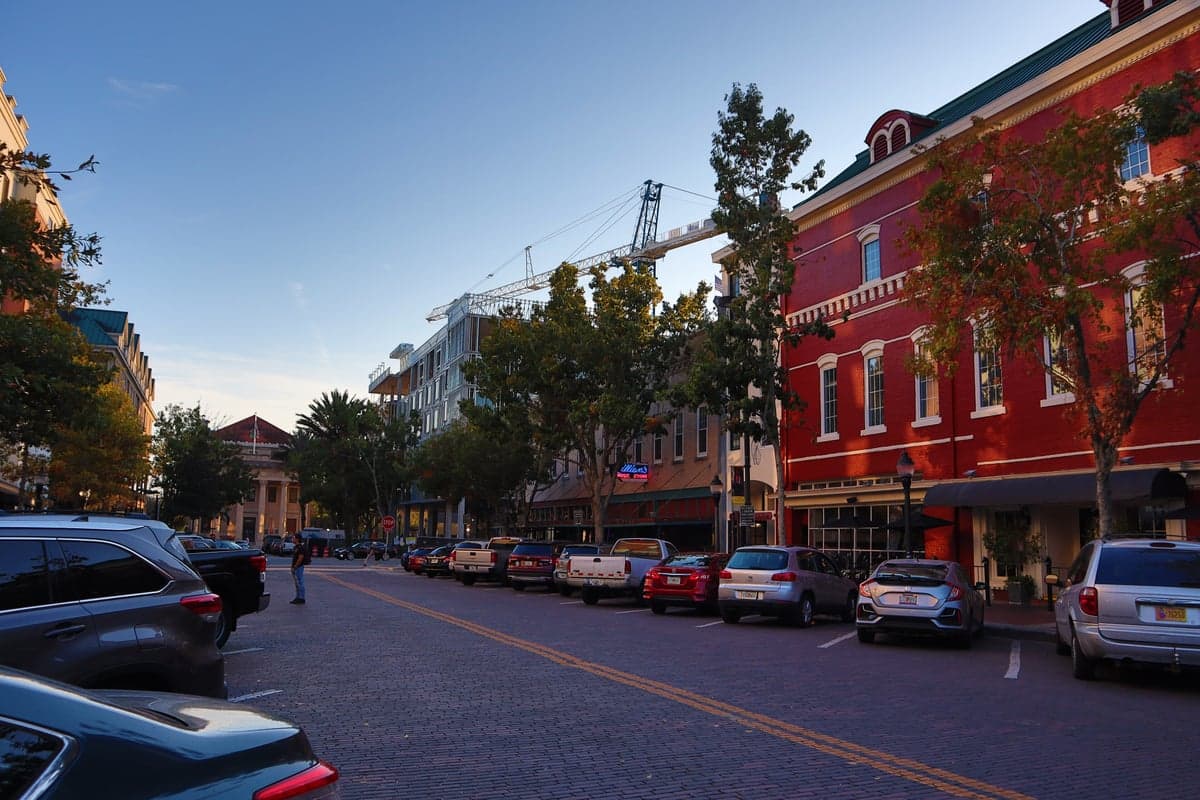
Photo: Wikipedia
Personal Sovereignty in Gainesville, FL
Viable for self-reliance. Generally workable, though some barriers may limit total independence.
What does Personal Sovereignty tell us?
Personal Sovereignty measures your capacity for self-reliance and independence with minimal government friction. Higher scores mean fewer barriers between you and the way you want to live... but it assumes you have the space you need and good neighbors.
What does this tell us?
Personal Sovereignty measures your capacity for self-reliance and independence with minimal government friction. Higher scores mean fewer barriers between you and the way you want to live... but it assumes you have the space you need and good neighbors.
State Policy
Energy independence: Importer (10% of energy produced in-state)
Personal Liberty
Homesteading

Personal Liberty Analysis
Gainesville, Florida, presents a mixed picture for those prioritizing personal sovereignty. While the city itself leans left politically, it sits within a state that has aggressively pushed back against federal overreach on multiple fronts, creating a unique tension between local governance and state-level protections. For the survivalist or prepper, the key question isn't just what the law says, but how aggressively local authorities enforce it—and in Gainesville, the answer often depends on whether you're dealing with city hall or the state capitol. The net effect is a sovereignty environment that offers strong structural protections on paper, but requires careful navigation of local ordinances and cultural attitudes.
Tax burden and regulatory posture in Alachua County
Florida's lack of a state income tax is a major win for anyone looking to keep more of what they earn, and Gainesville residents benefit from this directly. The combined state and local sales tax rate in Alachua County is 7.5%, which is moderate by Florida standards. Property taxes are another story: the effective property tax rate in Gainesville hovers around 1.1% of assessed value, slightly above the state average, driven by Alachua County's school district and municipal services. For a $300,000 home, that's roughly $3,300 annually—not crushing, but worth noting if you're comparing to more rural Florida counties. The regulatory posture at the city level is notably more interventionist than in surrounding areas. Gainesville has its own rental inspection program, strict tree protection ordinances, and a stormwater utility fee that adds to monthly costs. Building permits can take longer than in unincorporated areas, and the city's zoning code is dense. For the prepper, this means that any significant property modification—whether a workshop, a root cellar, or a privacy fence—will likely require navigating city bureaucracy. The state, however, preempts many local regulations on firearms, occupational licensing, and COVID-era mandates, which provides a meaningful check on city-level overreach.
Self-defense and gun law specifics in Gainesville
Florida is a "shall issue" state for concealed carry, and as of 2023, permitless carry (constitutional carry) is legal for anyone 21 or older who can legally possess a firearm. This is a significant sovereignty win. Gainesville city officials have occasionally pushed for local gun restrictions, but Florida law explicitly preempts firearm regulation to the state, meaning city ordinances cannot ban or restrict carry in most public spaces. Open carry of handguns is generally prohibited except in specific circumstances like hunting or fishing, but concealed carry without a permit is now fully legal. Stand Your Ground laws apply statewide, including in Alachua County, so there is no duty to retreat before using deadly force in self-defense if you are in a place you have a legal right to be. Magazine capacity is not restricted, and there is no state-level assault weapons ban. The practical reality in Gainesville: you can legally carry a concealed firearm without a permit, you can keep standard-capacity magazines, and you have strong legal backing if you ever need to defend yourself. The main limitation is that the University of Florida campus and its immediate surroundings have stricter policies—carrying on campus is restricted to those with a valid concealed carry license (permitless carry does not apply on campus), and some student housing is off-limits. For the prepper, this is a solid legal environment, but you need to know the campus boundaries and avoid carrying into posted government buildings.
Self-reliance and homesteading viability: lot sizes, zoning, and off-grid feasibility
Within Gainesville city limits, homesteading is constrained by standard suburban zoning. Most residential lots are between 5,000 and 10,000 square feet, and keeping chickens, goats, or bees requires a permit and adherence to setback rules. Backyard chickens are allowed with a limit of four hens (no roosters), and beekeeping is permitted with registration. Larger livestock like goats or pigs are generally not allowed on standard residential lots. For serious self-reliance, the real opportunity lies in unincorporated Alachua County or the surrounding rural areas like Archer, Newberry, or Micanopy. There, you can find properties with 1 to 10 acres, and zoning is far more permissive for gardening, animal husbandry, and even small-scale farming. Off-grid feasibility is limited by Florida's high water table and building codes. Rainwater collection is legal for non-potable uses, but the state requires a permit for systems that supply potable water. Solar panels are widely permitted, but net metering rules have become less favorable in recent years, and the city's utility, Gainesville Regional Utilities (GRU), is publicly owned and has some of the highest electricity rates in Florida. Going fully off-grid with GRU is difficult because the utility has a franchise agreement that requires connection in many areas. For the prepper, the best strategy is to buy land outside city limits, ideally in a county with minimal zoning, and build with a focus on water storage, solar backup, and food production. Inside the city, you can have a productive garden and a few chickens, but you won't be self-sufficient.
Personal liberties: parental rights, medical autonomy, speech, and property
Florida has been a battleground for parental rights, and the state has passed several laws that strengthen parents' authority over their children's education and medical decisions. The Parental Rights in Education Act (often called the "Don't Say Gay" law by opponents) restricts classroom instruction on sexual orientation and gender identity in early grades, and subsequent laws have given parents more control over school curriculum and library materials. In Alachua County, the school board has been at odds with the state over these policies, creating a situation where parents need to be actively engaged to ensure their rights are respected. Medical autonomy is a mixed bag. Florida banned COVID-19 vaccine mandates for most employers and schools, and the state has restricted the use of mRNA vaccines for certain populations. However, the state also has strict prescription drug monitoring and has not expanded Medicaid, which limits healthcare access for low-income individuals. For the prepper, the key is that you can refuse any medical treatment or vaccination without government penalty, and you have the right to purchase medical supplies and equipment without a prescription in many cases. Free speech is protected under the First Amendment, and Florida has passed laws to protect political speech on social media and to prevent "deplatforming" by tech companies. Property rights are strong: Florida has a homestead exemption that protects your primary residence from most creditors, and the state has relatively low eminent domain abuse compared to some northeastern states. The main property concern in Gainesville is the city's rental inspection program, which some landlords view as an overreach, and the tree protection ordinance, which can limit your ability to clear your own land.
Overall, personal sovereignty in Gainesville is a study in contrasts. The state provides a robust legal framework for self-defense, tax freedom, parental rights, and property protection, but the city itself leans toward more regulation and higher costs. For the survivalist or prepper, the smart play is to live outside city limits—within a 20-minute drive of Gainesville's resources but under county jurisdiction—where you can own land, keep animals, and build without excessive bureaucracy. Compared to cities in California, New York, or Illinois, Gainesville offers far more breathing room for the individualist. Compared to rural Texas or Idaho, it falls short on raw land availability and off-grid ease. It's a middle-ground option: strong on paper, but requiring vigilance against local creep. If you're willing to engage with local politics and choose your property wisely, Gainesville can work. If you want maximum autonomy with minimal hassle, look further north or west.

* Values derived from national, state, county, city and local statistics and may differ in a specific area. Last updated: 2026-04-19T06:58:56.000Z
Narrative content on this page is AI-generated and may contain mistakes. Verify any details that matter before acting on them.
ReloMaps may earn a commission from affiliate links at no extra cost to you.

