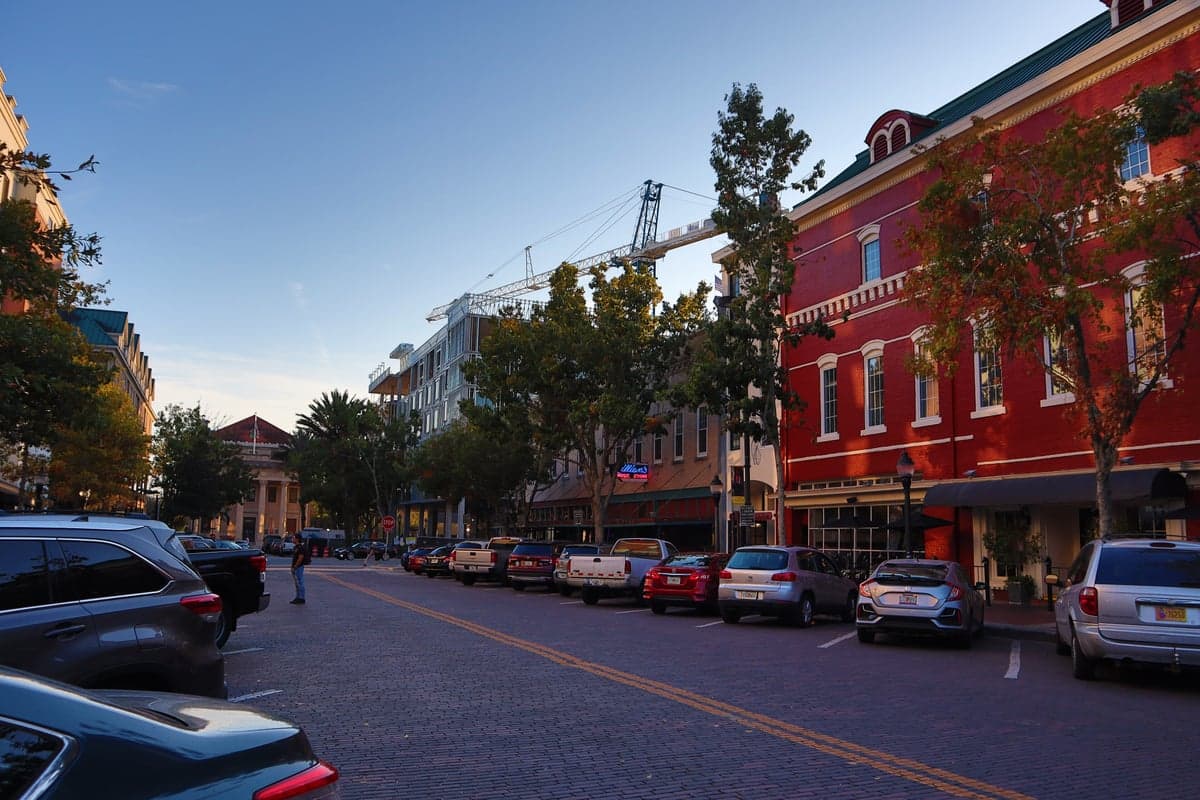
Photo: Wikipedia
Political ClimatePolitical Climate in Gainesville, FL
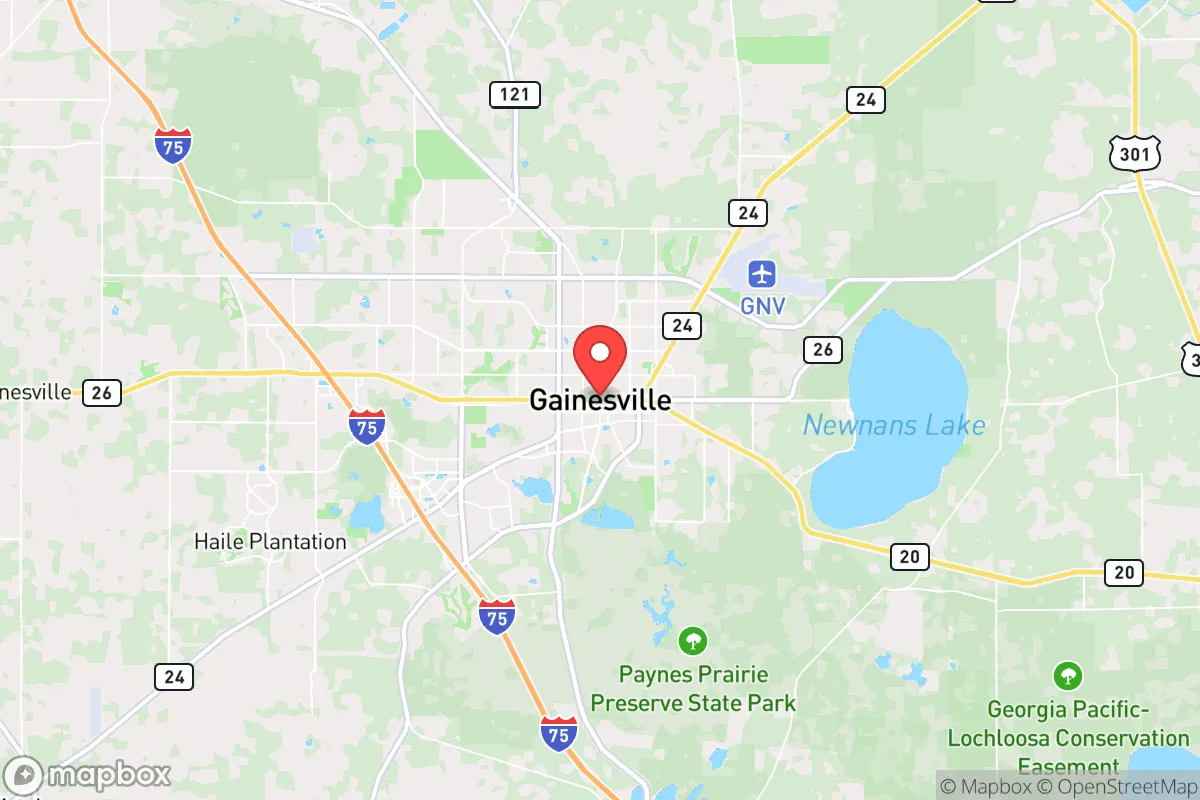
District shown is the primary district for this city’s centroid. Cities may span multiple districts.
Local Political AnalysisPolitical Analysis of Gainesville, FL
Gainesville, Florida, sits in a bit of a political bubble compared to the rest of North Central Florida. While the city itself is a deep blue island thanks to the University of Florida and Shands Hospital, the surrounding Alachua County and the broader region lean heavily conservative. The Cook PVI for the congressional district is R+10, meaning the area outside the city limits votes about ten points more Republican than the national average. That gap between the progressive city core and the conservative rural county has been widening for years, and it creates a real tension in local governance that long-time residents feel more and more.
How it compares
Drive twenty minutes in any direction from downtown Gainesville, and you’re in a different world. Towns like Newberry, Alachua, and High Springs are solidly conservative, with churches, gun shops, and pickup trucks outnumbering coffee houses and bike lanes. Head north to Lake City or west to Chiefland, and you’re in deep red territory where the Second Amendment is a given and government overreach is the top concern. Even Ocala, about 45 minutes south, is a conservative stronghold. The contrast is stark: Gainesville’s city commission has pushed for things like rent control, sanctuary city policies, and mask mandates that would never fly in the surrounding towns. That’s where the friction comes in—what feels like progress in the city feels like government overreach to everyone else.
What this means for residents
For those of us who’ve lived here a while, the biggest change has been the steady creep of progressive policies into everyday life. The city council has become more activist in recent years, pushing for higher taxes, stricter land-use regulations, and a police oversight board that some see as undermining law enforcement. Property taxes have gone up, and new development is often held up by environmental reviews and affordable housing mandates that make it harder to build anything quickly. If you value personal freedoms—whether it’s the right to keep and bear arms, choose your own healthcare, or run a small business without endless red tape—Gainesville’s local government can feel like it’s working against you. The school board has also shifted left, with debates over critical race theory and gender identity policies that have parents worried about what their kids are being taught.
What the future looks like
Looking ahead, the political divide is only going to get sharper. The university continues to attract young, progressive transplants, while the surrounding rural areas are growing with families and retirees fleeing higher-tax states like California and New York. State-level politics in Tallahassee have pushed back hard on Gainesville’s progressive agenda—preempting local rent control, banning sanctuary city policies, and limiting what local governments can do with COVID mandates. That’s a double-edged sword: it protects some freedoms, but it also means local elections feel less consequential. In the long run, I expect the city to keep leaning left, but the county and state will keep pulling it back to the center. For conservatives, the best bet is to get involved in local elections and school board races—that’s where the real battles over your rights and your wallet are fought.

State Political ClimatePolitical Climate in Florida
State Political AnalysisPolitical Environment in the State
Florida has transformed from a classic swing state into a solidly Republican-leaning powerhouse over the past two decades, driven by a massive influx of conservative-leaning transplants from the Northeast and Midwest. The state now boasts a registered Republican voter advantage of over 700,000, and in 2024, Donald Trump carried it by roughly 13 points—a dramatic shift from the 0.1-point margin in 2000. The dominant coalition is a mix of ex-urban families, retirees from red states, and a growing Hispanic population in places like Miami-Dade that has moved rightward, while the Democratic strongholds have shrunk to a few urban cores and college towns.
Urban vs. rural divide
The political map of Florida is starkly divided. The major metros—Miami, Fort Lauderdale, Orlando, and Tampa—are the Democratic anchors, but even these have shifted. Miami-Dade County, once a Democratic fortress, flipped to Trump in 2020 and 2024, driven by Cuban-American and Venezuelan voters who are fiercely anti-socialist. Meanwhile, the rural Panhandle and interior counties like Liberty, Holmes, and Lafayette routinely vote 80%+ Republican. The I-4 corridor, stretching from Tampa through Lakeland to Daytona Beach, remains the ultimate battleground, with Volusia County and Polk County trending redder as new subdivisions fill with families fleeing blue states. The biggest surprise has been St. Johns County (St. Augustine), which has become one of the most reliably Republican suburban counties in the nation, while Alachua County (Gainesville) remains a deep blue island thanks to the University of Florida.
Policy environment
Florida’s policy environment is a conservative dream, with no state income tax, a right-to-work law, and a regulatory climate that actively courts business. The legislature has passed a series of election integrity measures, including strict voter ID laws and limits on drop boxes, which have held up in court. Education policy is a major battleground: the Parental Rights in Education Act (HB 1557, the "Don't Say Gay" law) and the Stop WOKE Act (HB 7) have banned classroom instruction on sexual orientation and gender identity in early grades and prohibited mandatory diversity training in workplaces. School choice is expansive, with the Family Empowerment Scholarship program allowing state funds to follow students to private or religious schools. On healthcare, Florida did not expand Medicaid under Obamacare, and the state has banned gender-affirming care for minors. The Constitutional Revision Commission, once a vehicle for progressive ballot initiatives, was effectively neutered in 2018 after a conservative backlash.
Trajectory & freedom
Florida is arguably the most freedom-oriented state in the country right now, but that freedom is being actively contested. On the plus side, Governor Ron DeSantis signed a constitutional carry law in 2023, allowing permitless carry of firearms, and the state has a strong Stand Your Ground statute. Property rights were bolstered by the Live Local Act, which preempts local zoning to allow more affordable housing development. However, the state has also seen an expansion of government power that should give conservatives pause: the Disney special district dissolution was a clear use of state power to punish a private company for political speech, setting a dangerous precedent. The anti-riot law (HB 1) increased penalties for protest-related crimes and created new felonies for blocking roads, which has been praised by law-and-order types but criticized as overreach. The trend is toward more state preemption of local ordinances—on everything from mask mandates to rent control—which limits local control but ensures uniformity across the state.
Civil unrest & political movements
Florida has been a flashpoint for political movements on both sides. The 2020 Black Lives Matter protests in Miami, Orlando, and Tampa saw significant property damage and led directly to the passage of the anti-riot law. The Moms for Liberty movement, which started in Brevard County, has become a national force in school board politics, pushing for parental rights and book bans. Immigration politics are intense: the SB 1718 law, which requires hospitals to ask about immigration status and criminalizes transporting undocumented immigrants, has made Florida a national leader in enforcement. There have been no serious secession or nullification movements, but the state has openly defied federal immigration policies, busing migrants to Martha's Vineyard and California. Election integrity remains a hot-button issue, with the Office of Election Crimes and Security actively prosecuting voter fraud cases, though critics say the cases are minor and politically motivated. A new resident will notice the constant presence of political yard signs, especially in suburban areas like The Villages, where conservative activism is a way of life.
Projection
Over the next 5-10 years, Florida will likely become even more conservative, but with growing internal tensions. The in-migration from blue states is overwhelmingly Republican-leaning, with Naples, Sarasota, and Palm Beach County seeing the biggest influx of high-income conservatives. However, the Democratic base is also growing in the urban cores, and the Hispanic vote—especially Puerto Ricans in Orlando—is not monolithic. The biggest wildcard is climate change: rising insurance costs and hurricane risk could eventually slow growth, but for now, the state's low taxes and freedom-friendly policies are a powerful draw. Expect continued battles over school curriculum, with the Classical Learning Test replacing the SAT in some districts, and more preemption of local progressive ordinances. The state's political trajectory is toward a Texas-style model: low regulation, strong executive power, and a culture war that never ends.
For a new resident, the bottom line is this: Florida offers a rare combination of low taxes, strong gun rights, and parental control over education that is increasingly hard to find elsewhere. But you need to be strategic about where you land—choose St. Johns County or Collier County for a reliably conservative environment, or Hillsborough County if you want a more mixed political landscape. The state government is activist in its conservatism, so expect your local school board and city council to be overridden by Tallahassee on hot-button issues. If you value personal liberty and are willing to tolerate a few degrees of government overreach in the name of cultural preservation, Florida is as good as it gets in 2026.
* Values derived from national, state, county, city and local statistics and may differ in a specific area. Last updated: 2026-04-19T06:58:56.000Z
Narrative content on this page is AI-generated and may contain mistakes. Verify any details that matter before acting on them.
ReloMaps may earn a commission from affiliate links at no extra cost to you.

