Photo: Wikipedia
Demographics of Gallatin, TN
Affluence Level in Gallatin, TN
A middle-class area roughly in line with national averages across income, home values, education, and employment.
People of Gallatin, TN
Gallatin, Tennessee, is a city of 46,667 residents that blends a historic Southern small-town character with the rapid growth of a Nashville exurb. Its population is predominantly White (66.2%), with a significant Black community (16.0%) and a growing Hispanic population (11.7%), while the foreign-born share remains low at 3.8%. The city’s identity is shaped by its Sumner County roots, a strong manufacturing and healthcare employment base, and a demographic profile that is becoming more diverse but remains less cosmopolitan than Nashville proper.
How the city was settled and grew
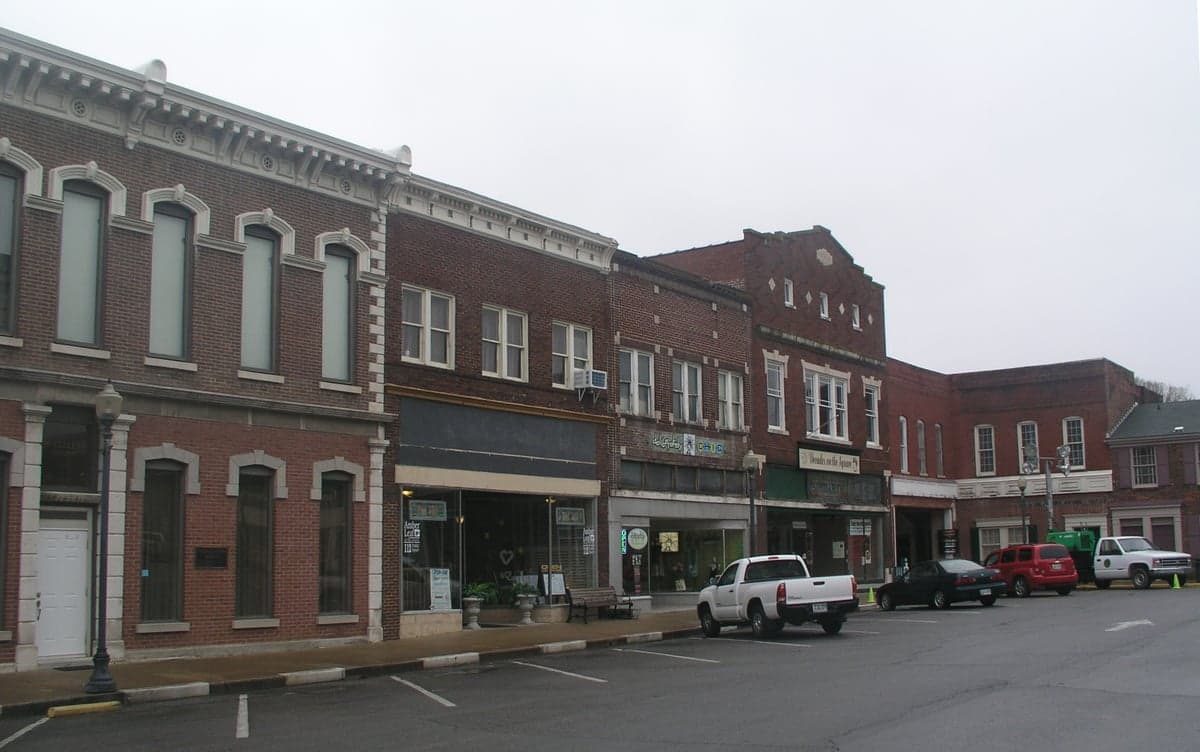
Gallatin was founded in 1802 as the county seat of Sumner County, named after U.S. Secretary of the Treasury Albert Gallatin. The original population was drawn by fertile land for tobacco and hemp farming, with early settlers arriving from Virginia and North Carolina via the Cumberland River. These Anglo-American families established the historic Downtown Gallatin district, centered around the Public Square, which remains the city’s civic and commercial core. By the mid-19th century, the city’s economy shifted toward river trade and small-scale manufacturing, attracting a modest number of German and Irish immigrants who settled in the Fairfield neighborhood, near the riverfront warehouses and mills. The post-Civil War era saw the arrival of freed Black families, who formed the foundation of the South Gallatin area, historically known as the “Black Bottom” district, where churches and community institutions like the Gallatin Colored School were established. The early 20th century brought a wave of White migrants from rural Sumner County, drawn by jobs at the Gallatin Cotton Mill and the Tennessee Central Railroad, settling in the North Gallatin neighborhoods of Douglas Avenue and Blythe Street.
Modern era (post-1965)
The 1965 Hart-Cellar Act had a limited immediate impact on Gallatin, as the city’s foreign-born population remains low at 3.8% today. Instead, the major demographic shift after 1965 was domestic: the construction of Interstate 65 in the 1970s turned Gallatin into a viable bedroom community for Nashville, 30 miles south. This spurred suburbanization, with White middle-class families moving into new subdivisions like Blue Grass Downs and Fairvue in the 1980s and 1990s. The Black population, which had been concentrated in South Gallatin, began a slow dispersal into other parts of the city, particularly the Station Camp area near the developing Station Camp High School zone. The Hispanic population, now 11.7%, began growing significantly in the 2000s, driven by construction and service-sector jobs tied to the Nissan North America plant in nearby Smyrna and the Gallatin industrial parks. These families initially clustered in the East Gallatin corridor along Highway 109, where affordable housing and proximity to warehouse jobs created a distinct enclave. The East/Southeast Asian population (1.0%) and Indian subcontinent population (0.6%) are small but visible, with professionals working at the Sumner Regional Medical Center and local engineering firms, and they tend to settle in newer subdivisions like Fairvue rather than forming ethnic neighborhoods.
The future
Gallatin’s population is projected to continue growing, driven by exurban spillover from Nashville and the expansion of industrial employers like the upcoming LG Chem battery plant. The city is not homogenizing; rather, it is tribalizing into distinct geographic enclaves. The White population, while still the majority at 66.2%, is aging in place in established neighborhoods like Fairvue and Blue Grass Downs, while younger White families are moving to new subdivisions on the city’s southern fringe. The Hispanic community is growing rapidly and becoming more established, with second-generation families moving from East Gallatin into the Station Camp area, though they remain residentially concentrated. The Black population is stable but slowly declining as a share, as out-migration to more affordable rural areas in northern Sumner County continues. The foreign-born share is likely to rise modestly as the LG Chem plant attracts skilled workers from abroad, but Gallatin is unlikely to become a major immigrant destination. For a conservative-leaning mover, this means a city that is becoming more diverse in practice but remains culturally anchored in its Southern, family-oriented identity, with clear neighborhood distinctions that allow newcomers to choose their preferred level of integration.
Gallatin is becoming a more diverse, fast-growing exurb where the historic White and Black communities are being joined by a significant Hispanic population, but the city remains overwhelmingly native-born and culturally conservative. For someone moving in now, the key takeaway is that Gallatin offers a clear choice of neighborhoods—from historic downtown to newer subdivisions—each with its own demographic character, but the overall trajectory is toward a more suburban, family-focused, and moderately diverse community that still feels distinctly Middle Tennessee.

* Values derived from national, state, county, city and local statistics and may differ in a specific area. Last updated: 2026-05-01T18:05:01.000Z
Narrative content on this page is AI-generated and may contain mistakes. Verify any details that matter before acting on them.
ReloMaps may earn a commission from affiliate links at no extra cost to you.

