 Popular
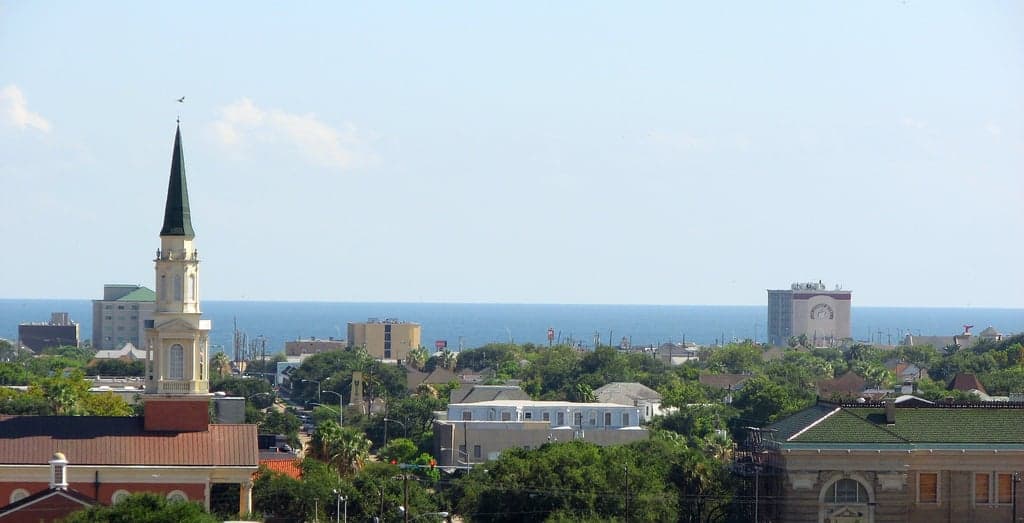
Photo: Wikipedia
Demographics of Galveston, TX
Affluence Level in Galveston, TX
A below-average socioeconomic profile. Incomes, home values, and educational attainment trail the U.S., with higher poverty and unemployment.
People of Galveston, TX
Today, Galveston’s 53,348 residents form a racially and economically layered community shaped by centuries of maritime commerce, disaster, and recovery. The city is majority-white (50.5%) but with a substantial Hispanic population (29.7%) and a significant Black minority (14.5%), creating a demographic profile distinct from mainland Texas suburbs. Galveston remains denser and more walkable than most Texas cities, with a strong sense of place rooted in its historic districts and working waterfront, though its population has been essentially flat for decades.
How the city was settled and grew
Galveston’s human history begins with the Karankawa and Akokisa peoples, who used the island seasonally before European contact. Spanish and Mexican land grants drew the first permanent non-Native settlers in the 1820s, but the city’s explosive growth came after the Texas Revolution, when the port became the state’s commercial gateway. By the 1850s, German and Irish immigrants arrived in large numbers, settling in the East End Historic District and the area around the Strand, building the cotton warehouses, banks, and shipping offices that made Galveston the “Wall Street of the Southwest.” Enslaved Black laborers, who constituted roughly one-third of the island’s pre-Civil War population, lived in the Post Office District and along the waterfront, building much of the city’s physical infrastructure. After emancipation, freedmen established the Carnegie-Colored Library District and the North Side neighborhoods, creating a self-sufficient Black business corridor along 19th Street. The 1900 Hurricane devastated the population, killing an estimated 6,000 and halting the city’s growth trajectory; many survivors relocated inland, and Galveston never regained its status as Texas’s largest city. The early 20th century saw a second wave of European immigration—Italian, Greek, and Eastern European Jews—who clustered in the Silent Set area and the San Jacinto District, working in the docks, fishing industry, and the newly built medical school.
Modern era (post-1965)
The 1965 Hart-Cellar Act had a modest effect on Galveston compared to Houston, but it did bring a small wave of Vietnamese and Filipino immigrants, who settled primarily in the West End and near the University of Texas Medical Branch, working in healthcare and fishing. The larger post-1965 shift was domestic: the construction of Interstate 45 and the rise of Houston’s suburbs pulled white middle-class families off the island, accelerating a pattern of white flight that began after World War II. By 1980, Galveston’s white share had fallen to around 55%, while the Black population stabilized at roughly 20% and the Hispanic share began climbing from under 10%. The Hispanic growth came primarily from Mexican-American families moving from Houston’s East End and from direct migration from northern Mexico, settling in the Central City and Alta Loma neighborhoods. The Black population, once concentrated in the North Side and Post Office District, has dispersed somewhat but remains anchored in those historic areas. The Asian population, now 1.5% East/Southeast Asian and 1.2% Indian, is small but visible in the medical and academic sectors around UTMB. The foreign-born share of 6.9% is below the Texas average of 17%, reflecting Galveston’s limited appeal to recent immigrants compared to Houston’s job market.
The future
Galveston’s population is aging and slowly diversifying, but it is not experiencing the rapid demographic churn seen in suburban Texas. The white share has declined from 60% in 2000 to 50.5% today, while the Hispanic share has risen from 22% to 29.7% over the same period, a trend that will likely continue as younger Hispanic families move in and older white residents age out. The Black share has held steady at 14-15% for two decades, suggesting a stable community rather than one in decline or growth. The Asian and Indian populations, while small, are growing from a low base, driven by UTMB’s research expansion and the island’s appeal to medical professionals. The city is not tribalizing into distinct enclaves—neighborhoods remain relatively mixed by race and income—but the West End is becoming more uniformly white and affluent, while the North Side and Central City are increasingly Hispanic. The biggest wildcard is climate: rising sea levels and hurricane risk may suppress population growth, as insurance costs and flood risk deter new construction. Galveston’s population has hovered between 47,000 and 57,000 since 1970, and that stability is likely to continue, with gradual Hispanicization and a slowly growing professional class.
For a conservative-leaning newcomer, Galveston offers a stable, historically grounded community with a clear sense of identity, but it is not a high-growth opportunity. The city is becoming more Hispanic and slightly more diverse, but at a pace slow enough that the character of its historic neighborhoods remains intact. The bottom line: Galveston is a mature, slow-changing coastal city where the population story is one of persistence rather than transformation—a place for those who value continuity over growth.

* Values derived from national, state, county, city and local statistics and may differ in a specific area. Last updated: 2026-05-12T00:16:58.000Z
Narrative content on this page is AI-generated and may contain mistakes. Verify any details that matter before acting on them.
ReloMaps may earn a commission from affiliate links at no extra cost to you.

