Photo: Wikipedia
Demographics of Garden City, NY
Affluence Level in Garden City, NY
A wealthy area with high-earning, well-educated households. Incomes, home values, and educational attainment meaningfully outpace national averages.
People of Garden City, NY
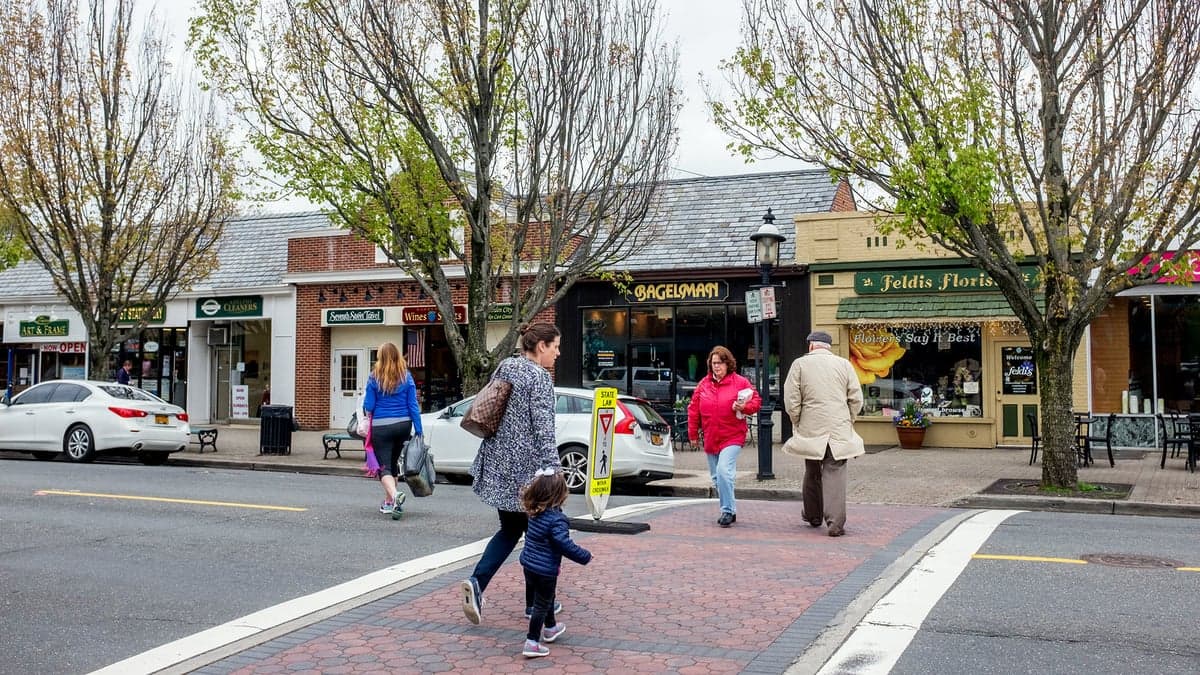
Garden City, New York, is a planned village of 22,866 residents that remains overwhelmingly white (84.2%) and highly educated (75.2% college degree holders), with a foreign-born population of just 2.8% — far below the Nassau County average. Its character is defined by tree-lined streets, historic estates, and a strong sense of institutional permanence, anchored by the Cathedral of the Incarnation and the Garden City Hotel. The population is notably stable: families often stay for generations, and the village’s identity as an affluent, low-crime enclave draws professionals working in Manhattan and nearby corporate hubs.
How the city was settled and grew
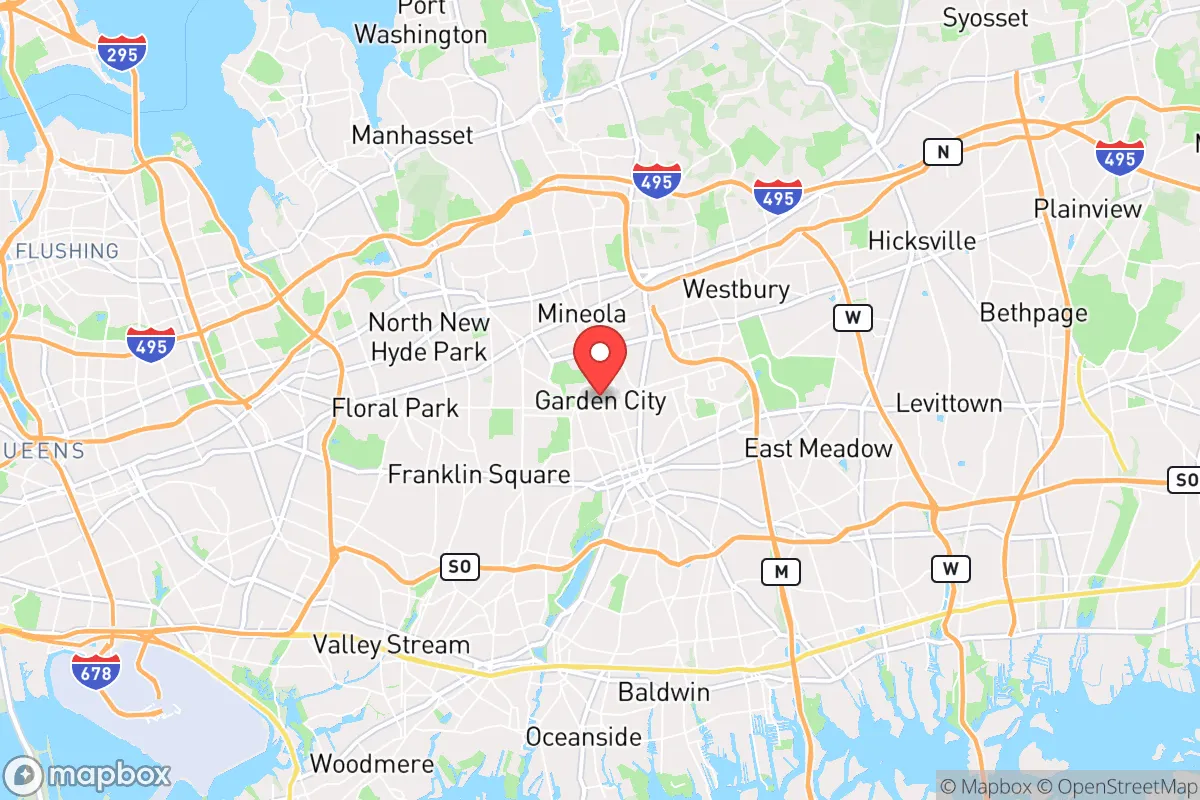
Garden City was not a gradual settlement but a deliberate creation. In 1869, department-store magnate Alexander Turney Stewart purchased 7,000 acres of Hempstead Plains grassland to build a model suburban community — one of the earliest planned suburbs in America. Stewart envisioned a self-contained village for middle- and upper-class families, with a central axis (now Franklin Avenue) and a railroad connection to New York City. The original population was almost entirely white, Anglo-Saxon Protestant, drawn from Manhattan’s merchant and professional classes seeking a pastoral escape from urban crowding. The first wave of residents settled around the Cathedral of the Incarnation and along Stewart Avenue, where large Victorian homes were built on generous lots. By the early 20th century, Garden City had become a commuter haven for executives and financiers, with the Garden City Estates section — east of Franklin Avenue — attracting the wealthiest families. The village incorporated in 1919, and its zoning laws deliberately excluded industry and multi-family housing, preserving its low-density, single-family character. Through the 1950s, the population remained nearly all white, with small numbers of Irish and Italian Catholic families moving into the Westbury Road area as the village’s original Protestant dominance softened slightly.
Modern era (post-1965)
The 1965 Hart-Cellar Act had minimal impact on Garden City’s demographics. Unlike neighboring Hempstead or Uniondale, which saw significant Black and Hispanic in-migration, Garden City’s high property values and strict zoning kept its population largely unchanged. By 2020, the village was 84.2% white, with a Black population of just 1.2% and a Hispanic share of 6.6%. The modest Hispanic presence is concentrated in the Garden City Park area (a small unincorporated pocket on the village’s southern edge) and among service workers employed in local restaurants and landscaping. East and Southeast Asian residents — primarily Chinese and Korean — make up 3.7% of the population, with families settling in the Hilton Section (north of Old Country Road) and the newer condominium developments near the Garden City LIRR station. Indian-subcontinent residents account for 0.9%, a small but growing presence drawn to the village’s top-ranked schools. The most notable demographic shift since 2000 has been the aging of the white population: the median age rose from 41 to 46 between 2000 and 2020, as younger families were priced out by median home values exceeding $1.2 million. The village’s Central Section — the original Stewart-era grid — retains the highest concentration of multi-generational white families, while the Eastern Property Owners Association district has seen the most turnover, with older homes being purchased by younger professional couples and a handful of Asian buyers.
The future
Garden City’s population is likely to remain overwhelmingly white and affluent over the next 10–20 years, but with gradual diversification at the margins. The village’s foreign-born share (2.8%) is so low that even doubling would still leave it far below the Nassau County average of 22%. The most probable change is a slow increase in East/Southeast Asian and Indian-subcontinent families, drawn by the Garden City School District’s reputation — it consistently ranks among New York’s top 10 districts. However, the village’s housing stock (mostly single-family homes on quarter-acre lots) and lack of new construction limit how many new households can form. The white population will continue to age in place, with some homes passing to adult children who can afford the inheritance taxes. Hispanic and Black populations are unlikely to grow significantly unless zoning changes allow multi-family development — a politically unlikely scenario in a village that has fought to preserve its single-family character since 1919. The Garden City Downtown redevelopment (a mixed-use project near the LIRR station) may attract a small number of childless professionals and empty-nesters, but it will not alter the village’s fundamental demographic trajectory.
For someone moving in now, Garden City is a place of remarkable stability — a village where the population has changed less in 50 years than most American suburbs change in 10. The trade-off is clear: you gain safety, schools, and property values that are among the best in the region, but you join a community that is demographically narrow and likely to remain so. If your priority is a homogeneous, high-amenity environment with minimal turnover, Garden City delivers. If you seek ethnic or economic diversity, you will need to look elsewhere on Long Island.

* Values derived from national, state, county, city and local statistics and may differ in a specific area. Last updated: 2026-04-19T07:16:15.000Z
Narrative content on this page is AI-generated and may contain mistakes. Verify any details that matter before acting on them.
ReloMaps may earn a commission from affiliate links at no extra cost to you.

