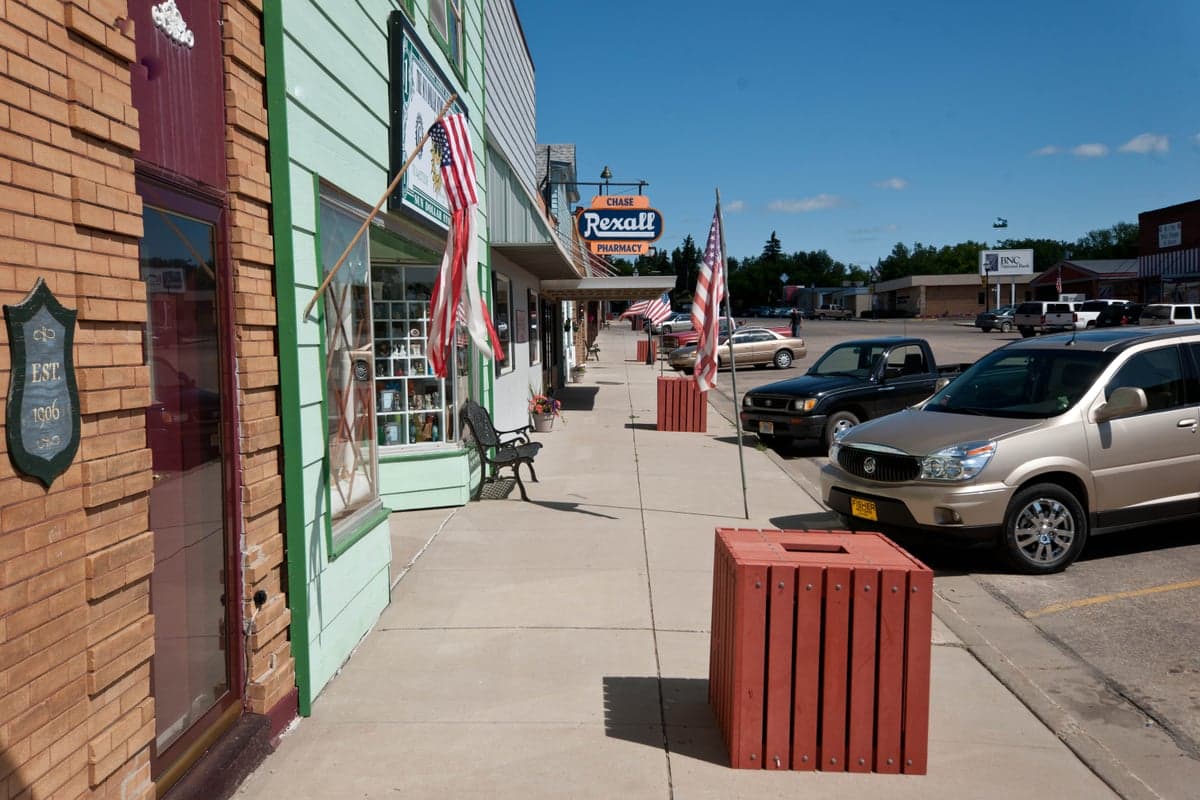
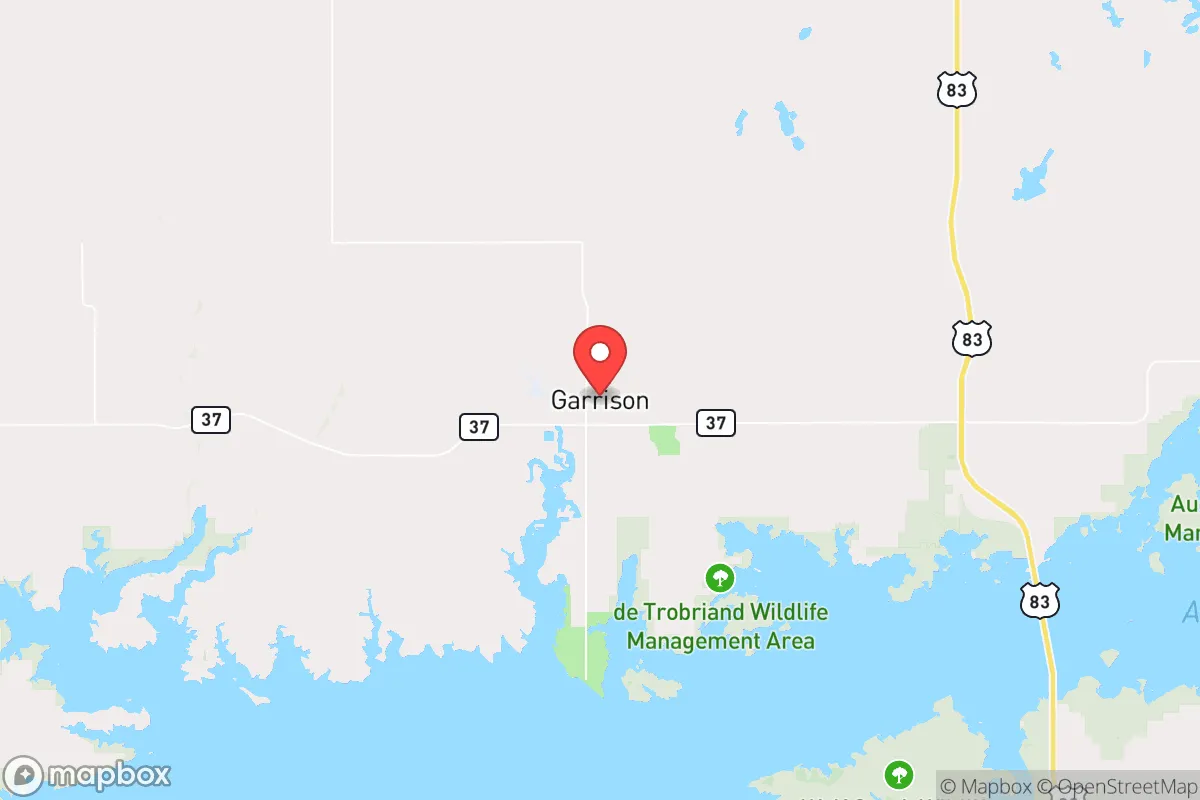
Photo: Wikipedia
Demographics of Garrison, ND
Affluence Level in Garrison, ND
A middle-class area roughly in line with national averages across income, home values, education, and employment.
People of Garrison, ND
The people of Garrison, North Dakota, today number 1,456 and form a tightly knit, predominantly white community with a strong rural and agricultural identity. With 89.6% of residents identifying as white and a foreign-born population of just 0.6%, the city remains one of the most ethnically homogeneous in McLean County. Small Hispanic (2.7%) and Indian-subcontinent (0.5%) communities exist, but Garrison’s character is defined by its deep-rooted families, a modest college attainment rate of 21.0%, and a population that has held steady for decades despite regional outmigration.
How the city was settled and grew
Garrison was founded in 1905 as a railroad town on the Soo Line, drawing its first wave of settlers from Scandinavian and German immigrant families who took up homesteads under the Enlarged Homestead Act of 1909. These early arrivals—mostly Norwegian, Swedish, and German-Russian farmers—built the original Downtown Garrison district along Main Street, where grain elevators and a depot anchored commerce. A second wave arrived during the 1930s and 1940s, when the U.S. Army Corps of Engineers began construction of the Garrison Dam (completed 1953) on the Missouri River. This project brought hundreds of construction workers and engineers, many of whom settled in the Dam View Addition neighborhood, a modest subdivision of ranch-style homes built on the bluffs overlooking the reservoir. The dam’s completion also displaced the Fort Berthold Indian Reservation’s Three Affiliated Tribes, whose members had historically used the area for hunting and fishing, but Garrison itself remained overwhelmingly white and rural. By 1960, the population had peaked near 1,800, supported by dam-related employment and the expansion of dryland wheat farming.
Modern era (post-1965)
After the 1965 Immigration and Nationality Act, Garrison saw virtually no new foreign-born influx—the foreign-born share today is just 0.6%. Instead, the post-1965 period was defined by domestic outmigration of young adults seeking jobs in Bismarck (60 miles south) or the oil fields of the Bakken region. The population declined from 1,800 in 1960 to 1,456 by 2020, with the South Garrison neighborhood—a cluster of 1970s-era split-level homes near the high school—absorbing most of the few new families who moved in, often retirees or telecommuters from the state capital. The small Hispanic population (2.7%) is concentrated in a handful of households in the West Side district, near the grain elevators, and is largely composed of seasonal agricultural workers who have settled permanently. The Indian-subcontinent community (0.5%) is represented by a single family operating a motel on Highway 37, a pattern common in rural Plains towns where immigrant entrepreneurs fill service niches. No significant East/Southeast Asian (0.4%) or Black (0.0%) populations exist. The city’s racial homogeneity has actually deepened since 2000, as the small Native American population that once commuted from the Fort Berthold reservation for retail jobs has declined due to the reservation’s own economic development.
The future
Garrison’s population is projected to remain flat or decline slightly over the next decade, with no major employer or migration corridor to drive growth. The city is homogenizing further: the small Hispanic and Indian-subcontinent communities are assimilating into the white majority through intermarriage and are not growing in absolute numbers. The Lake View Estates subdivision, a 2010s development of 40 lots near the reservoir, has attracted a few out-of-state retirees but has not reversed the overall trend. Younger residents continue to leave for college and not return; the median age has risen to 46. The city’s future likely resembles a stable, aging rural enclave—whiter and older than the state average, with little ethnic or cultural diversification. For someone moving in now, Garrison offers a quiet, low-crime environment with strong social ties, but little demographic change on the horizon.
Garrison is becoming a slower, older, and more homogeneous version of its mid-20th-century self—a place where the population is stable but not growing, and where new arrivals will find a community that values continuity over change. For conservative-leaning individuals or families seeking a predictable, safe, and affordable rural setting, Garrison’s demographic trajectory reinforces its existing character rather than transforming it.

* Values derived from national, state, county, city and local statistics and may differ in a specific area. Last updated: 2026-04-19T07:46:48.000Z
Narrative content on this page is AI-generated and may contain mistakes. Verify any details that matter before acting on them.
ReloMaps may earn a commission from affiliate links at no extra cost to you.

