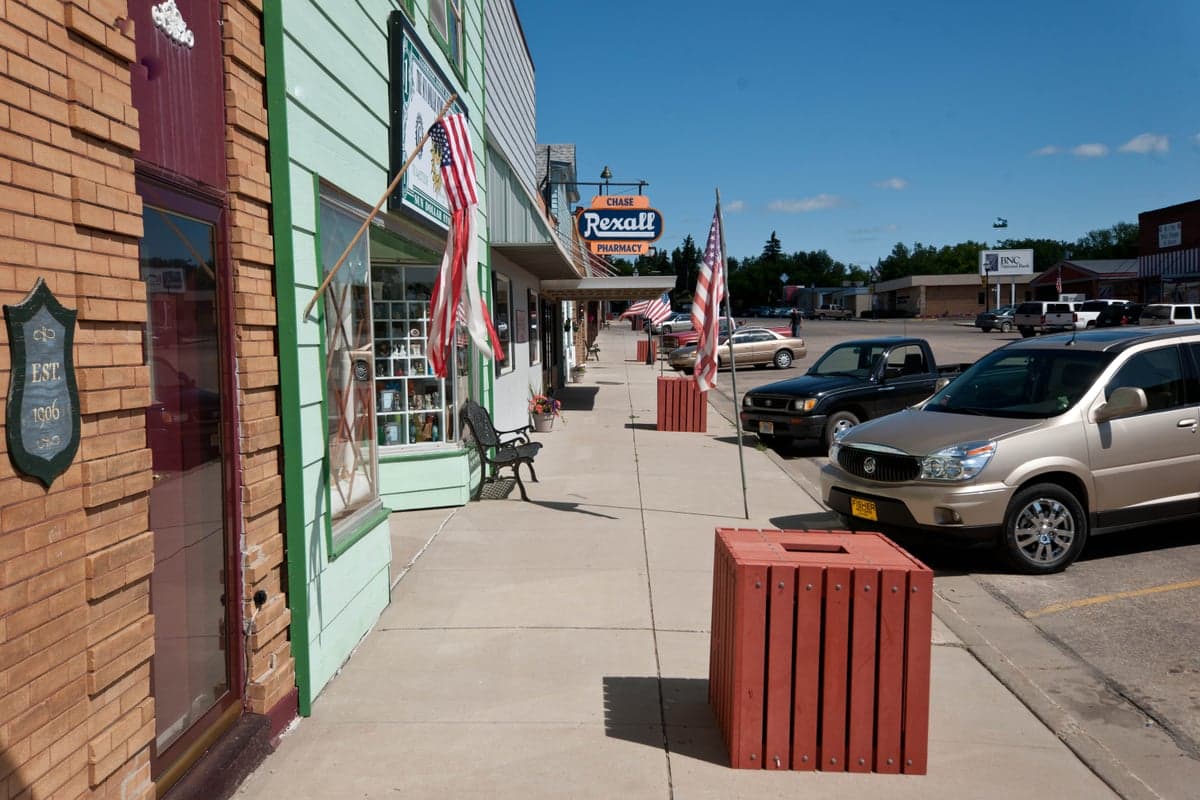
Photo: Wikipedia
Political ClimatePolitical Climate in Garrison, ND
District shown is the primary district for this city’s centroid. Cities may span multiple districts.
Inherited from parent state — no local data available.
Local Political AnalysisPolitical Analysis of Garrison, ND
Garrison, North Dakota, sits solidly in deep-red territory, with a Cook PVI of R+18 that reflects a community where conservative values aren't just a preference—they're the baseline. The area has long leaned Republican, but the shift over the past decade has been toward an even more pronounced skepticism of federal overreach and a fierce defense of local control. You won't find much hand-wringing about progressive policies here; instead, folks in Garrison tend to see any move toward bigger government as a direct threat to the way of life that's kept this place stable for generations.
How it compares
Drive an hour east to Bismarck, and you'll find a more moderate, business-friendly conservatism—still red, but with a pragmatic streak that sometimes accommodates state-level compromises. Head west to Minot, and the politics are similar to Garrison's, though the oil boom has brought in a transient workforce that can dilute the local culture. The real contrast is with places like Fargo or Grand Forks, where younger populations and university influences have nudged politics toward a softer shade of red. In Garrison, that kind of drift is viewed with suspicion. The surrounding McLean County is even more conservative than the state average, and local elections rarely see a competitive Democrat. The political climate here isn't just about voting Republican; it's about resisting the creeping normalization of progressive ideas that many residents see as a threat to personal freedoms—especially around property rights, gun ownership, and parental control over education.
What this means for residents
For someone living in Garrison, the political climate translates into a daily life where government intrusion is minimal. You're not dealing with heavy-handed zoning rules, strict environmental mandates that hamper small farms, or school boards pushing curriculum that undermines traditional values. The local government tends to stay out of the way, which is exactly how most folks want it. That said, there's a growing unease about state-level trends—like the push for more centralized health mandates or data collection programs that feel like surveillance. Residents here are increasingly vocal about wanting to keep decisions about healthcare, education, and land use as local as possible. The long-term concern is that as North Dakota's population shifts and urban areas gain more legislative seats, the rural conservative stronghold like Garrison could see its influence diluted. For now, though, the community remains a reliable bulwark against what many see as overreach from both state and federal levels.
What cultural or policy distinctions stand out
One thing that sets Garrison apart is its strong sense of self-reliance. You don't hear much talk about needing government programs to solve problems; instead, neighbors help neighbors, and churches and local organizations fill gaps that elsewhere might be handled by bureaucracy. The area's hunting and fishing culture is deeply tied to a belief in the Second Amendment as a non-negotiable right, and any talk of gun control is met with immediate pushback. There's also a quiet but firm resistance to the kind of diversity, equity, and inclusion initiatives that have taken hold in larger cities—not out of hostility, but out of a conviction that such programs often create division rather than unity. The policy landscape here is shaped by a simple principle: the less government, the better. If you're looking for a place where personal freedom is still the guiding star, Garrison is about as close as it gets in the modern Midwest.

State Political ClimatePolitical Climate in North Dakota
State Political AnalysisPolitical Environment in the State
North Dakota has long been one of the most reliably Republican states in the nation, with a deep-rooted conservative culture that has only hardened over the past two decades. The state hasn’t voted for a Democratic presidential candidate since Lyndon Johnson in 1964, and in 2024, Donald Trump carried it by a staggering 20 points, with every single county going red. The dominant coalition is a mix of rural agricultural interests, energy-sector workers from the Bakken oil fields, and a growing number of conservative transplants fleeing blue states. Over the last 10-20 years, the state has shifted noticeably rightward, driven by an influx of out-of-state workers in the oil patch and a backlash against national Democratic policies on energy and regulation. This isn’t a purple state flirting with moderation—it’s a deep red stronghold where conservative values are the baseline, not the exception.
Urban vs. rural divide
The political map of North Dakota is surprisingly uniform, but there are subtle gradients. The two largest metros—Fargo and Bismarck—anchor the state’s political center, but even they lean reliably Republican. Fargo, home to North Dakota State University and a growing tech sector, is the most moderate area, with Cass County voting about 55% Republican in 2024. That’s still solidly red, but it’s the closest thing to a swing area you’ll find. Bismarck, the state capital, is more conservative, with Burleigh County hitting around 65% Republican. The real firepower comes from the rural counties and the oil-rich northwest. Williston, the heart of the Bakken shale play, and Watford City are deeply conservative, driven by energy workers who see federal regulation as a direct threat to their livelihoods. Minot, home to the Air Force base, is another reliably red pocket. The only real outlier is Grand Forks, where the university presence creates a small liberal bubble, but even Grand Forks County went 58% Republican in 2024. There are no blue counties left—the rural-urban divide here is between shades of red, not red vs. blue.
Policy environment
North Dakota’s policy environment is a conservative dream, with low taxes, minimal regulation, and a strong emphasis on individual liberty. The state has no state income tax—a major draw for relocators—and relies on a mix of property taxes, sales taxes, and oil extraction revenue. The regulatory posture is business-friendly, especially in energy and agriculture, with the state actively pushing back against federal overreach on everything from methane rules to water rights. Education policy is locally controlled, with school choice options expanding through charter schools and open enrollment, though private school vouchers remain limited. Healthcare is a mixed bag: the state expanded Medicaid under the Affordable Care Act in 2013, a move that still rankles some conservatives, but it also has some of the lowest per-capita healthcare costs in the nation. Election laws are solid—voter ID is required, early voting is available but not excessive, and the state has resisted mail-in ballot expansions. The legislature is dominated by Republicans, holding supermajorities in both chambers, meaning progressive policy shifts are virtually impossible without a major demographic upheaval.
Trajectory & freedom
North Dakota is actually becoming more free in several key areas, bucking national trends. In 2023, the legislature passed a near-total abortion ban, with exceptions only for rape, incest, and life of the mother—a clear win for the pro-life movement. Gun rights are robust: the state has constitutional carry (no permit needed for concealed carry), no magazine capacity limits, and a strong preemption law that prevents local governments from enacting their own restrictions. On parental rights, North Dakota passed a bill in 2023 requiring schools to notify parents of any changes to a student’s health or well-being, including gender identity, and banning instruction on gender identity and sexual orientation in K-3 classrooms. Property rights are strong, with the state actively fighting federal land grabs and supporting private mineral rights. The only concerning trend is a slight uptick in property taxes, driven by local school funding needs, but the state has no income tax to offset it. Medical autonomy is respected—there are no vaccine mandates at the state level, and COVID-era restrictions were minimal compared to coastal states. Overall, the trajectory is toward more personal liberty, not less.
Civil unrest & political movements
North Dakota is remarkably stable compared to the rest of the country, but it’s not without its flashpoints. The most visible political movement in recent years was the Standing Rock protests (2016-2017), where thousands of activists, including left-wing environmentalists and Native American groups, clashed with law enforcement over the Dakota Access Pipeline. That was a major event, drawing national attention and exposing deep tensions between energy interests and tribal sovereignty. Since then, the state has seen a quieter but persistent push from environmental activists, particularly around oil and gas regulation, but it hasn’t gained much traction in the legislature. On the right, the Three Percenters and other militia-adjacent groups have a presence, especially in the oil patch, but they’re more about self-defense and property rights than active unrest. Immigration politics are minimal—North Dakota has a tiny foreign-born population (about 4%), and there are no sanctuary policies. Election integrity controversies are virtually nonexistent; the state’s voting system is widely trusted. A new resident would notice a general sense of civic calm, with the occasional flare-up over energy or land use, but nothing like the protests seen in Portland or Seattle.
Projection
Over the next 5-10 years, North Dakota is likely to remain deeply conservative, but with some subtle shifts. The biggest demographic trend is the continued growth of the oil patch, which brings in workers from across the country—many of them conservative, but some from blue states who may bring more moderate views on social issues. The state’s population is aging, and younger residents are leaving for bigger cities, which could slowly erode the rural conservative base. However, the in-migration of remote workers and retirees from high-tax states like California and New York is accelerating, and these newcomers tend to be conservative-leaning, drawn by the low taxes and freedom. The biggest wildcard is the energy transition: if federal policies push hard against fossil fuels, North Dakota’s economy could take a hit, potentially fueling a more populist, anti-establishment conservatism. Expect the state to double down on its pro-energy, pro-liberty stance, with possible moves toward school choice expansion and further tax cuts. A new resident moving in now should expect to find a state that’s stable, safe, and increasingly resistant to national progressive trends.
For someone considering a move to North Dakota, the bottom line is this: you’re getting a state that’s deeply conservative, with low taxes, strong gun rights, and a government that mostly stays out of your way. The winters are brutal, but the political climate is as stable as it gets. If you’re fleeing a blue state’s overreach, you’ll find a welcoming home here—just be prepared for the cold and the quiet. The state isn’t perfect, but for those who value freedom and self-reliance, it’s one of the best bets in the country.
* Values derived from national, state, county, city and local statistics and may differ in a specific area. Last updated: 2026-04-19T07:46:48.000Z
Narrative content on this page is AI-generated and may contain mistakes. Verify any details that matter before acting on them.
ReloMaps may earn a commission from affiliate links at no extra cost to you.

