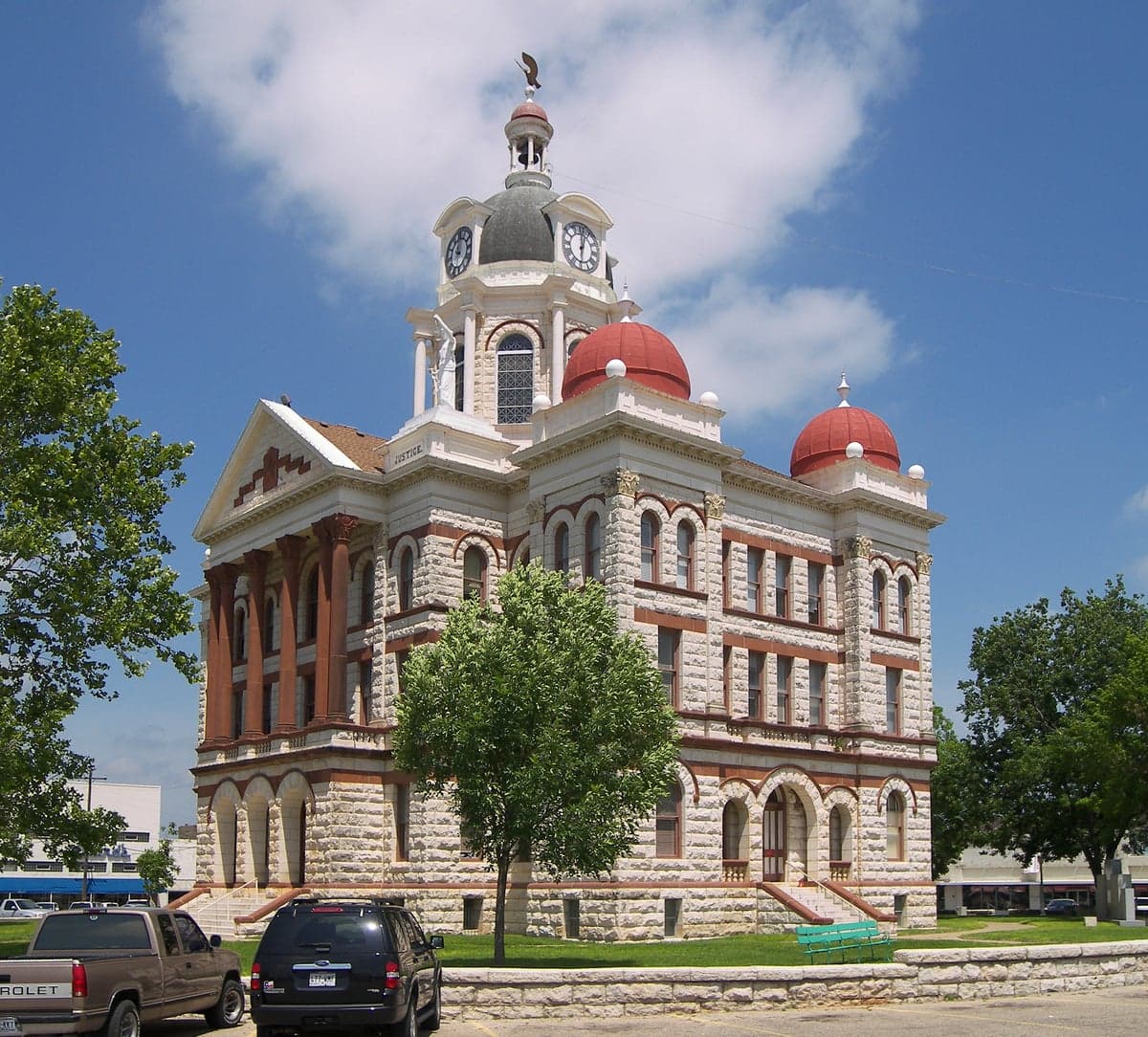
Photo: Wikipedia
Strategic Assessment of Gatesville, TX
Meaningful friction. Expect exposure to either population pressure, blast zones, or natural disaster risk. Consider buying a retreat property.
What does the Strategic Assessment tell us?
Our Strategic Assessment grades tactical survivability of an area. Major population centers, military targets, fallout zones, natural disasters, and border exposure all drive risk — lower exposure means a more defensible position in a crisis.
This is heavily inspired by Joel Skousen's Strategic Relocation book. Highly recommended you checkout the book ($)What does this tell us?
Our Strategic Assessment grades tactical survivability of an area. Major population centers, military targets, fallout zones, natural disasters, and border exposure all drive risk — lower exposure means a more defensible position in a crisis.
This is heavily inspired by Joel Skousen's Strategic Relocation book. Highly recommended you checkout the book ($)Strategic Pillars

Key Distances
Regional Safe Places
Below is our recommended "safe zones" in Texas and the surrounding area based on our strategic heuristics. For most people, it's unrealistic to live in a “safe zone” full-time due to work, family or other personal reasons. They tend to be more rural. However, many of these areas are perfect for second homes and retreat properties that double as a vacation home or even a short-term rental.

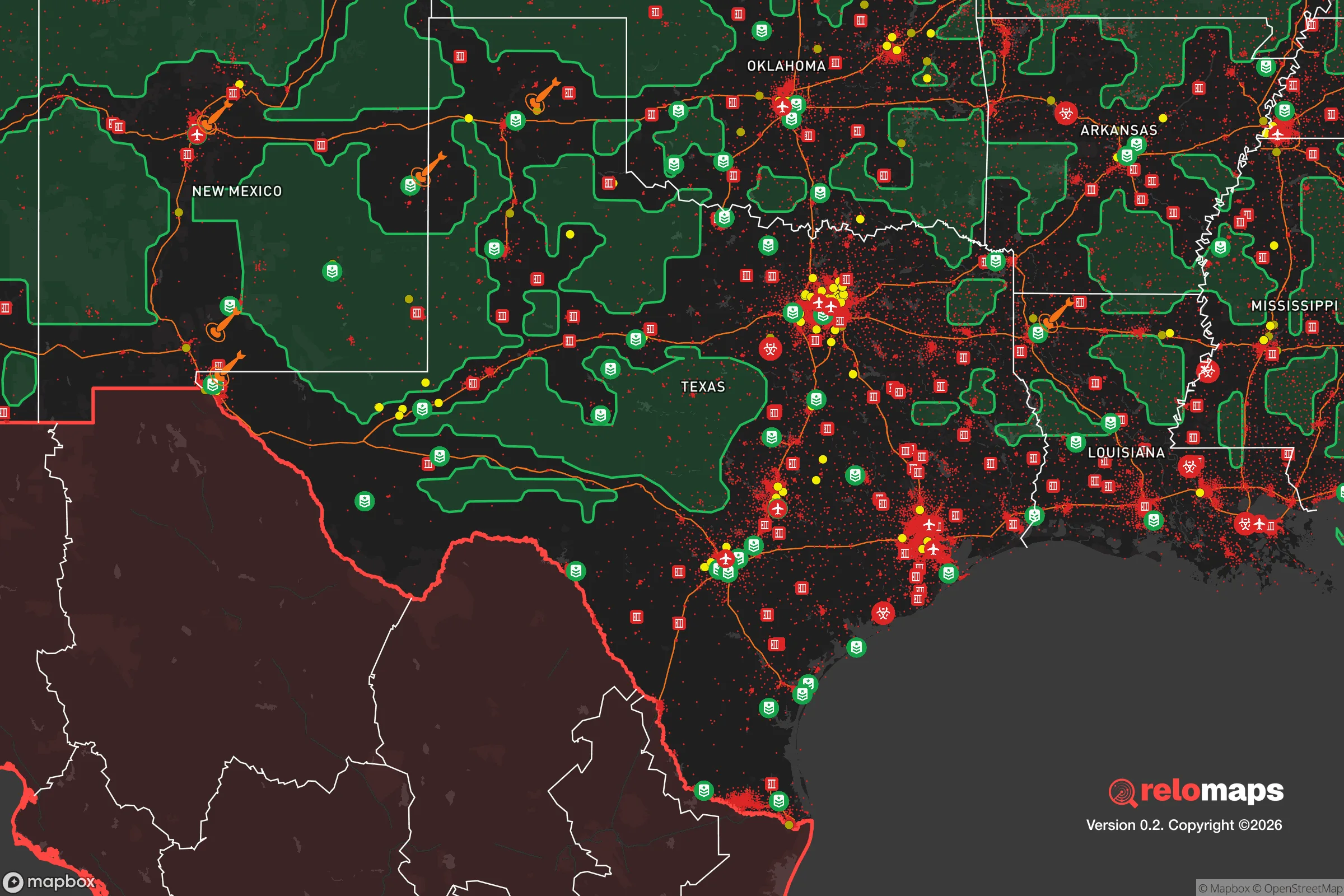


Important Note: For informational purposes only. This does not mean nothing bad ever happens in the green zones. Please use common sense. This is based on public data and modeled with AI. We tried to take a conservative approach but mistakes happen. We update this regularly as new information becomes available.
Solar Generator Recommendations
Backup power matters more here than in safer locations. We've picked three solar generators across budgets and capacity tiers — start with the budget unit if you only need a few essentials, or step up if you want to run a fridge and HVAC for days at a time.

Jackery Portable Power Station Explorer 300
Budget OptionPower on the Go: Weighing only 11 lbs, it's convenient to set up and store with book-sized foldable solar panels

BLUETTI Portable Power Station AC180
Designed for both indoor and outdoor scenarios, AC180 is highly capable as it has a robost capacity and continuous output power.

EF ECOFLOW DELTA Pro Ultra Power Station
Upgraded PickEcoFlow DELTA Pro Ultra is a whole-home energy system designed to grow with your family. Integrated with the Smart Home Panel 2, it scales to meet your evolving energy needs — keeping your home powered, intelligent, and secure through every stage of life.
We earn a commission, at no additional cost to you.
Strategic Assessment Analysis
Gatesville, Texas, offers a compelling strategic profile for those prioritizing resilience, offering a blend of geographic isolation and practical self-sufficiency that is increasingly rare in modern America. Located in Coryell County, roughly 40 miles west of Waco and 60 miles south of Fort Worth, this community of roughly 16,000 residents sits far enough from major metropolitan centers to avoid the worst of urban collapse scenarios, yet remains connected enough for supply runs and medical access. For the conservative-minded prepper or survivalist, Gatesville’s position—nestled in the rolling hills of the Texas Hill Country—provides a natural buffer against the cascading failures that could emanate from larger cities, while its local economy and infrastructure offer a baseline of stability that many other small towns lack.
Geographic position and natural advantages for long-term survival
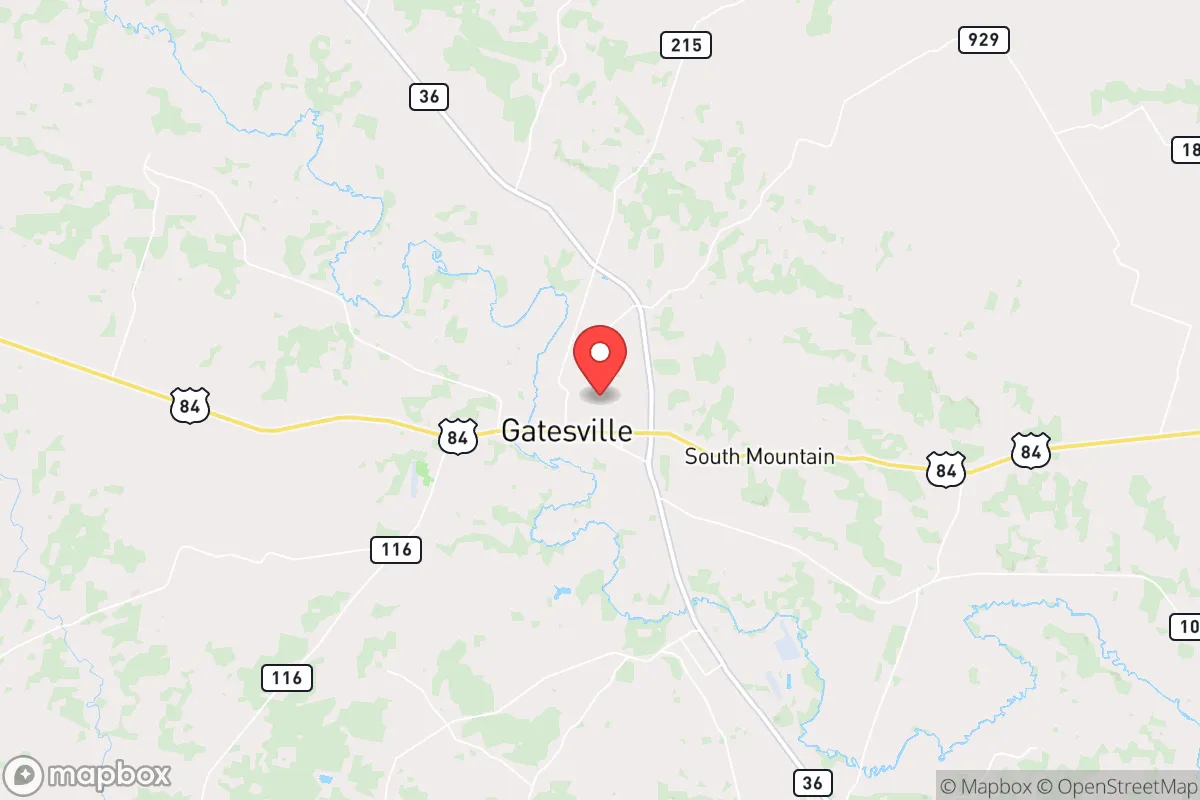
Gatesville’s location is its primary strategic asset. The city sits at the intersection of U.S. Highway 84 and State Highway 36, providing multiple egress routes without being a major thoroughfare that would attract refugees or looters during a crisis. The surrounding terrain—a mix of limestone hills, oak-juniper woodlands, and open ranchland—offers natural defensibility and ample cover. The area is part of the Balcones Fault Zone, which creates a varied topography that can slow movement and provide concealment, a significant advantage if civil unrest forces a retreat to rural property. The local climate is semi-arid, with hot summers and mild winters, reducing the risk of catastrophic weather events like hurricanes or blizzards that plague other regions. Critically, Gatesville lies outside the 50-mile blast radius of any major military or nuclear target, such as Fort Hood (now Fort Cavazos) to the north or the Dallas-Fort Worth metroplex to the northeast. This distance from high-value targets—including the nearby nuclear power plant at Glen Rose (Comanche Peak, about 50 miles northwest)—means a lower probability of being caught in a first-strike scenario or a secondary fallout plume. The area’s water resources are modest but reliable, with the Leon River running through town and several small lakes and stock ponds in the surrounding county, providing a baseline for off-grid water collection and storage.
Risks, exposures, and proximity to fallout-relevant landmarks
No location is without vulnerabilities, and Gatesville has several that a serious relocator must weigh. The most immediate concern is the proximity to Fort Cavazos, one of the largest military installations in the world, located roughly 30 miles north. In a major conflict or domestic breakdown, this base could become a target for enemy action or a focal point for federal mobilization, potentially drawing military traffic, checkpoints, or even refugees. The nearby Comanche Peak Nuclear Power Plant, while not an immediate blast danger, presents a fallout risk if a containment breach occurs—prevailing winds from the northwest could carry radioactive material toward Gatesville within hours. Additionally, the city itself is home to the Gatesville State School and the Mountain View Unit, both state correctional facilities. In a collapse scenario, these prisons could become sources of instability, either through inmate releases or as targets for outside groups. The local economy is heavily dependent on government employment (corrections, county administration, and the school district), which means a federal or state funding collapse would hit the area hard, potentially leading to a rapid loss of services and population. The region also sits in Tornado Alley, with a moderate risk of severe storms and occasional flooding along the Leon River, though these are manageable with proper preparation. For the prepper, the biggest risk is not a single event but the slow erosion of local resources if a prolonged crisis causes the nearby cities of Waco, Killeen, or Temple to empty their populations into the countryside—Gatesville lies directly in the path of any westward exodus from the I-35 corridor.
Practical resilience for a relocator: food, water, energy, and defensibility
For a single individual or family looking to establish a sustainable foothold, Gatesville offers a mix of advantages and challenges. The local soil is thin and rocky, but with raised beds and careful management, a determined gardener can produce vegetables and herbs for much of the year—the long growing season (March through November) is a plus. The surrounding ranchland supports cattle, goats, and poultry, and the local agricultural extension office provides resources for small-scale farming. Water is the critical variable: the Leon River is seasonal and prone to drought, so a well is essential for any rural property. The average well depth in Coryell County is 200-400 feet, with yields varying widely; a prepper should budget for a hand-pump or solar-powered backup. The electric grid is typical for rural Texas—vulnerable to winter storms and summer demand spikes—but the area has a growing number of off-grid solar installations, and the local hardware stores stock generators and propane. Defensibility is strong for those who choose property outside city limits: the hilly terrain, dense brush, and long sightlines make it difficult for large groups to approach unnoticed. The local gun culture is robust, with multiple shooting ranges and a sheriff’s office that is generally supportive of the Second Amendment. However, the town itself is not defensible in a siege scenario—it has a single police station and a small volunteer fire department, and the population is spread out enough that a coordinated defense would require neighborhood-level organization. For the relocator, the key is to secure a rural property within a 15-minute drive of town, where you can access supplies while maintaining a low profile. The local farmers’ market and feed stores are good sources for seeds, tools, and livestock, and the presence of several hardware and building supply stores means you can stockpile materials without drawing attention.
The overall strategic picture for Gatesville is one of cautious optimism for the prepared relocator. It is not a fortress or a prepper paradise—it lacks the deep water resources and extreme isolation of places like the Idaho panhandle or the Montana Rockies. But for someone who wants to stay within the continental United States, maintain access to medical care and supply chains, and avoid the high-risk zones of the coasts and the I-35 corridor, it is a solid middle-ground option. The community is predominantly conservative, with a strong church presence and a culture of self-reliance that aligns with prepper values. The local government is small and responsive, and property taxes are reasonable compared to the rest of Texas. The biggest wildcards are the prison population and the proximity to Fort Cavazos, but these are manageable with situational awareness and a good bug-out plan. For the single individual or family looking to ride out the coming instability—whether from economic collapse, civil unrest, or geopolitical conflict—Gatesville offers a defensible, resource-rich base that is close enough to civilization to be practical, yet far enough to be safe. The key is to arrive prepared, build relationships with neighbors, and treat the area not as a final destination, but as a strategic position from which to adapt to whatever comes.

* Values derived from national, state, county, city and local statistics and may differ in a specific area. Last updated: 2026-05-18T01:52:25.000Z
Narrative content on this page is AI-generated and may contain mistakes. Verify any details that matter before acting on them.
ReloMaps may earn a commission from affiliate links at no extra cost to you.

