Photo: Wikipedia
Demographics of Clarke County
Affluence Level in Clarke County
A middle-class area roughly in line with national averages across income, home values, education, and employment.
People of Clarke County
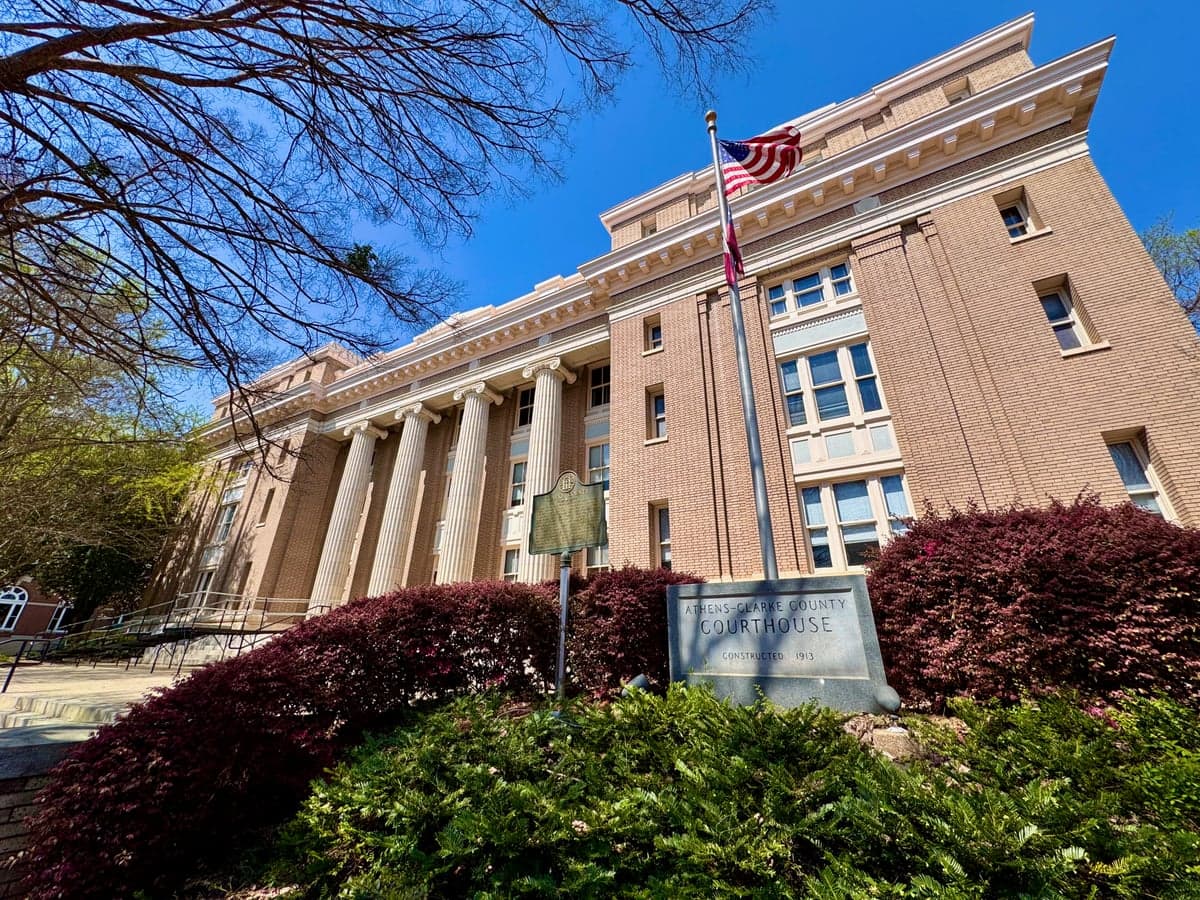
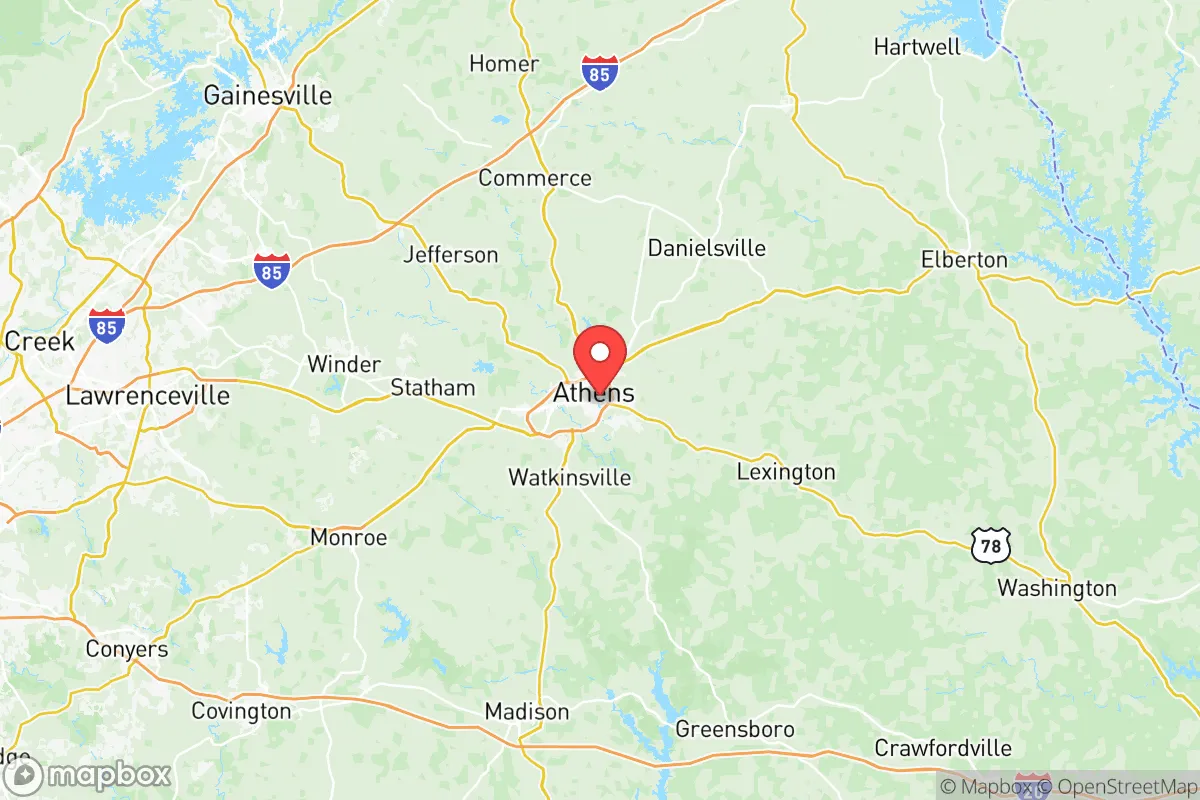
Clarke County, Georgia, anchored by Athens, is a college town at its core, with a population of 129,267 that is younger and more transient than the state average. The county’s identity is defined by the University of Georgia, which pulls in a steady stream of students and faculty from across the country and globe, creating a highly educated populace where 48.7% hold a college degree. This academic influence tempers a historically Southern character, resulting in a politically liberal enclave within a conservative region, marked by a diverse racial mix of 54.4% White, 26.2% Black, 11.4% Hispanic, and growing Asian and Indian communities.
Settlement & growth (pre-1960)
Before American settlement, the area now known as Clarke County was the heartland of the Creek (Muscogee) Nation, with the Cherokee people also claiming territory to the north. The region was sparsely populated by these indigenous groups, who used the land for hunting and established towns along the Oconee River. European contact intensified after the American Revolution, and the Creeks ceded the land in the 1802 Treaty of Fort Wilkinson, opening it to white settlement.
The first wave of American settlers were primarily Scots-Irish and English yeoman farmers from Virginia and the Carolinas, arriving in the 1780s and 1790s. They were drawn by the promise of cheap, fertile land in the newly opened Georgia frontier. These early settlers established small farms and the first county seat, Watkinsville (now in Oconee County), before the county was formally created in 1801. The founding of the University of Georgia in 1785—though it didn’t open until 1801—began to shape the area’s character, with the town of Athens growing up around the campus as a center for education and commerce.
The second major population wave was the forced migration of enslaved Black people, who were brought primarily from the Upper South (Virginia, Maryland, the Carolinas) to work the cotton plantations that dominated Clarke County’s economy from the 1820s through the Civil War. By 1860, enslaved people made up roughly 45% of the county’s population, concentrated on plantations in the rural areas around Winterville and along the Middle Oconee River. After emancipation, many freedmen remained in the county, forming the foundation of the Black community in Athens’ Poulain Avenue and Baxter Street neighborhoods, as well as the independent town of Bogart.
The post-Reconstruction period saw modest growth driven by the railroad and the rise of textile mills. The 1890s brought a small influx of European immigrants, primarily Irish and German, who worked on the railroad and in the mills, settling in working-class neighborhoods near the rail lines in Athens. However, Clarke County remained overwhelmingly native-born and rural well into the 20th century. The Great Depression and World War II slowed growth, but the post-war G.I. Bill dramatically expanded the University of Georgia, attracting a new wave of students and faculty from across the South and the nation, many of whom settled in the expanding suburbs of Five Points and Normaltown.
Modern era (post-1965)
The 1965 Hart-Cellar Act had a delayed but significant impact on Clarke County. Unlike coastal cities, Athens did not see a large wave of immediate post-1965 immigration. Instead, the county’s modern demographic shifts have been driven primarily by the University of Georgia’s growth and the broader Sun Belt migration. The university’s international recruitment efforts, particularly from the 1990s onward, brought the first substantial immigrant populations: East/Southeast Asian communities (2.8% of the population today), including Chinese, Korean, and Vietnamese students and faculty, who tend to concentrate in neighborhoods near campus like Beechwood and Whitehall. A smaller but notable Indian-subcontinent community (1.4%) has also grown, primarily composed of graduate students and tech professionals, with a visible presence in the Epps Bridge Parkway corridor.
Domestic migration has been the larger force. The 1970s and 1980s saw a steady influx of White and Black professionals from the Rust Belt and the Northeast, drawn by the university’s research sector and the lower cost of living. This wave accelerated after 2000, as Athens became a popular destination for retirees and remote workers seeking a vibrant, smaller city. The Hispanic population (11.4%) grew rapidly from the 1990s onward, driven by labor demand in construction, landscaping, and the poultry processing plants in neighboring Jackson County. This community is concentrated in the Gaines School Road and Lexington Road corridors in east Athens, as well as in the unincorporated area around Hull.
Suburbanization has reshaped the county’s internal geography. The historic core of Athens has become increasingly dominated by students and university staff, while families and longer-term residents have moved to the outer edges of the county and into adjacent Oconee and Madison counties. This has created a stark divide: the city of Athens is a liberal, transient, and diverse college town, while the unincorporated areas of Clarke County lean more conservative and are more demographically stable.
The future
Clarke County’s population is likely to continue growing slowly, constrained by its small geographic size (121 square miles) and high land prices near the university. The county is not homogenizing; rather, it is tribalizing into distinct enclaves. The university-adjacent neighborhoods will become more international and more transient, with the Asian and Indian populations likely growing as UGA expands its global recruitment. The Hispanic community is expected to plateau or grow slowly, as the construction and service sectors that drew them face labor competition from automation and out-of-county commuters.
The most significant trend is the continued out-migration of families—both White and Black—to Oconee and Madison counties, which offer larger lots, lower taxes, and more conservative school boards. This will leave Clarke County with an increasingly bifurcated population: a highly educated, liberal, and transient core in Athens, and a smaller, more stable, and more conservative population in the county’s rural fringes. The Black population share (26.2%) is likely to decline slowly as younger Black professionals follow the same suburbanization pattern.
For someone moving in now, Clarke County offers a unique mix: the energy and diversity of a major university town, but with the cultural and political tensions of a small Southern city in transition. The county is becoming less of a cohesive community and more of a collection of distinct, self-selecting neighborhoods. New arrivals will find their experience shaped heavily by whether they live inside the Athens city limits or in the unincorporated county, and by whether they are connected to the university or not.

* Values derived from national, state, county, city and local statistics and may differ in a specific area. Last updated: 2026-05-11T19:48:42.000Z
Narrative content on this page is AI-generated and may contain mistakes. Verify any details that matter before acting on them.
ReloMaps may earn a commission from affiliate links at no extra cost to you.

