
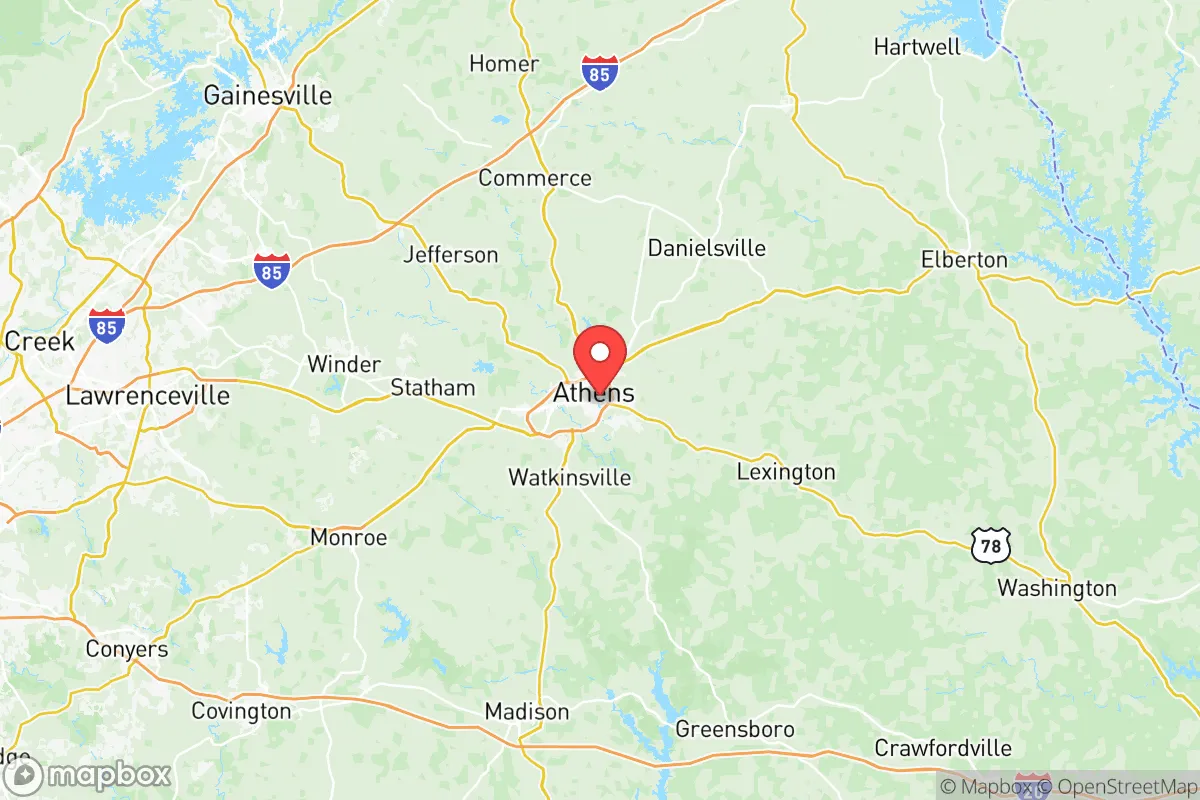
Photo: Wikipedia
Personal Sovereignty in Clarke County
Viable for self-reliance. Generally workable, though some barriers may limit total independence.
What does Personal Sovereignty tell us?
Personal Sovereignty measures your capacity for self-reliance and independence with minimal government friction. Higher scores mean fewer barriers between you and the way you want to live... but it assumes you have the space you need and good neighbors.
What does this tell us?
Personal Sovereignty measures your capacity for self-reliance and independence with minimal government friction. Higher scores mean fewer barriers between you and the way you want to live... but it assumes you have the space you need and good neighbors.
State Policy
Energy independence: Importer (12% of energy produced in-state)
Personal Liberty
Homesteading

Personal Liberty Analysis
Clarke County, Georgia, presents a mixed picture for those prioritizing personal sovereignty, with the city of Athens exerting a strong pull toward progressive governance while the county’s unincorporated areas and smaller towns offer more breathing room. For conservative-leaning individuals and families who value autonomy—whether in self-defense, homeschooling, or homesteading—the key is knowing where within the county the regulatory leash is loosest. The state of Georgia generally provides a favorable legal framework for gun rights, property freedom, and low taxes, but local ordinances in Athens can chip away at that foundation, making location-specific analysis critical for anyone serious about preserving personal liberty.
Tax burden and regulatory posture across Clarke County
Georgia’s state-level tax climate is a net positive for sovereignty-minded residents, with a flat 5.39% income tax and no state-level estate or inheritance taxes. Property taxes in Clarke County average around 1.2% of assessed value, which is moderate for the state, but the county’s millage rate is higher than in neighboring Oconee County (0.85%) or Madison County (0.9%). The city of Athens imposes its own 1% sales tax on top of the state’s 4%, bringing the total to 8% in the urban core—a noticeable bite for anyone stocking up on supplies. Regulatory posture is where the divergence sharpens: Athens has a reputation for zoning restrictions, rental registration requirements, and a business licensing process that can feel invasive. In contrast, unincorporated areas like Winterville and Bogart operate under county-level rules that are less burdensome, with fewer hoops for home-based businesses or workshops. For preppers, the takeaway is clear: avoid the Athens city limits if you want to minimize government oversight on your property and purchases.
Self-defense and gun law specifics in Clarke County
Georgia is a constitutional carry state, meaning no permit is required to carry a concealed firearm for anyone 21 or older who can legally possess a gun. This is a bedrock of personal sovereignty, and Clarke County does not impose any local restrictions beyond state law—no magazine bans, no assault weapon bans, and no waiting periods. The sheriff’s office in Athens issues weapons carry licenses (WCLs) for reciprocity purposes, and the process is straightforward, typically taking under 30 days. However, the political climate in Athens can feel less gun-friendly than the rest of the county. The city council has occasionally floated resolutions supporting state-level gun control, though none have passed locally. For a survivalist mindset, the practical concern is that Athens has a higher crime rate than the county average—violent crime per capita is about 40% above the state average—making self-defense a daily consideration. In contrast, areas like Watkinsville (just over the line in Oconee County) or Colbert in northern Clarke County see far fewer incidents, and the culture around firearms is more openly supportive. Stand-your-ground laws apply statewide, and there are no red flag laws in Georgia, so your right to defend your home or person is legally robust regardless of which part of the county you choose.
Self-reliance and homesteading viability: lot sizes, zoning, and off-grid feasibility
For those looking to reduce dependence on the grid, Clarke County offers a stark contrast between urban and rural parcels. Inside Athens, lot sizes are typically small—quarter-acre or less—and zoning codes restrict livestock, large gardens, and accessory structures like workshops or root cellars. The city also enforces building codes that can complicate off-grid systems like solar panels or rainwater collection, though Georgia law does protect rainwater harvesting for non-potable uses. Head north or east to unincorporated areas like Hull or Pittman, and the picture changes dramatically. Here, you can find parcels of 1 to 5 acres with agricultural zoning that permits chickens, goats, and even small-scale farming. The county’s soil is generally good for gardening, with a growing season of about 220 days. Off-grid feasibility is limited by the need for septic systems and well permits, but these are obtainable with standard county approval. Bishop and Arnoldsville are particularly attractive for homesteaders, with lower property taxes and fewer neighbors to complain about a wood-fired stove or a backup generator. The county does not have a specific ban on tiny houses or RVs as permanent dwellings, but you’ll need to meet minimum square footage requirements (typically 500 sq. ft.) and have a proper septic system. For serious preppers, the northern and eastern edges of Clarke County offer the best balance of affordability and regulatory freedom.
Personal liberties: parental rights, medical autonomy, speech, and property
Georgia law provides strong protections for parental rights, including the ability to homeschool without government approval—just a simple declaration of intent each year. Clarke County does not add extra reporting requirements, and the local school district in Athens has not been aggressive in challenging homeschoolers. Medical autonomy is more nuanced: Georgia has no vaccine mandate for adults, and while the state does require certain immunizations for school attendance, religious exemptions are available and widely used. The Athens-Clarke County government has not passed any local health mandates that would override state law, so your medical choices remain largely your own. Free speech is protected under the First Amendment, and while Athens has a reputation as a liberal enclave, there have been no local ordinances restricting political speech or assembly. Property rights are solid, with Georgia’s eminent domain laws requiring just compensation and a public purpose. However, the city of Athens has a rental registration ordinance that requires inspections and fees for landlords, which some see as an overreach into private property agreements. For homeowners in unincorporated areas, property rights are more absolute—no rental registry, no occupancy limits beyond standard building codes. Whitehall and Timothy are examples of neighborhoods where you can modify your property without city interference, as long as you stay within county setback and septic rules.
Overall, Clarke County offers a tiered sovereignty environment: the state provides a solid foundation of gun rights, low taxes, and parental freedom, but the city of Athens introduces regulatory friction that can erode personal autonomy. For a conservative-leaning individual or family, the smart move is to settle in the unincorporated areas—Hull, Bishop, Arnoldsville, or Winterville—where you can enjoy Georgia’s constitutional carry, homestead with livestock, and keep government at arm’s length. Compared to deep-blue metro areas like Atlanta or Decatur, Clarke County’s rural pockets are a haven; compared to truly free counties like Oconee or Banks, they require a bit more vigilance. The bottom line: if you value personal sovereignty above all, pick your spot carefully within Clarke County, and you’ll find a place where you can live largely on your own terms.

* Values derived from national, state, county, city and local statistics and may differ in a specific area. Last updated: 2026-05-11T19:48:42.000Z
Narrative content on this page is AI-generated and may contain mistakes. Verify any details that matter before acting on them.
ReloMaps may earn a commission from affiliate links at no extra cost to you.

