
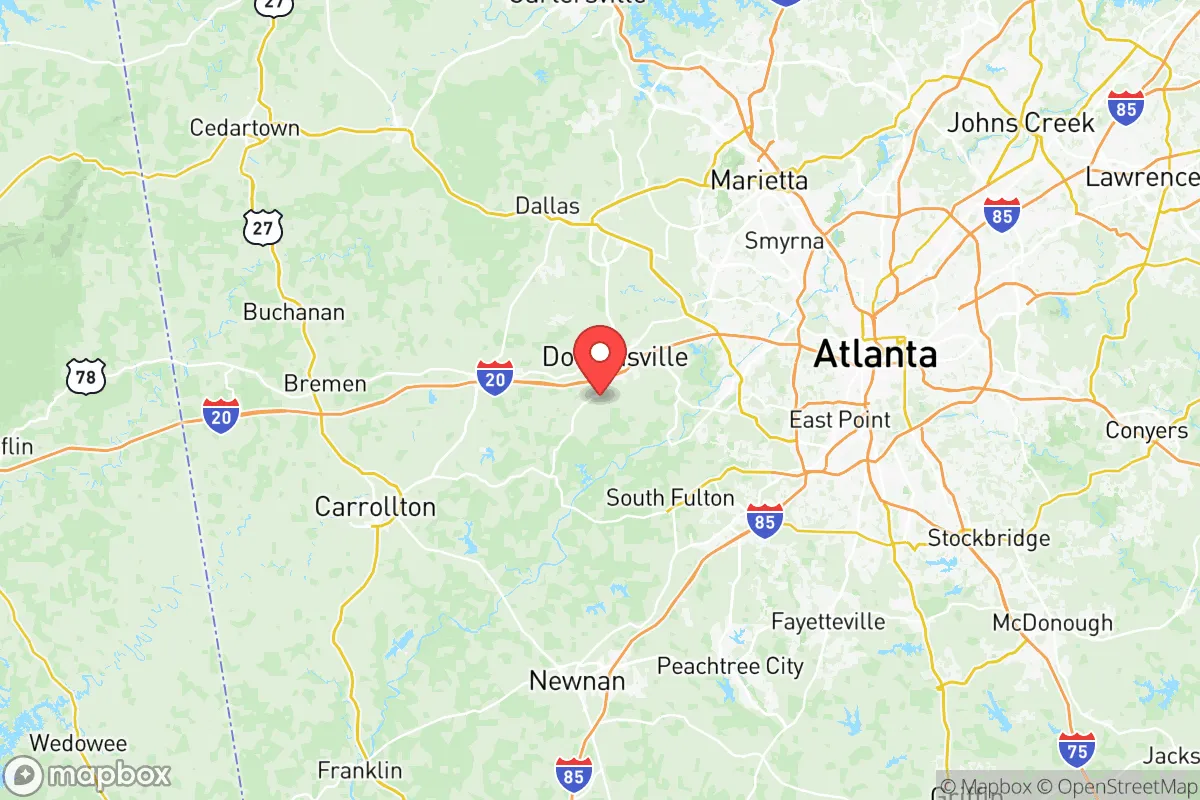
Photo: Wikipedia
Personal Sovereignty in Douglas County
Moderate friction. Expect trade-offs in some aspect of personal liberty and independence.
What does Personal Sovereignty tell us?
Personal Sovereignty measures your capacity for self-reliance and independence with minimal government friction. Higher scores mean fewer barriers between you and the way you want to live... but it assumes you have the space you need and good neighbors.
What does this tell us?
Personal Sovereignty measures your capacity for self-reliance and independence with minimal government friction. Higher scores mean fewer barriers between you and the way you want to live... but it assumes you have the space you need and good neighbors.
State Policy
Energy independence: Importer (12% of energy produced in-state)
Personal Liberty

Personal Liberty Analysis
Douglas County, Georgia, offers a meaningful degree of personal sovereignty relative to the Atlanta metro core, though it is not without trade-offs. The western half of the county—particularly around Winston, Whitesburg, and Villa Rica—feels distinctly more rural and self-directed than the more suburban and denser eastern side anchored by Douglasville and Lithia Springs. For a strategic relocation focused on autonomy, the key is to pick the right part of the county and understand where the local government draws lines around your freedoms.
Tax burden and regulatory posture in Douglas County versus metro Atlanta
Georgia is a right-to-work state with a flat income tax rate of 5.49% as of 2026, and the state's constitutional amendment capping property tax assessment increases helps keep your primary residence from being taxed out from under you. Within Douglas County, the total tax burden is moderate by metro Atlanta standards—millage rates in the unincorporated areas run around 13.5 mills for county operations, with additional school taxes pushing the combined rate near 21 mills depending on the district. That is higher than parts of rural west Georgia, but well below the crushing property tax environments of DeKalb or Fulton counties just to the east. The regulatory posture is generally business-friendly, but you will encounter real zoning enforcement if you try to run an unpermitted home-based operation or keep livestock in areas zoned residential. The county's development standards for unincorporated land are less invasive than city ordinances inside Douglasville proper, where you face stricter setback rules, noise limitations, and permitting hurdles for anything structural. If you are a prepper looking to minimize government intrusion into your daily affairs, Whitesburg and western Winston give you the widest berth, with far fewer code enforcement complaints and a more live-and-let-live culture.
Self-defense and gun law specifics: Georgia's constitutional carry framework
Georgia is a constitutional carry state—no permit required for open or concealed carry of a handgun for anyone legally allowed to possess a firearm. This applies fully in Douglas County, and local law enforcement in the western precincts is generally gun-friendly. The county is home to multiple federally licensed firearms dealers, and you will find that shooting on private property is permitted in unincorporated areas as long as it does not violate noise ordinances or safety setbacks. The practical constraint comes from density: if you buy five acres near Lithia Springs, your neighbors are closer, and a complaint about target practice can bring a deputy to your door. In contrast, a parcel of 10 acres or more tucked back in the Winston countryside gives you far more practical freedom to shoot, hunt, and train on your land without interference. The county does not impose its own magazine capacity bans or additional firearm registration—Georgia preempts local gun laws, so Douglasville city council cannot pass anything stricter than state law. Stand-your-ground and castle doctrine are codified in state statute, so there are no legal surprises if you need to defend your home or vehicle.
Self-reliance and homesteading viability: lot sizes, zoning, and off-grid feasibility
Homesteading viability in Douglas County varies dramatically by location. Minimum lot sizes in the rural west are 1 to 3 acres depending on the zoning district, while the eastern unincorporated strip near I-20 often sees 0.5- to 1-acre lots that are too small for meaningful livestock or intensive gardening. If you want to keep chickens, goats, or a family cow, your best bet is to look at properties zoned R-A (Residential-Agricultural) in the Winston and Whitesburg areas. Off-grid feasibility is a mixed picture. Douglas County has adopted the state's minimum standard building codes, which means any permanent dwelling must meet electrical and plumbing code requirements if you ever need a certificate of occupancy. Full off-grid living with no connection to the power grid is legally possible for an accessory structure or "camp," but a primary residence with sleeping quarters will trigger county inspection. Rainwater collection is not prohibited—Georgia law actually encourages it—but graywater systems require a permit and annual inspection. Vegetable gardens, composting, and small-scale food preservation are completely unregulated and widely practiced. The western outskirts, especially south of Highway 92 near the Chattahoochee River corridor, offer the best combination of land affordability, minimal neighbor proximity, and practical freedom to build self-reliant systems.
Personal liberties: parental rights, medical autonomy, speech, and property
Georgia has a strong track record on parental rights in education—the state affirmed parental opt-out rights for certain curriculum content and upheld that parents are the primary decision-makers for their children's healthcare and education. Douglas County School System generally respects those boundaries, though the district's policies on critical race theory and gender ideology instruction have been debated in school board meetings, and the outcome shifts with board composition. On medical autonomy, Georgia is not a vaccine-mandate state for adults, and there is no state-level forced medical treatment order on the books. However, county health officials follow state communicable disease protocols, so local mandates could theoretically be imposed in declared emergencies—something to watch in Douglasville's city jurisdiction. Free speech and assembly are protected under the Georgia Constitution, and the county has no unusual parade permit requirements or protest restrictions beyond state law. Property rights are reasonably strong: Georgia is not a state that allows county-wide inclusionary zoning or rent control, and Douglas County's eminent domain actions are limited and subject to public hearing requirements. The greatest threat to your property sovereignty here is the slow creep of suburban density—the eastern corridor near Lithia Springs and Douglasville sees frequent annexations and zoning map amendments that can increase regulation on existing parcels over time. Investing in land west of Chapel Hill or around Winston insulates you from that suburban expansion far longer.
Compared to areas like Cobb County to the north or Fulton to the east, Douglas County—especially its western half—is a viable relocation for someone prioritizing personal sovereignty, self-reliance, and freedom from intrusive government. The tax burden is manageable, gun laws are as favorable as any in the Southeast, and the rural-agricultural zoning in the western precincts allows real homesteading and off-grid experimentation. The trade-off is that you are still within the Atlanta media market and subject to state-level trends, and the eastern side of the county increasingly mirrors the regulatory posture of the inner suburbs. If you want the maximum autonomy in this county, target land west of Highway 5, south of Mirror Lake, and keep your permanent address in unincorporated Douglas County rather than inside any city limits. That combination gives you the constitutional protections of Georgia law with the lightest local regulatory footprint available in this part of the metro area.

* Values derived from national, state, county, city and local statistics and may differ in a specific area. Last updated: 2026-06-06T00:27:15.000Z
Narrative content on this page is AI-generated and may contain mistakes. Verify any details that matter before acting on them.
ReloMaps may earn a commission from affiliate links at no extra cost to you.

