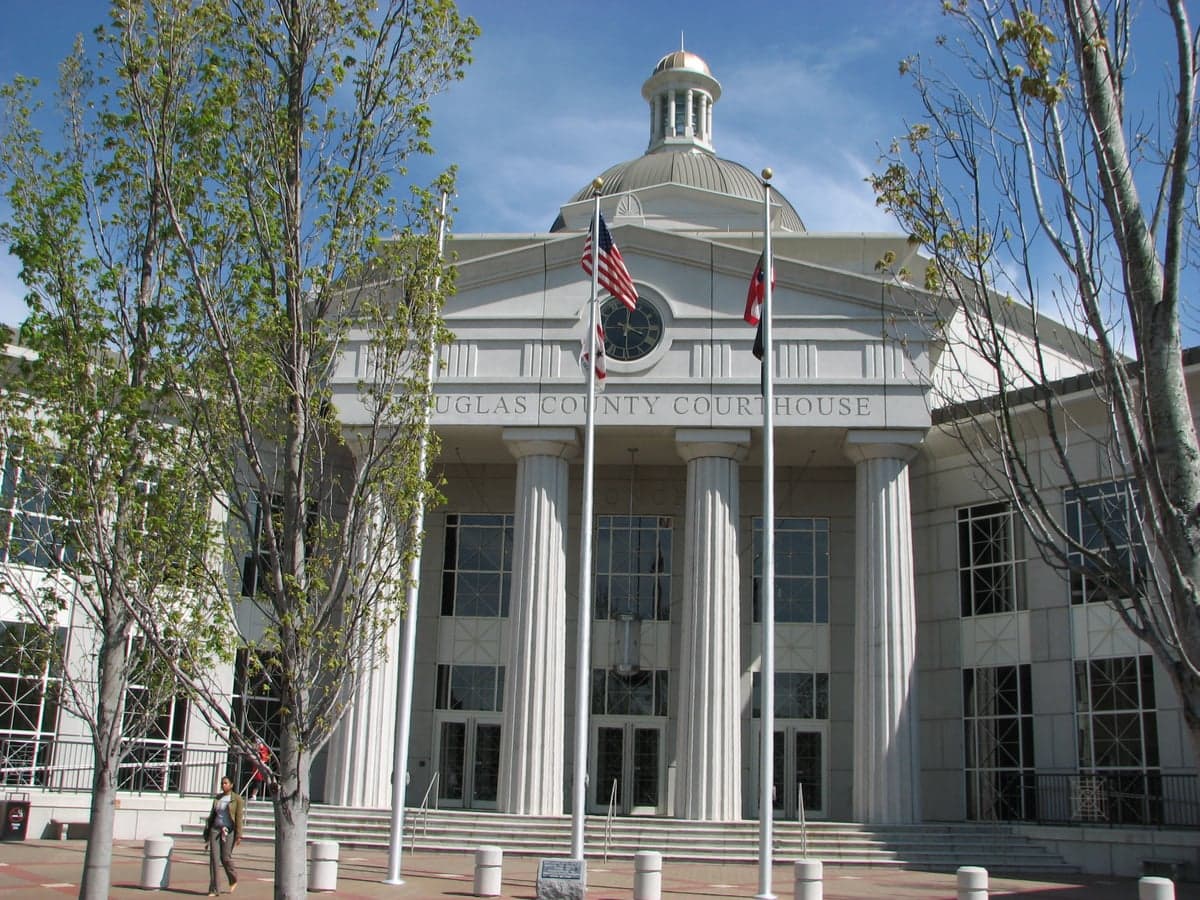
Photo: Wikipedia
Political ClimatePolitical Climate in Douglas County
Showing district-level results — no local-only data available.
Local Political AnalysisPolitical Analysis of Douglas County
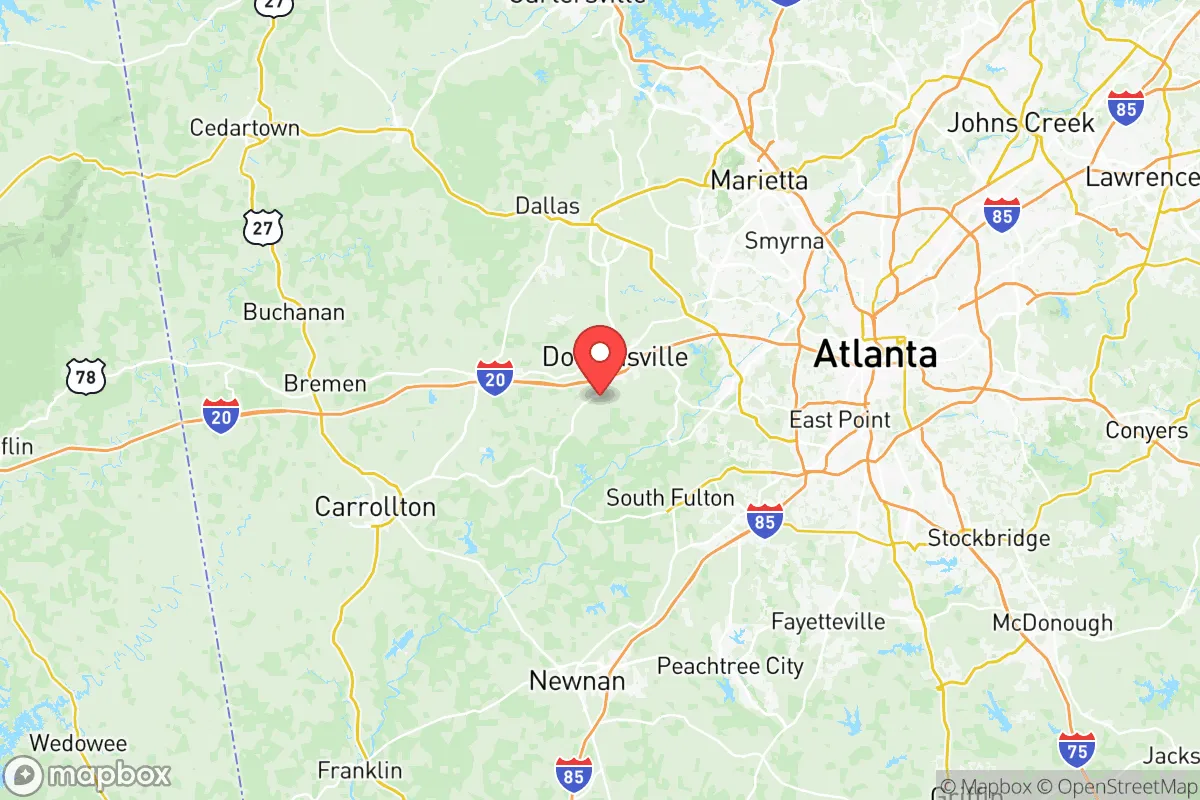
If you're looking at Douglas County, you need to understand this isn't the reliably blue metro pocket some assume it is. The county carries a Cook PVI of R+15 — meaning it votes about 15 points more Republican than the nation as a whole. That's a solid red lean, and it's been getting redder over the last decade. But dig a little deeper and you'll see it's a place in transition, with a real split between the older, more conservative communities and the newer subdivisions creeping in from the Atlanta edge.
How it compares
Georgia itself is a toss-up state — it went blue for Biden in 2020 and flipped back to Trump in 2024 by about 2 points. But Douglas County is running well to the right of the state average. That's a big shift from the 1990s and early 2000s, when the county was a reliable Democratic stronghold in local races. The change is driven by newcomers — families moving out from Cobb and Fulton who want lower taxes, larger lots, and fewer strings attached. You see it clearest inside the county: Douglasville, the county seat, is still the most moderate area, with a few precincts near downtown that swing purple. But head west to Winston or south toward Bremen and you're in deep red territory — Trump won those precincts by 40 points or more. Villa Rica (which straddles Douglas and Carroll counties) leans conservative but has a small pocket of blue around the historic square. Lithia Springs and Austell in the east are more mixed, with many working-class families who still vote Republican on economic and gun rights issues but aren't as reliably red on social matters. The real swing precincts are around the Chapel Hill and Mirror Lake areas — newer developments where transplants from more liberal counties are starting to tip local races toward the center.
What this means for residents
For those of us who value personal freedom and want government to stay out of our lives, Douglas County has mostly been a safe bet — low property taxes relative to neighbors, a sheriff who publicly states he won't enforce unconstitutional gun laws, and school boards that have held the line on radical curriculum changes. But I've watched the pressure build. The Georgia state legislature has preempted local control on some issues (good for stopping Atlanta-style mandates), but county commissioners are increasingly fighting over zoning, development regulations, and whether to accept federal money that comes with strings attached. The biggest red flag right now is the sprawl from Douglasville into Lithia Springs — denser housing, more apartment complexes, and a push for "transit-oriented development" that brings exactly the kind of government overreach we moved out here to escape. If you care about keeping your property rights, your Second Amendment rights, and your tax dollars out of woke initiatives, pay close attention to the next few county commission and school board elections. The margins are thin in a few districts, and a 2% turnout shift could change the character of this county fast.
One thing that still sets Douglas County apart from its neighbors — especially Fulton and DeKalb — is the culture of self-reliance. You don't see the same top-down HOA control in unincorporated areas, and there's a strong network of volunteer fire departments and civic clubs that actually get things done without asking the government for permission. But the progressive push is real: the city of Douglasville has started talking about inclusionary zoning and "equity" measures that would dictate what you can build on your own land. For now, the county as a whole is still a place where a conservative can feel comfortable, but you have to stay engaged. Don't assume the R+15 is permanent — it only holds if people show up.

State Political ClimatePolitical Climate in Georgia
State Political AnalysisPolitical Environment in the State
Georgia has shifted from a reliably Republican stronghold to a genuine battleground over the past two decades, yet it still leans slightly right at the state level thanks to deep conservative roots outside Atlanta. The 2020 presidential election saw Joe Biden win the state by fewer than 12,000 votes, while Republicans swept all other statewide races in 2022 and held the legislature by supermajorities. That split — a purple presidential state with red state governance — defines the tension here, and the trajectory over the last 20 years shows a steady suburban drift toward Democrats in metro Atlanta countered by a resurgent rural and exurban GOP base.
Urban vs. rural divide
Georgia’s political map is brutally simple: the Atlanta metro core (Fulton, DeKalb, Clayton, Cobb, Gwinnett) drives Democratic turnout, while the rest of the state votes Republican by wide margins. Atlanta itself is deep blue — think 85–90% Democratic in presidential elections — and its inner-ring suburbs like Decatur and Sandy Springs are similarly solid. But the real story is the exurban ring: counties like Forsyth, Cherokee, Paulding, and Hall were once swingy but have hardened Republican, with Forsyth voting +32 points for Trump in 2020. Outside the metro, places like Macon, Augusta, Columbus, and Savannah are either red-leaning or purple at the local level, while vast rural stretches — from the pine woods of south Georgia around Valdosta to the Appalachian foothills near Dalton — reliably deliver 70–80% GOP margins. The most notable flip in recent cycles is Cobb County, once a Republican suburb that backed Romney by 2 points in 2012 and then went Biden by 14 points in 2020, largely due to an influx of younger, more educated, and more diverse residents from inside the Perimeter.
Policy environment
Georgia’s state-level policy is still clearly conservative, especially on taxes and business regulation. The state has a flat income tax rate of 5.49% (phasing down toward 4.99% by 2027), no estate or inheritance tax, and a relatively low corporate income tax. Sales tax is capped at 4% state-level, though local options push it higher — Atlanta’s total rate is 8.9%. On education, the state expanded school choice significantly with the Georgia Promise Scholarship Act (2024), offering roughly $6,500 per year for students in low-performing districts to attend private or homeschool programs. Parents’ rights got a boost with the Parents’ Bill of Rights (2022), which mandates parental notification for any school curriculum involving sexuality. On election integrity, the Election Integrity Act of 2021 (SB 202) tightened absentee ballot rules, reduced drop box availability on a timeline, and limited third-party ballot collection — measures critics called restrictive but supporters say restored confidence. Healthcare policy remains mixed: the state refused Medicaid expansion for years but finally implemented a limited waiver in 2023 for partial expansion, though Georgia still has one of the highest uninsured rates in the country. On gun rights, Georgia is a permitless carry state as of 2022 (HB 218), meaning no license needed to carry a concealed firearm for legal residents 21 or older — a huge plus for Second Amendment advocates.
Trajectory & freedom
The overall trajectory in Georgia is mixed for freedom-minded residents: some areas expanded liberty, others watched it shrink. On the positive side, the permitless carry law and the Parents’ Bill of Rights are clear wins. The state also passed a religious freedom restoration act (RFRA) in 2021, though it was watered down compared to other states. On the concerning front, local governments have pushed back against state preemption — Atlanta passed an ordinance requiring employers to provide paid sick leave and a $15 minimum wage for city contractors, a local overreach that state lawmakers tried to nullify. The biggest flashpoint remains government overreach during COVID: Governor Kemp reopened the state aggressively in 2020 and even sued Atlanta’s mayor for imposing a mask mandate, a win for personal liberty advocates. However, the Georgia Department of Public Health continues to push vaccine mandates for healthcare workers and school employees via hospital licensing requirements, which rankles some conservatives. On the property rights front, the state’s Georgia Landowner’s Bill of Rights (2021) strengthened condemnation protections, but eminent domain abuse still happens in energy pipeline projects. Overall, state-level freedom has held or improved, but blue-leaning local governments keep testing the limits.
Civil unrest & political movements
Georgia saw significant protest activity in 2020 following the killing of George Floyd, with Atlanta becoming a national epicenter. The Movement for Black Lives organized large, sometimes violent demonstrations near the state capitol and in the city’s historic downtown, leading to property damage and a state trooper shooting death of a protester (now a flashpoint). That energy evolved into organized efforts to flip the state’s U.S. Senate seats, which succeeded in 2021 with Raphael Warnock and Jon Ossoff. On the right, the Georgia Republican Party has taken a hardline turn, with the state party censuring Secretary of State Brad Raffensperger for his 2020 election administration. The Stop the Steal movement remains active, with regular rallies at the Gold Dome during legislative sessions. Immigration politics are less heated than in border states, but the Georgia Security and Immigration Compliance Act (2006) remains on the books, requiring verification of legal status for public benefits. More recent efforts to restrict sanctuary cities failed in 2021, though the state does penalize jurisdictions that refuse to cooperate with ICE. Overall, civil unrest is largely confined to Atlanta proper; new residents in the suburbs or rural areas see little tension day to day beyond polarized social media.
Projection
Over the next 5–10 years, Georgia will likely remain a presidential battleground but gradually shift more toward Democrats if current in-migration patterns hold. The Atlanta metro is adding hundreds of thousands of newcomers, many from high-tax blue states, bringing more Democratic voters into formerly red exurbs — places like Forsyth and Cherokee have seen their Republican margins shrink by 5–10 points since 2016. Meanwhile, rural Georgia is both depopulating and aging, which will further reduce its overall electoral weight. At the state legislative level, Republicans have drawn aggressive gerrymanders that lock in their supermajorities through 2030, but the 2020 census and subsequent redistricting lawsuits (including a 2023 ruling that the state’s congressional map illegally diluted Black voting power) mean the maps could loosen. What this means for a conservative moving in now: you’ll likely still find a friendly state government for at least another decade, but the political culture will become more contested. Expect continued battles over election procedures, local control, and school curriculum as blue efforts to chip away at red dominance intensify. The key swing areas to watch are the crescent of exurban counties north and east of Atlanta — places like Jackson, Barrow, and Walton — which are growing fast and could tip the balance of power.
Bottom line for a new resident: Georgia offers a solid conservative policy environment at the state level on taxes, guns, and parental rights, but the cultural and political trajectory in the metro area is definitely shifting blue. If you settle in the exurbs or smaller cities like Savannah, Macon, or Columbus, you’ll find like-minded communities and a high degree of personal freedom. Live inside the Perimeter in Atlanta proper, and you’ll be surrounded by the opposite — ballot harvesting at every election, sky-high property taxes funding progressive pet projects, and a city council eager to preempt state law. Pick your county carefully, and Georgia still gives you room to live free without the headache of California-style overreach. But that window is slowly closing, so the time to act is now.
* Values derived from national, state, county, city and local statistics and may differ in a specific area. Last updated: 2026-06-06T00:27:15.000Z
Narrative content on this page is AI-generated and may contain mistakes. Verify any details that matter before acting on them.
ReloMaps may earn a commission from affiliate links at no extra cost to you.

