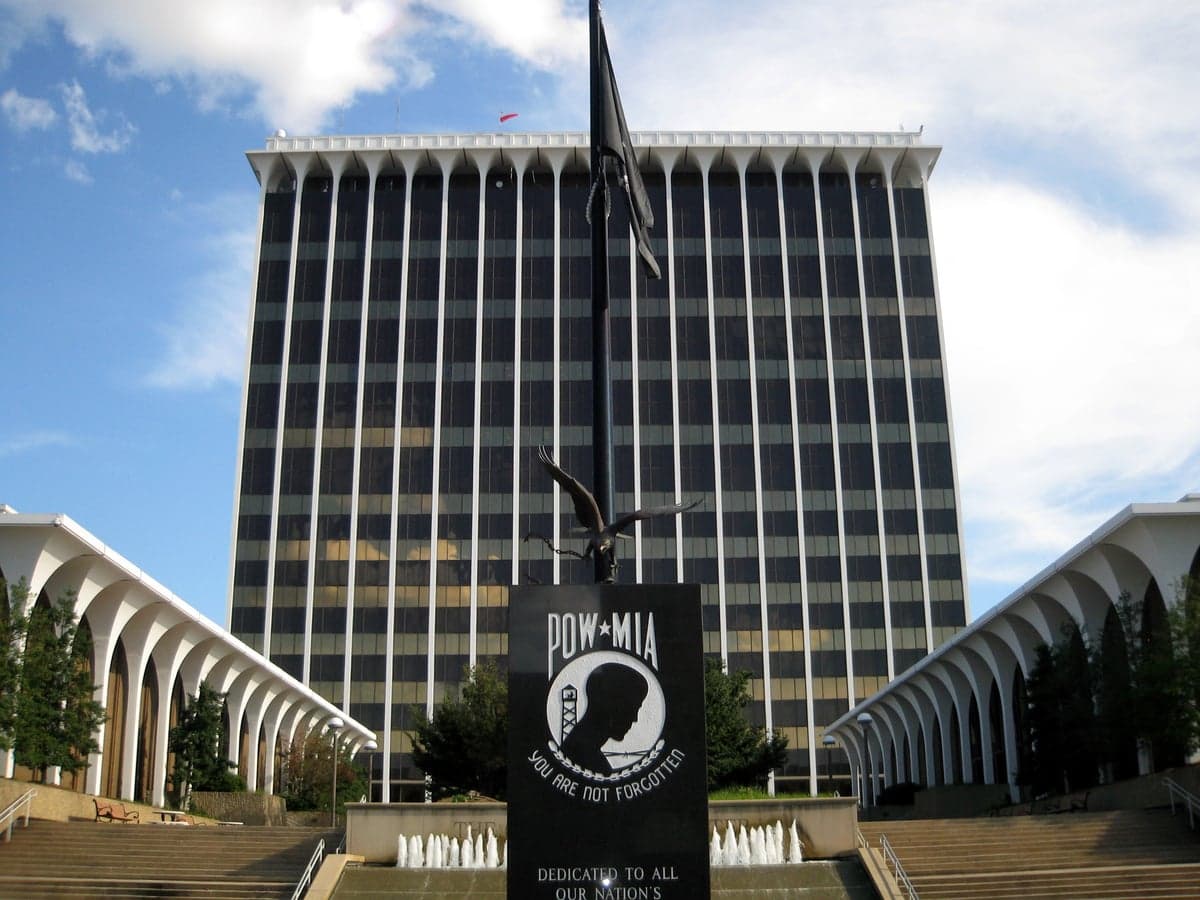
Photo: Wikipedia
Demographics of Muscogee County
Affluence Level in Muscogee County
A below-average socioeconomic profile. Incomes, home values, and educational attainment trail the U.S., with higher poverty and unemployment.
People of Muscogee County
Muscogee County, anchored by Columbus, is a majority-Black county (45.9%) with a significant White minority (37.4%) and a growing Hispanic population (8.3%), creating a demographic profile distinct from much of the rest of Georgia. Its people are shaped by a deep military presence—Fort Moore (formerly Fort Benning) drives a transient, nationally diverse population—and a history of industrial and agricultural labor that has left a legacy of both opportunity and economic struggle. With a foreign-born population of just 2.3%, the county remains less ethnically diverse than the national average, but its internal racial dynamics and steady suburbanization are quietly reshaping its character.
Settlement & growth (pre-1960)
Long before European contact, the area was the heart of the Muscogee (Creek) Confederacy, with the principal town of Cusseta (near present-day Cusseta, GA) serving as a major political and trade center. The Creek people cultivated the fertile floodplains of the Chattahoochee River, and their towns—including Kasihta and Coweta—formed the core of a sophisticated Mississippian-derived society. The first European incursion came via Spanish expeditions in the 16th century, but sustained contact began with British traders from Carolina in the late 1600s, who exchanged guns and goods for deerskins and enslaved Native people.
After the Creek War (1813–1814) and the subsequent Treaty of Fort Jackson, the Creek Nation was forced to cede vast tracts of land. The 1825 Treaty of Indian Springs, widely seen as fraudulent, led to the removal of most remaining Creeks by the 1830s, opening the region to white settlement. The Georgia General Assembly created Muscogee County in 1826, and Columbus was founded in 1828 as a planned river town at the head of navigation on the Chattahoochee. Its location made it a natural hub for the cotton trade, and by the 1840s, Columbus was one of the wealthiest cities in the South, with a booming textile industry powered by enslaved Black labor. The city's mills—such as the Eagle and Phenix—drew a workforce that was overwhelmingly enslaved, and by 1860, Black residents made up nearly half the county's population.
After the Civil War, Reconstruction brought a brief period of political empowerment for freedmen, but the rise of Jim Crow laws and the 1907 disenfranchisement of Black voters reversed those gains. The county's economy diversified slowly: the textile mills remained dominant, but the establishment of Fort Benning in 1918 brought a permanent military presence that would become the county's largest employer. The Great Depression hit the cotton-based economy hard, but the New Deal's rural electrification and the expansion of the fort provided a lifeline. The post-World War II era saw a wave of domestic migration from the rural Deep South, as Black and white families alike moved into Columbus from surrounding counties, seeking work in the mills and the growing military-industrial complex. By 1960, the county's population was roughly 40% Black and 60% white, with a small but established Jewish community centered around Columbus's Midtown.
Modern era (post-1965)
The 1965 Hart-Cellar Act had a muted effect on Muscogee County compared to coastal Georgia or metro Atlanta. The county's foreign-born population remains low at 2.3%, and the immigrant communities that did arrive are small and dispersed. The most notable post-1965 influx has been a modest but steady growth of East/Southeast Asian communities (1.3% of the population), primarily Vietnamese and Filipino families drawn by military connections to Fort Moore. These families tend to cluster near the base in Midland and Fortson, where housing is affordable and military support networks are strong. A smaller Indian-subcontinent population (1.2%) has grown more recently, largely composed of professionals in healthcare and engineering at the region's hospitals and the Columbus State University campus.
The most significant demographic shift since 1965 has been internal: the suburbanization of the county's Black middle class. As white flight accelerated in the 1970s and 1980s, many white families moved to the northern suburbs of Harris County and Lee County, leaving Columbus's urban core increasingly Black. In response, upwardly mobile Black families began moving to newer subdivisions in North Columbus and Green Island Hills, creating a pattern of Black suburbanization that is now the dominant trend. The county's Hispanic population, while still small at 8.3%, has grown rapidly since 2000, driven by construction and service-sector jobs. This community is concentrated in East Columbus and along the Victory Drive corridor, where Mexican and Central American restaurants and bodegas have become a visible part of the landscape.
The 2020 census confirmed that Muscogee County is now a majority-Black county, with the white share falling to 37.4% as older white residents age out and younger families continue to move to outlying counties. The college-educated share stands at 29.7%, below the national average but rising, driven by the presence of Columbus State University and the professional workforce at Fort Moore. The military remains the single largest demographic force: the base's active-duty population and their families are disproportionately young, racially diverse, and transient, creating a constant churn that keeps the county's demographics fluid.
The future
Muscogee County is becoming more diverse, but slowly and unevenly. The Hispanic share is projected to continue rising, potentially reaching 12–15% by 2040, as younger families move in and birth rates among the existing Hispanic population remain above the county average. The East/Southeast Asian and Indian communities are likely to grow modestly, driven by continued military and healthcare recruitment, but they will remain small enclaves rather than forming large ethnic neighborhoods. The Black population share is expected to stabilize or increase slightly, as the county's affordable housing and relatively low cost of living attract Black families from more expensive metro areas like Atlanta.
The most consequential trend is the ongoing suburbanization of the county's population. New subdivisions are spreading into southern Muscogee County near the Alabama line and into northern areas around Upatoi, where land is cheaper and schools are perceived as better. This is creating a more dispersed, car-dependent county, with the urban core of Columbus continuing to lose population to its own suburbs. The county's cultural identity is evolving from a historically Black-and-white Southern city into a more layered, multi-ethnic community, but the pace of change is slow enough that the military base remains the primary engine of diversity.
For someone moving in now, Muscogee County offers a place where the cost of living is low, the military presence provides stability, and the demographic trends point toward gradual diversification rather than rapid transformation. The county is becoming more suburban, more Hispanic, and more educated, but it remains a deeply Southern community where race and class continue to shape where people live and how they interact. The next decade will likely see a continued dispersion of population away from the urban core, a slow rise in immigrant communities, and a steady, if unspectacular, growth in the college-educated workforce.

* Values derived from national, state, county, city and local statistics and may differ in a specific area. Last updated: 2026-08-04T04:25:05.000Z
Narrative content on this page is AI-generated and may contain mistakes. Verify any details that matter before acting on them.
ReloMaps may earn a commission from affiliate links at no extra cost to you.

