
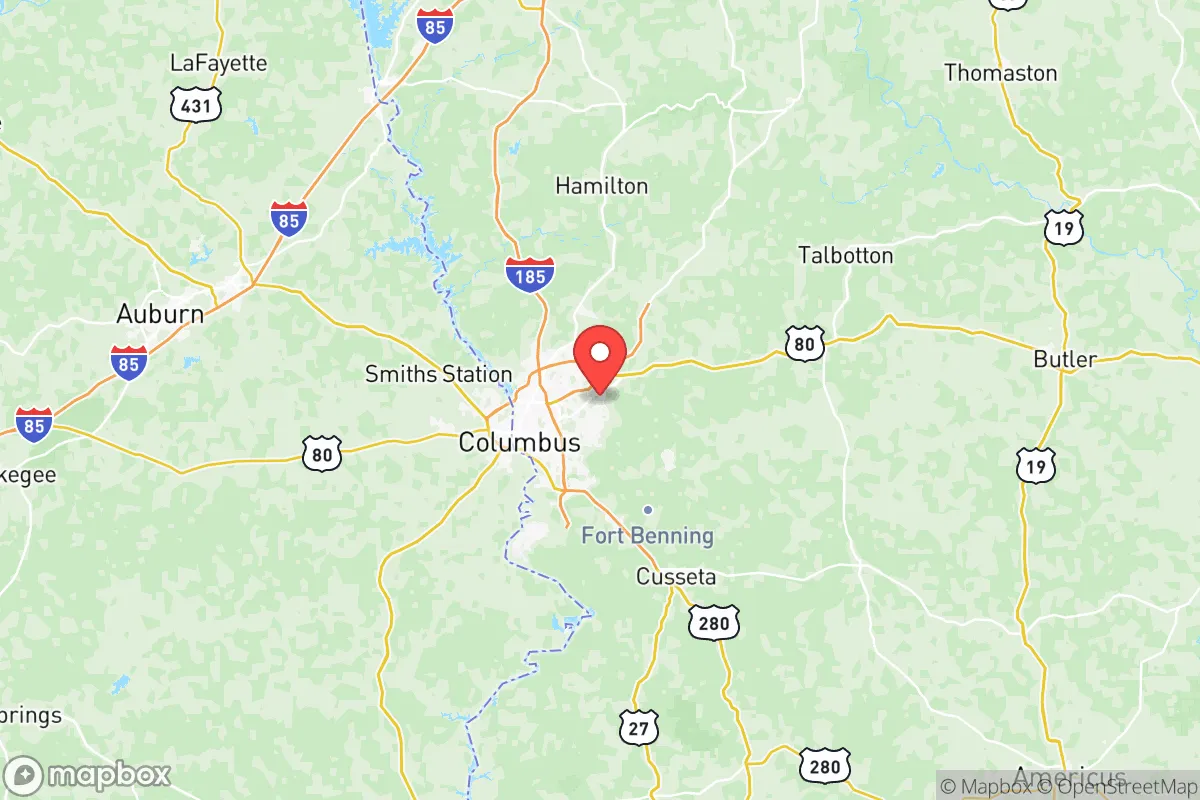
Photo: Wikipedia
Quality of Life in Muscogee County
A livable area that tracks near national norms for affordability, walkability, and neighborhood health.
What does Quality of Life tell us?
Quality of Life measures an area by evaluating factors like cost of living, nearby amenities, country club access, airport proximity, socioeconomic signals and neighborhood character. For large states, this is a general average — quality of life can vary dramatically between metro areas, suburbs, and rural communities within the same state.
What does this tell us?
Quality of Life measures an area by evaluating factors like cost of living, nearby amenities, country club access, airport proximity, socioeconomic signals and neighborhood character. For large states, this is a general average — quality of life can vary dramatically between metro areas, suburbs, and rural communities within the same state.
Cost of Living
19% below national average
109%
The Real Cost of Living in Muscogee County for 2026
| Tier | Individual | Family (4) |
|---|---|---|
| Survival | $17k | $32k |
| Comfortable | $35k | $52k |
| Luxury | $102k+ | $159k+ |
| Elite (Top 5%) | $136k+ | $211k+ |
Quality-of-Life Analysis
Muscogee County, Georgia, anchored by the midsized city of Columbus, offers a quality-of-life spectrum that ranges from dense urban living and historic neighborhoods to quiet unincorporated communities and working farmland, all within a county that is geographically compact yet socially diverse. The county’s overall cost of living index of 81 (well below the national average of 100) and a median home value of $182,300 make it accessible to first-time homebuyers, military families connected to Fort Moore, and retirees seeking a lower-cost alternative to Atlanta, while the average commute of just over 20 minutes means that even residents in the outer parts of the county can reach Columbus’s job centers quickly.
Largest town(s) & population centers
Columbus is the county seat and by far the dominant population center, home to roughly 200,000 of the county’s 200,000-plus residents. Daily life in Columbus is defined by a mix of historic districts like Midtown and North Highland, where restored Craftsman bungalows and Victorian homes sit near the Chattahoochee Riverwalk, and by newer suburban-style developments along Veterans Parkway and Whittlesey Boulevard. The city’s downtown has seen a revival anchored by the Columbus State University campus, the RiverCenter for the Performing Arts, and a growing food scene. For families, the Columbus Consolidated Government provides city-county services, and the Muscogee County School District operates magnet programs like the Columbus High School International Baccalaureate program. The median rent of $1,072 is affordable compared to Georgia’s major metros, and the average commute of 20.2 minutes means most residents can get to work, shopping, or the riverfront in under half an hour.
Smaller towns & rural pockets
Outside Columbus, the county contains several unincorporated communities and census-designated places that offer a distinctly slower pace. Fort Moore (formerly Fort Benning) occupies a large swath of southern Muscogee County and functions as its own small city, with military housing, schools, and retail. Bibb City, a historic mill village annexed into Columbus in 2000, retains a small-town feel with its grid of modest homes and the nearby Chattahoochee River. Upatoi, in the county’s southeastern corner, is a rural crossroads with a post office, a few churches, and large-lot homes on acreage. Midland, straddling the Harris County line, is a lightly populated area of horse farms and newer subdivisions. These areas lack the retail density of Columbus but offer lower property taxes and more land, appealing to those who want a country setting within a 25-minute drive of downtown Columbus.
Cost & lifestyle range
The cost of living varies noticeably across the county. At the lower end, neighborhoods in south Columbus near the Alabama line and older sections of East Columbus have median home values well below the county average of $182,300, with some homes under $100,000. Renters in these areas can find apartments for under $900, though amenities like grocery stores and parks are more limited. At the higher end, the Green Island Hills neighborhood along the river and newer subdivisions in north Columbus near the Harris County line feature homes from $300,000 to over $600,000, with larger lots and access to private golf clubs. The lifestyle range is equally broad: a resident in a downtown loft pays roughly the same rent as someone in a rural rental house near Upatoi, but the former walks to restaurants and the Riverwalk while the latter drives 20 minutes to the nearest supermarket. The county’s compact geography means that even the most rural homes are within a 30-minute drive of Columbus’s two hospitals, the Columbus Airport, and major employers like Aflac, TSYS, and Kia Motors Manufacturing (just across the state line in West Point).
Muscogee County works best for people who want the economic and cultural anchors of a midsized city without the high costs or long commutes of a major metro. Military families, young professionals at Columbus State or the growing tech sector, and retirees seeking a low-tax environment (Georgia’s retirement income exclusion applies) all find a niche here. The county’s diversity of housing stock—from historic bungalows to new subdivisions to rural acreage—means that a household earning $40,000 and one earning $120,000 can both find a comfortable, convenient place to live within the same 20-minute commute radius.

Crime in Muscogee County
Generally safer than 56% of comparable U.S. locations.
Violent CrimeViolent Crime Analysis
Property CrimeProperty Crime Analysis
Crime Analysis
Muscogee County, anchored by the city of Columbus, presents a mixed safety picture. The county’s violent crime rate of 266.1 incidents per 100,000 residents is below the national average but above the state of Georgia’s average, while its property crime rate of 1,252.7 per 100,000 significantly exceeds both state and national benchmarks. This means residents face a notably higher risk of theft, burglary, and vehicle break-ins than in most of Georgia, though the risk of violent victimization is comparatively moderate.
Crime in context
Muscogee County’s violent crime rate of 266.1 per 100,000 is roughly 25% lower than the national average of about 380 per 100,000, but it is approximately 15% higher than the Georgia state average of roughly 230 per 100,000. The property crime rate of 1,252.7 per 100,000 is a more serious concern: it is nearly 40% higher than the national average of about 900 per 100,000 and roughly 50% higher than the Georgia state average of around 830 per 100,000. This disparity is driven largely by property offenses in Columbus, the county seat and largest city, which accounts for the vast majority of the county’s population and crime reports. By comparison, smaller communities within the county—such as Fort Moore (formerly Fort Benning), which has its own military police jurisdiction, and the unincorporated areas near Midland and Upatoi—tend to report lower crime rates, though data for these specific areas is often aggregated into county totals.
What residents experience
For residents, the most tangible safety concern is property crime. Car break-ins, package thefts, and home burglaries are common complaints in Columbus neighborhoods, particularly in areas with higher population density and commercial activity. The Columbus Police Department has reported that a significant portion of property crime is concentrated in the Uptown Columbus district and along the Victory Drive corridor, where bars, restaurants, and retail draw crowds. Violent crime, while less frequent, is not evenly distributed: incidents of aggravated assault and robbery are more common in the south Columbus neighborhoods near the Chattahoochee River and in the East Columbus area around the intersection of Macon Road and Buena Vista Road. The presence of Fort Moore provides a stabilizing effect, as the military base maintains its own law enforcement and a relatively low-crime environment for its residents and personnel.
Neighborhood-level variation
Safety varies dramatically within Muscogee County. The safest areas are generally the suburban and rural fringes, including north Columbus near the Harris County line, the Green Island Hills neighborhood, and the Lakebottom area around Weracoba Park. These areas see far fewer property crimes and virtually no violent incidents. Conversely, the highest crime rates are concentrated in central and south Columbus, particularly in the Baker Village and Carver Heights neighborhoods, where poverty and population density are higher. The Columbus judicial system, overseen by the Chattahoochee Judicial Circuit (which includes Muscogee County), has faced criticism from some residents for what they perceive as lenient sentencing and progressive policies from the district attorney’s office. Critics argue that a focus on rehabilitation over incarceration, while well-intentioned, has contributed to repeat property offenders cycling through the system and back onto the streets, undermining public confidence in safety. For those considering a move, the north Columbus and Fort Moore areas offer the most secure options, while the urban core requires more vigilance.
* Values derived from national, state, county, city and local statistics and may differ in a specific area. Last updated: 2026-08-04T04:25:05.000Z
Narrative content on this page is AI-generated and may contain mistakes. Verify any details that matter before acting on them.
ReloMaps may earn a commission from affiliate links at no extra cost to you.

