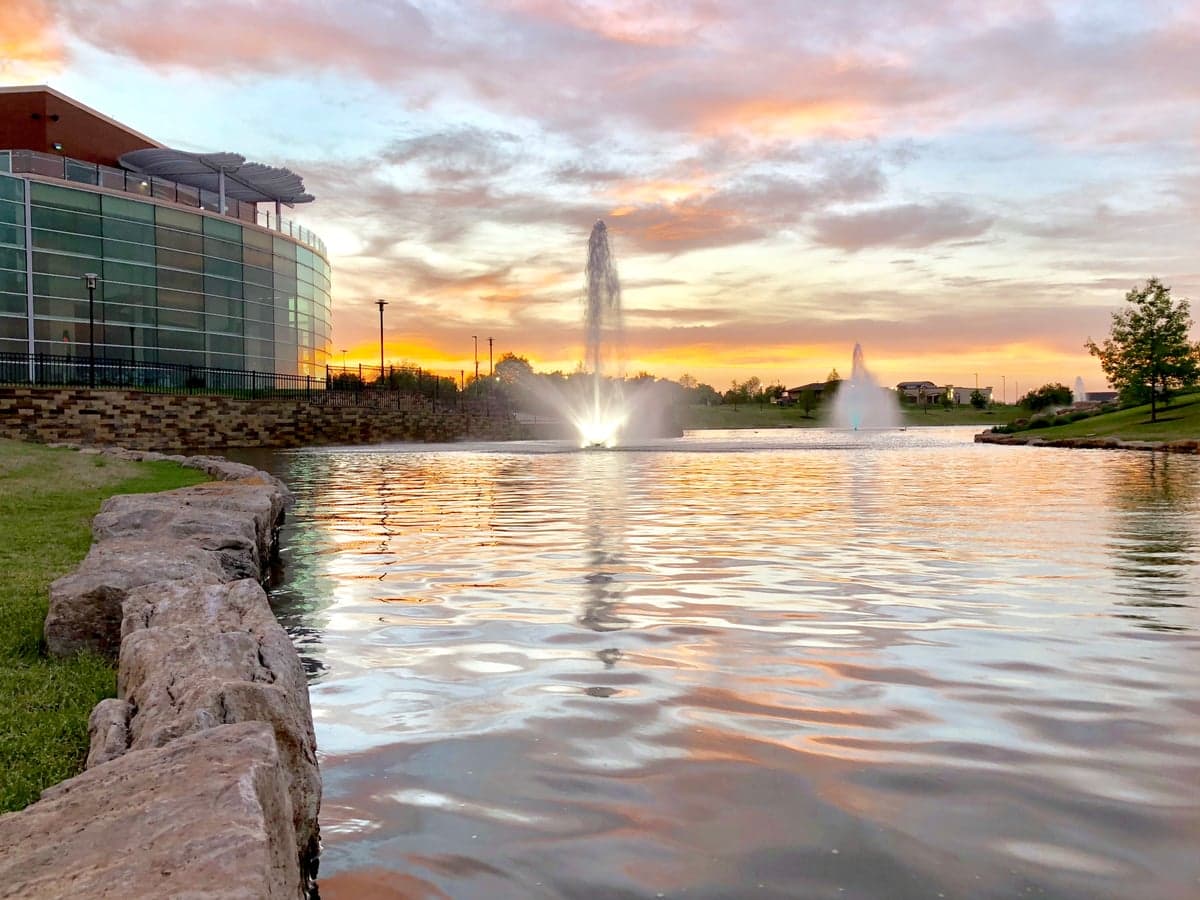
Photo: Wikipedia
Demographics of Glenpool, OK
Affluence Level in Glenpool, OK
A middle-class area roughly in line with national averages across income, home values, education, and employment.
People of Glenpool, OK
The people of Glenpool, Oklahoma today form a predominantly white, working- to middle-class community of 13,885, shaped by its roots as an oil-boom town and its later evolution into a Tulsa-adjacent suburb. The city’s identity is distinctly Oklahoman—practical, family-oriented, and politically conservative—with a population that is 61.5% white, 11.4% Hispanic, 4.1% East/Southeast Asian, and 3.9% Black, while only 3.7% of residents are foreign-born. Glenpool is denser than many surrounding towns, with a tight-knit feel centered around its historic downtown and newer subdivisions, and it remains a place where generational families live alongside recent domestic arrivals seeking affordable housing and good schools.
How the city was settled and grew
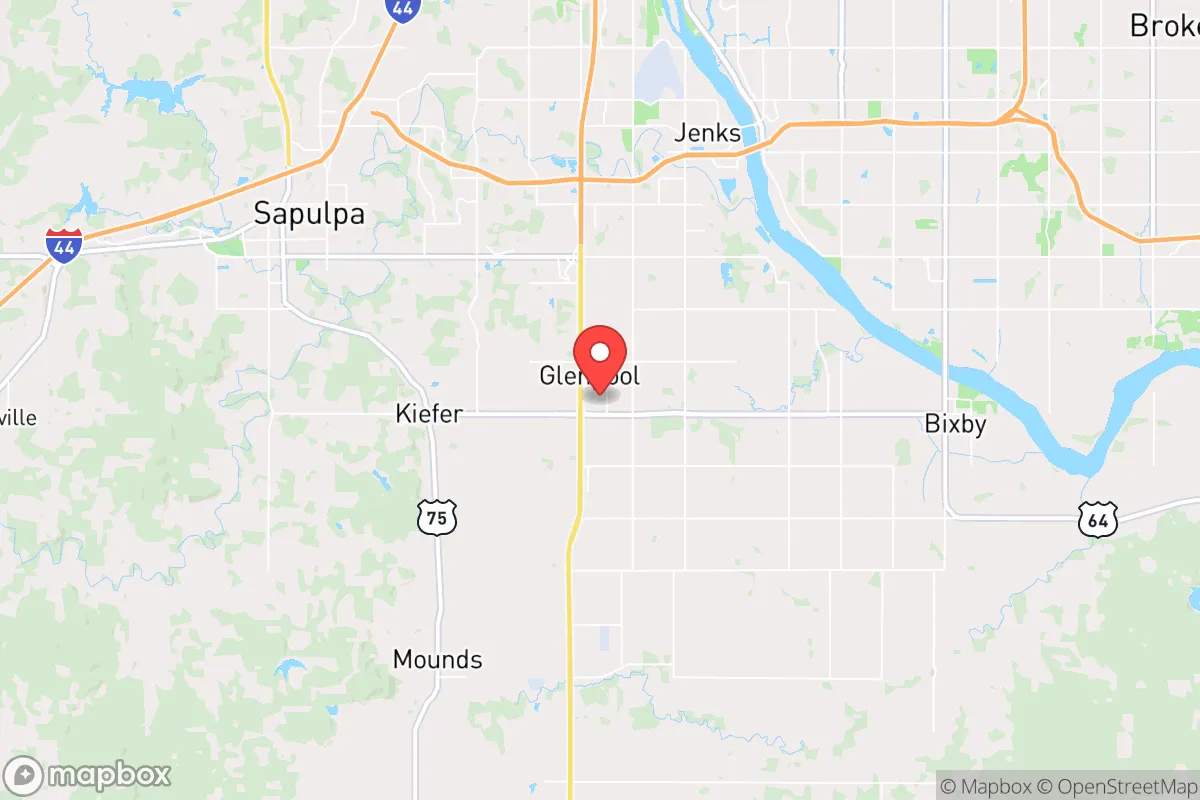
Glenpool’s human history begins not with colonial settlement but with a single transformative event: the 1905 discovery of the Glenn Pool Oil Field, one of the largest oil strikes in U.S. history. The city was incorporated in 1907, and the original population was a mix of white Oklahoma and Texas oil workers, roughnecks, and entrepreneurs who flooded in to work the wells. These early residents built the Old Town Glenpool district—the area around 145th Street and Elm—where modest wood-frame houses and company-built boarding houses still stand. The boom drew few Black or immigrant families at first; Oklahoma’s Jim Crow-era segregation and the oil industry’s hiring practices kept the workforce almost entirely white. By the 1920s, as production peaked, a small Hispanic community began forming in the South Glenpool area, near the rail spur used to haul crude, as Mexican laborers arrived to lay pipeline and maintain equipment. The Depression and subsequent decline of the oil field slowed growth dramatically, and Glenpool remained a small, largely white enclave of fewer than 1,000 residents through the 1950s.
Modern era (post-1965)
The 1965 Hart-Cellar Act had little direct effect on Glenpool—its foreign-born share remains low at 3.7%—but the city’s modern demographic story is one of domestic suburbanization. Beginning in the 1970s, Tulsa’s southward expansion pushed white middle-class families into Glenpool, where land was cheap and new subdivisions were platted. The Briarwood neighborhood, built in the 1980s along 141st Street, became the primary destination for these families, offering three-bedroom ranch homes on quarter-acre lots. In the 1990s and 2000s, a second wave of domestic in-migration brought younger families from other parts of Oklahoma and the Midwest, drawn by Glenpool’s low crime rates and the reputation of Glenpool Public Schools. These newcomers settled in the Stone Creek and Prairie View subdivisions, which feature larger homes and cul-de-sac layouts. The Hispanic population grew from negligible to 11.4% during this period, concentrated in the East Glenpool corridor near Highway 75, where a cluster of Mexican-owned restaurants and small construction businesses emerged. The East/Southeast Asian community, now 4.1%, arrived primarily in the 2010s, with Vietnamese and Filipino families settling in Stone Creek and the newer Lakewood Addition, often working in Tulsa’s healthcare and engineering sectors. The Black population, at 3.9%, is dispersed across the city with no single concentrated neighborhood, reflecting Glenpool’s pattern of gradual, individual moves rather than chain migration.
The future
Glenpool’s population is trending toward slow, steady growth—projected to reach roughly 16,000 by 2035—driven almost entirely by domestic in-migration from within Oklahoma and adjacent states. The city is not homogenizing into a single demographic block; rather, it is tribalizing into distinct enclaves along income and ethnic lines. The older, white working-class families remain anchored in Old Town and Briarwood, while newer, slightly more affluent white families fill Stone Creek and Prairie View. The Hispanic community in East Glenpool is growing but plateauing, as second-generation families assimilate and disperse into other neighborhoods. The East/Southeast Asian population is small and stable, with little new immigration expected given the low foreign-born share. The Indian-subcontinent population is effectively zero, and no significant growth is anticipated. The most notable future shift may be generational: as Baby Boomers age out of Briarwood, younger families—predominantly white but increasingly Hispanic—are buying those homes, slowly diversifying the older core. Glenpool is not becoming a melting pot; it is becoming a patchwork of distinct, stable neighborhoods where each group maintains its own character.
For someone moving in now, Glenpool offers a predictable, family-oriented environment with a conservative social fabric and a population that values stability over change. The city is neither diversifying rapidly nor stagnating; it is absorbing new residents at a moderate pace while preserving the small-town, oil-patch identity that defined its founding. New arrivals will find a place where neighborhoods have clear identities, schools are a priority, and the demographic trends point toward gradual, organic evolution rather than disruption.

* Values derived from national, state, county, city and local statistics and may differ in a specific area. Last updated: 2026-04-21T11:44:59.000Z
Narrative content on this page is AI-generated and may contain mistakes. Verify any details that matter before acting on them.
ReloMaps may earn a commission from affiliate links at no extra cost to you.

