Photo: Wikipedia
Demographics of Glenview, IL
Affluence Level in Glenview, IL
An upper-middle-class area. Household wealth, education levels, and homeownership run ahead of national benchmarks.
People of Glenview, IL
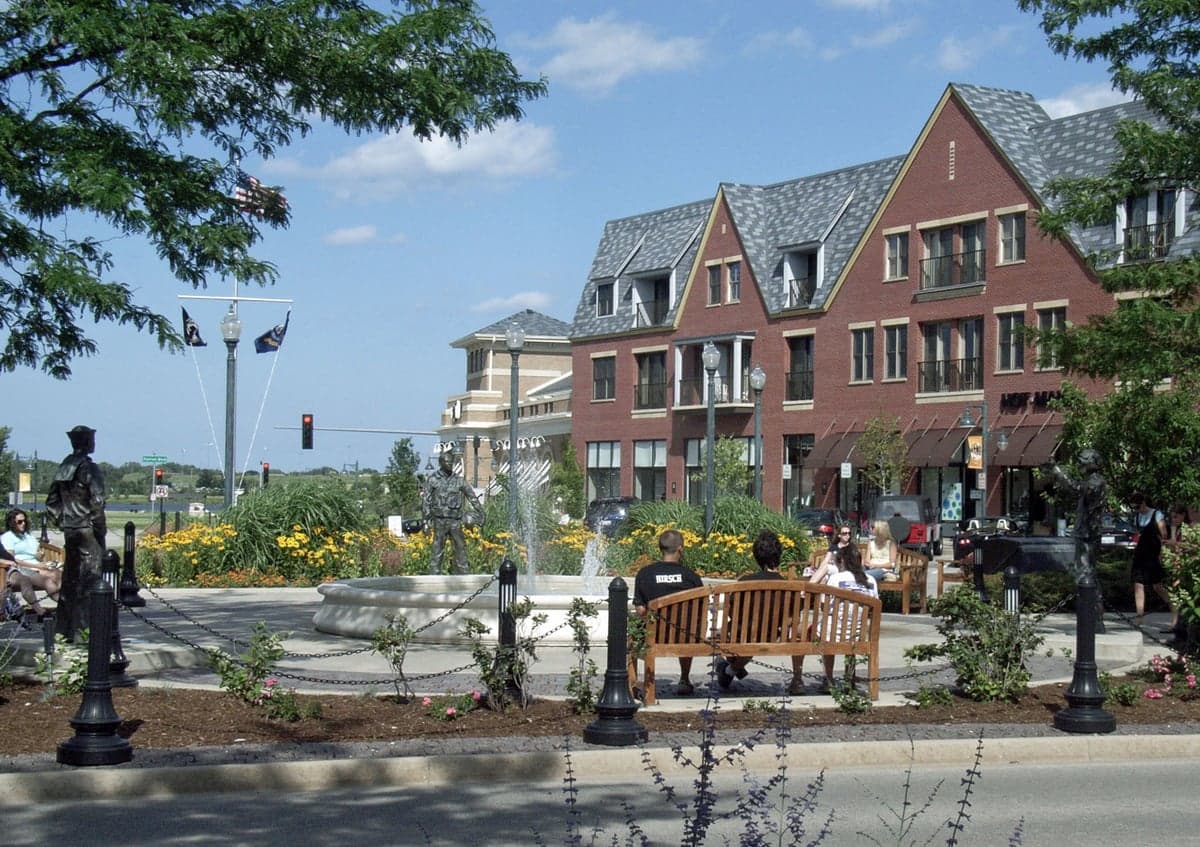
The people of Glenview, Illinois today number 47,682, forming a densely settled, highly educated suburban community where 68.1% of adults hold a college degree. The population is predominantly White (68.8%), with significant East and Southeast Asian communities (11.1%) and a separate Indian-subcontinent population (5.4%), alongside a Hispanic share of 8.9% and a small Black population of 1.2%. Only 5.2% of residents are foreign-born, a figure well below the national average, reflecting a community shaped more by domestic in-migration and long-term stability than by recent international arrivals. Glenview’s identity is that of an established, affluent North Shore suburb where professional families and empty-nesters coexist in a landscape of historic neighborhoods and modern subdivisions.
How the city was settled and grew
Glenview’s population history begins not with colonial settlement but with the arrival of European farmers in the 1830s, drawn by the fertile prairie land of northern Cook County. The area was originally part of the larger Northfield Township, and the first permanent settlers were primarily of Yankee and German stock, establishing farms along the Chicago River’s west fork. The village of Glenview was formally incorporated in 1899, spurred by the arrival of the Chicago, Milwaukee & St. Paul Railway, which turned a rural crossroads into a commuter stop for Chicago’s growing middle class. The Historic District around Glenview Road and Waukegan Road contains the original village core, with late-19th and early-20th-century homes built by these early merchant and professional families. A second wave of growth came in the 1920s and 1930s, when wealthy Chicago families built country estates and summer homes in areas like Glen Oak Acres and Swainwood, drawn by the golf courses and the Glenview Naval Air Station (established 1937). The air base brought a transient military population during World War II, but the real suburban boom began after 1945, when returning veterans and their families filled new subdivisions like Willowbrook and Harlem Heights, transforming Glenview from a village of 3,000 into a full-fledged suburb.
Modern era (post-1965)
The post-1965 period reshaped Glenview’s population through two major forces: the closure of the Naval Air Station in 1995 and the broader suburbanization of Chicago’s professional class. The base’s redevelopment into The Glen—a master-planned community of 2,200 homes, retail, and office space—attracted a new wave of affluent, college-educated residents, many of whom worked in Chicago’s Loop or the nearby corporate corridors of the Tri-State Tollway. This development also coincided with the growth of East and Southeast Asian communities, particularly Chinese and Korean families, who settled in The Glen and the West Side neighborhoods near Waukegan Road. These families were drawn by Glenview’s top-rated public schools, especially Glenbrook South High School, and the area’s proximity to Asian grocery and cultural amenities in neighboring Niles and Morton Grove. The Indian-subcontinent population, while smaller at 5.4%, has concentrated in similar areas, with many professionals in technology and medicine choosing Glenview East near the Metra station for its walkability and transit access. The Hispanic population (8.9%) is more dispersed but has a visible presence in the Southwest Glenview neighborhoods, where older, more affordable housing stock provides entry points for working-class families. The Black population remains very small at 1.2%, a figure that has not changed significantly in decades, reflecting the broader racial segregation patterns of Chicago’s North Shore suburbs.
The future
Glenview’s population is heading toward modest diversification, but the pace is slow. The White share has declined from roughly 80% in 2000 to 68.8% today, while the East/Southeast Asian and Indian populations have grown steadily, driven by professional families seeking school quality and safety. The foreign-born share, however, remains low at 5.2%, suggesting that these communities are largely composed of second-generation or long-settled families rather than new immigrants. The Hispanic population is growing slowly, but Glenview’s high housing costs—median home values exceed $500,000—limit in-migration from lower-income groups. The next 10-20 years will likely see continued gradual diversification, with East and Southeast Asian and Indian populations each approaching 10-15% of the total, while the White share settles around 60-65%. Glenview is not tribalizing into distinct ethnic enclaves; rather, it is homogenizing upward, with all groups sharing similar income and education profiles. For a conservative-leaning individual or family moving in now, Glenview offers a stable, low-crime, high-amenity environment where demographic change is slow and orderly, and where the dominant culture remains that of an affluent, family-oriented suburb with strong civic institutions.
Glenview is becoming a more diverse but still predominantly White, highly educated, and prosperous community where professional-class values and school excellence are the unifying forces. For a new resident, the city offers a predictable, well-managed environment with little of the rapid demographic churn seen in closer-in suburbs, making it a strong choice for those prioritizing stability and long-term property values.

* Values derived from national, state, county, city and local statistics and may differ in a specific area. Last updated: 2026-04-19T19:56:08.000Z
Narrative content on this page is AI-generated and may contain mistakes. Verify any details that matter before acting on them.
ReloMaps may earn a commission from affiliate links at no extra cost to you.

