Demographics of Gotha, FL
Affluence Level in Gotha, FL
A wealthy area with high-earning, well-educated households. Incomes, home values, and educational attainment meaningfully outpace national averages.
People of Gotha, FL
Gotha, Florida, is a small, affluent enclave of roughly 1,179 residents, characterized by its high concentration of college-educated professionals (66.3%) and a notably diverse, yet predominantly White (59.9%) population. The city’s identity is shaped by its historic citrus roots, its modern role as a quiet suburban bedroom community for Orlando’s professionals, and a demographic profile that is both older and more educated than the surrounding Orange County average. With a foreign-born population of just 3.2%, Gotha remains a largely native-born community, though its Hispanic (17.4%), Black (9.5%), East/Southeast Asian (8.6%), and Indian (2.0%) shares reflect a steady, if gradual, diversification since the late 20th century.
How the city was settled and grew
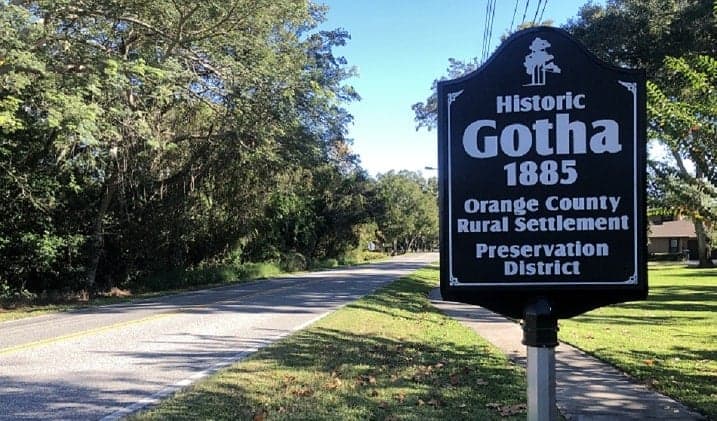
Gotha’s population history begins not with indigenous settlement, but with a deliberate late-19th-century land development scheme. Founded in 1885 by German immigrant John O. Fries, the town was originally part of a larger citrus-growing colony promoted to German and Swiss immigrants. The earliest residents were these European families—farmers and tradesmen—who established the Old Gotha neighborhood around the intersection of what is now Old Winter Garden Road and Gotha Road. They built small frame houses, a school, and a Lutheran church, laying the groundwork for a tight-knit, agrarian community. The citrus industry dominated through the early 1900s, drawing a small number of Black laborers who settled in the Gotha Grove area, a cluster of worker housing near the packing houses. The Great Freeze of 1894-1895 devastated the citrus crop, but the community persisted, shifting to mixed farming and later to residential development as Orlando expanded westward. By 1950, Gotha remained a rural hamlet of fewer than 500 people, almost entirely White and native-born.
Modern era (post-1965)
The post-1965 era brought the first significant demographic shifts. The Immigration and Nationality Act of 1965 opened doors for new arrivals, but Gotha’s remote, semi-rural character meant that most newcomers were domestic migrants—White professionals from the Northeast and Midwest drawn by Orlando’s booming aerospace and tourism industries. The Lake Avalon neighborhood, developed in the 1970s and 1980s around the lake of the same name, became the primary landing spot for these families, featuring larger lots and custom homes. A smaller wave of Hispanic families, primarily of Puerto Rican and Cuban origin, began arriving in the 1990s, settling in the Gotha Park subdivision, a more modest, mid-century development near the town’s eastern edge. The 2000s saw the first notable influx of East/Southeast Asian professionals—many employed in Orlando’s tech and medical sectors—who concentrated in the newer Gotha Estates enclave, a gated community built in the early 2000s. The Indian subcontinent population, though small at 2.0%, is a very recent arrival, mostly post-2010, and has not formed a distinct neighborhood, instead dispersing among the newer subdivisions. The Black population, at 9.5%, is largely composed of long-standing Florida families, with a smaller share of recent arrivals from other states, and remains concentrated in the historic Gotha Grove area and adjacent unincorporated pockets.
The future
Gotha’s population trajectory points toward slow, steady diversification, but not rapid change. The city is landlocked and largely built out, with little room for large-scale new development. The White share (59.9%) is likely to continue a gradual decline as older residents age in place and younger, more diverse families move into the limited resale market. The Hispanic and East/Southeast Asian shares are expected to grow modestly, driven by Orlando’s broader demographic trends, but will likely remain below county averages. The Indian subcontinent population, while small, may double in share over the next decade as tech and medical professionals seek quiet, high-performing school districts. The city is not tribalizing into distinct ethnic enclaves; rather, it is homogenizing into a single, affluent, multi-ethnic professional class. The key dividing line in Gotha is not race or ethnicity, but housing cost—the older, smaller homes in Old Gotha and Gotha Park are increasingly unaffordable to middle-income families, while the newer estates remain the domain of upper-income buyers.
For a conservative-leaning individual or family considering relocation, Gotha offers a stable, low-crime, highly educated community with a strong sense of local identity and minimal turnover. The population is becoming more diverse, but the cultural and political character remains center-right, shaped by property owners, professionals, and families who prioritize privacy, schools, and low taxes. This is not a place of rapid demographic churn or cultural conflict—it is a quiet, established suburb where the biggest change is the slow replacement of aging citrus groves with new custom homes. If you value a small-town feel with access to Orlando’s economy and a population that is educated, civically engaged, and largely like-minded, Gotha is a strong fit.

* Values derived from national, state, county, city and local statistics and may differ in a specific area. Last updated: 2026-05-14T02:16:36.000Z
Narrative content on this page is AI-generated and may contain mistakes. Verify any details that matter before acting on them.
ReloMaps may earn a commission from affiliate links at no extra cost to you.

