Strategic Assessment of Gotha, FL
Meaningful friction. Expect exposure to either population pressure, blast zones, or natural disaster risk. Consider buying a retreat property.
What does the Strategic Assessment tell us?
Our Strategic Assessment grades tactical survivability of an area. Major population centers, military targets, fallout zones, natural disasters, and border exposure all drive risk — lower exposure means a more defensible position in a crisis.
This is heavily inspired by Joel Skousen's Strategic Relocation book. Highly recommended you checkout the book ($)What does this tell us?
Our Strategic Assessment grades tactical survivability of an area. Major population centers, military targets, fallout zones, natural disasters, and border exposure all drive risk — lower exposure means a more defensible position in a crisis.
This is heavily inspired by Joel Skousen's Strategic Relocation book. Highly recommended you checkout the book ($)Strategic Pillars

Key Distances
Regional Safe Places
Below is our recommended "safe zones" in Florida and the surrounding area based on our strategic heuristics. For most people, it's unrealistic to live in a “safe zone” full-time due to work, family or other personal reasons. They tend to be more rural. However, many of these areas are perfect for second homes and retreat properties that double as a vacation home or even a short-term rental.

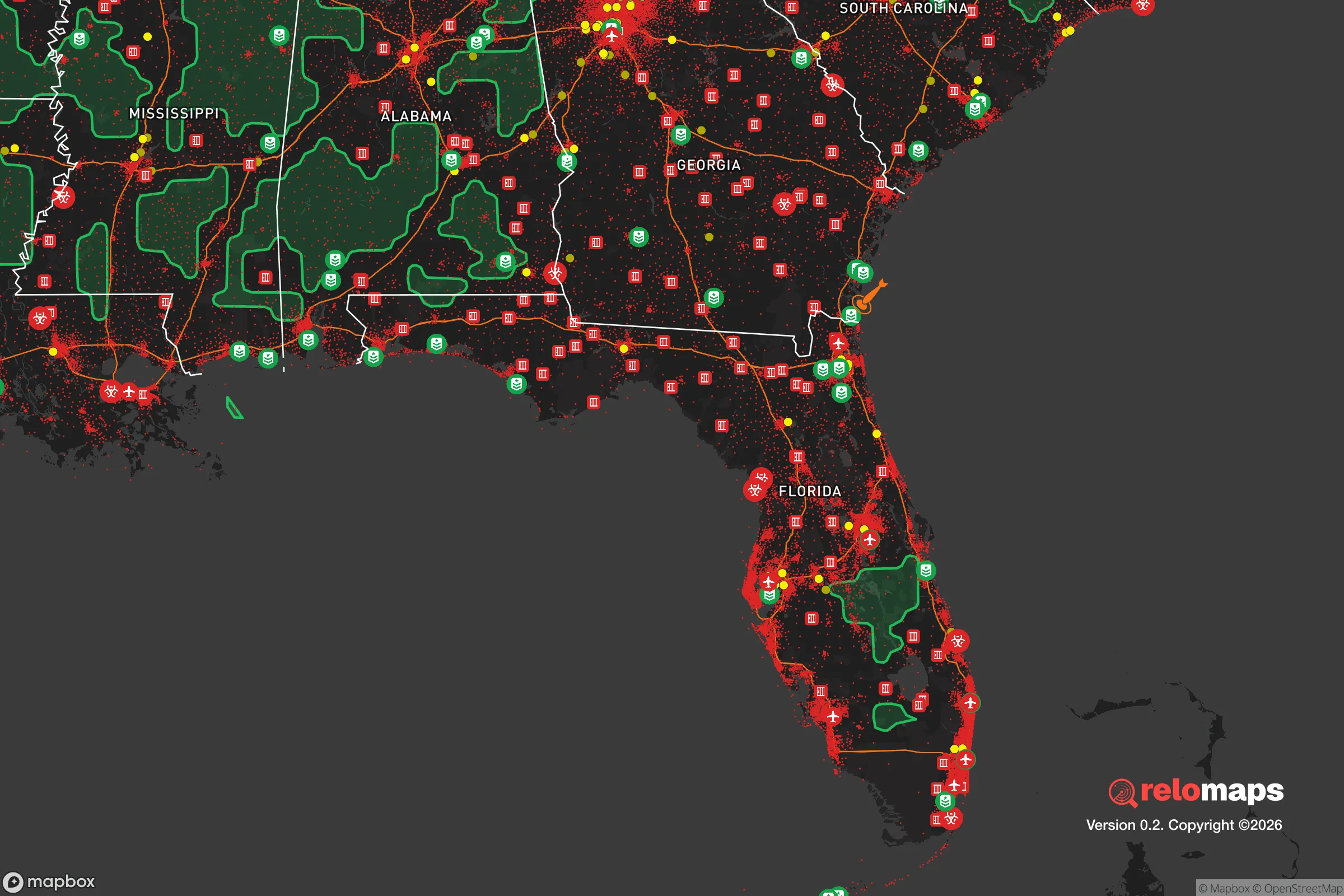


Important Note: For informational purposes only. This does not mean nothing bad ever happens in the green zones. Please use common sense. This is based on public data and modeled with AI. We tried to take a conservative approach but mistakes happen. We update this regularly as new information becomes available.
Solar Generator Recommendations
Backup power matters more here than in safer locations. We've picked three solar generators across budgets and capacity tiers — start with the budget unit if you only need a few essentials, or step up if you want to run a fridge and HVAC for days at a time.

Jackery Portable Power Station Explorer 300
Budget OptionPower on the Go: Weighing only 11 lbs, it's convenient to set up and store with book-sized foldable solar panels

BLUETTI Portable Power Station AC180
Designed for both indoor and outdoor scenarios, AC180 is highly capable as it has a robost capacity and continuous output power.

EF ECOFLOW DELTA Pro Ultra Power Station
Upgraded PickEcoFlow DELTA Pro Ultra is a whole-home energy system designed to grow with your family. Integrated with the Smart Home Panel 2, it scales to meet your evolving energy needs — keeping your home powered, intelligent, and secure through every stage of life.
We earn a commission, at no additional cost to you.
Strategic Assessment Analysis
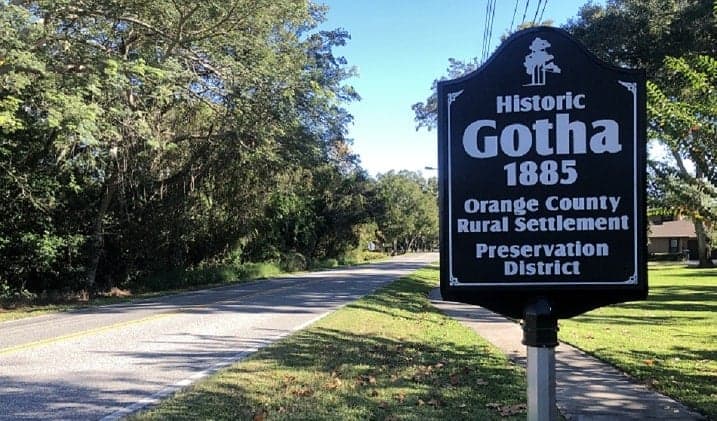
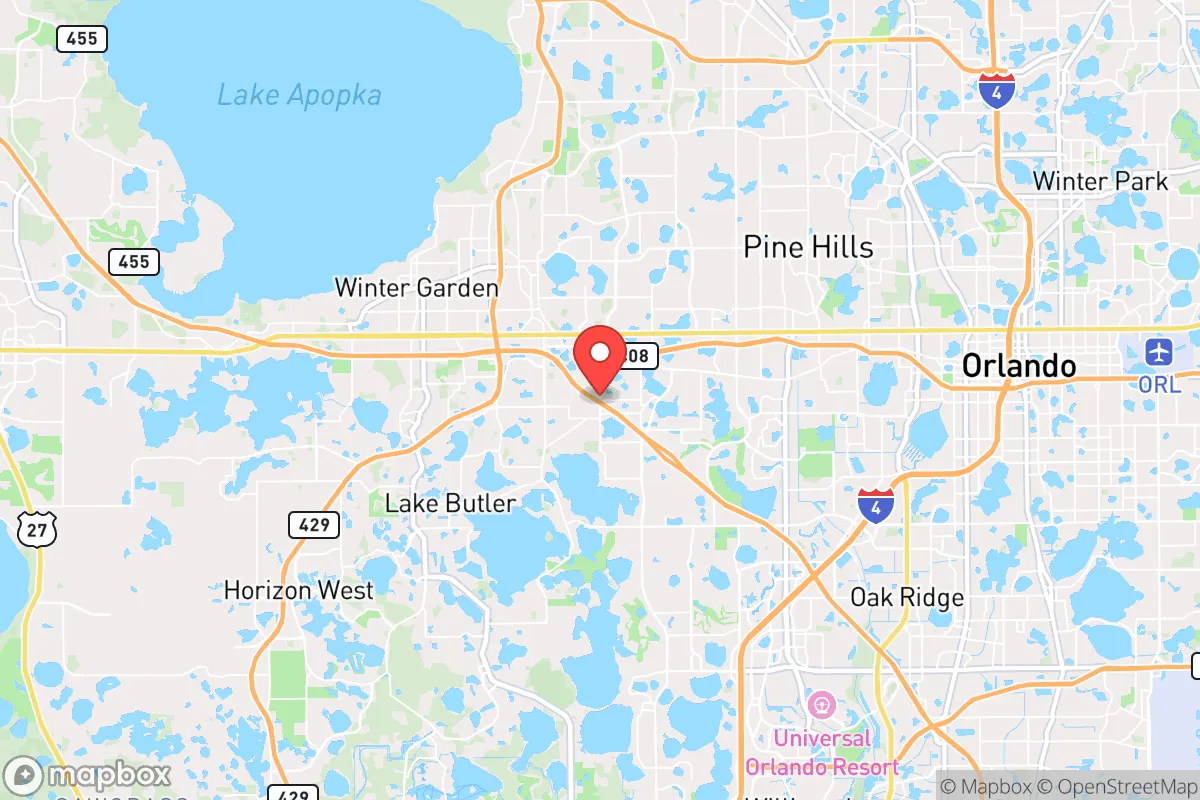
Gotha, Florida, presents a nuanced strategic picture for the conservative prepper: it offers genuine natural resilience and a low-key lifestyle, but its proximity to Orlando’s population center and critical infrastructure introduces significant risks that must be weighed. Located in west Orange County, roughly 15 miles from downtown Orlando, Gotha sits on a high ridge of ancient sand dunes—one of the highest natural elevations in Central Florida—which provides a meaningful advantage against flooding and storm surge. For the relocator focused on long-term stability, Gotha’s combination of semi-rural character, mature oak canopy, and relative isolation from the densest urban corridors makes it a defensible base, provided you understand the exposures that come with being within the blast radius of a major metropolitan area.
Geographic position and natural advantages for long-term stability
Gotha’s elevation—averaging 120 to 140 feet above sea level—places it well above the flood zones that plague much of Central Florida. This is not a coastal community; it sits on the Lake Wales Ridge, a sandy spine that drains quickly and rarely sees standing water even after heavy rains. For the prepper, this means your property is far less likely to be compromised by hurricane flooding, storm surge, or the slow-motion disaster of rising groundwater. The area’s dense live oak and pine canopy also provides natural camouflage and shade, reducing heat stress in a grid-down scenario and making aerial observation more difficult. The local water table is high enough that shallow wells are feasible on larger lots, and the sandy soil percolates well for septic systems—critical for off-grid sustainability. Gotha’s position also places it within a 30-minute drive of the Green Swamp, a massive 560,000-acre watershed that serves as a natural buffer zone and potential retreat area, while still offering access to the agricultural bounty of central Florida’s citrus and cattle country.
Risks, exposures, and proximity to fallout-relevant landmarks
The primary strategic liability of Gotha is its proximity to Orlando—a major population center, transportation hub, and target for civil unrest or infrastructure collapse. Orlando International Airport (MCO) is a major military and civilian airlift hub, and the nearby McCoy Air Force Base (now part of the airport) has historically been a staging area for strategic operations. In a national emergency, this makes the entire I-4 corridor a high-risk zone for evacuation bottlenecks, martial law checkpoints, or secondary effects from a strike on critical infrastructure. Additionally, the Orlando metropolitan area contains multiple theme parks, convention centers, and large-scale event venues that could become focal points for mass casualty events, disease outbreaks, or civil disorder. The proximity to the Cape Canaveral Space Force Station and Kennedy Space Center—roughly 50 miles east—introduces a low-probability but high-consequence risk of industrial accidents or targeted disruption. Gotha itself is not a primary target, but it lies within the “frag zone” of Orlando’s collapse: you will see the effects of any major event within hours, whether that’s refugees streaming west on State Road 408 or the grid going dark from a cyberattack on Duke Energy’s regional substations. The area’s reliance on a single major highway (SR 408/Toll Road) for east-west movement is a choke point that could become impassable in a crisis.
Practical resilience for a relocator: food, water, energy, and defensibility
For the relocator serious about self-sufficiency, Gotha offers a mixed bag. Water is the strongest suit: the Floridan Aquifer lies about 200 feet below the surface, and many older homes in the area already have private wells. With a hand pump or solar-powered pump, you can secure a reliable water source independent of municipal systems. Rainwater collection is also viable, with annual rainfall averaging 50 inches. Food resilience is moderate—the area has several small farms and u-pick operations within a 15-minute drive, and the sandy soil can support raised-bed vegetable gardens, citrus trees, and even small livestock on parcels of one acre or more. However, the soil is nutrient-poor and requires amendment; this is not prime farmland without work. Energy resilience is a challenge: Duke Energy’s grid is reliable in normal times but vulnerable to hurricane damage and cascading failures. Solar is a strong option given Florida’s sun, but homeowners’ associations (HOAs) in some Gotha subdivisions restrict panel placement, and battery storage is essential due to frequent summer thunderstorms. Defensibility is Gotha’s hidden strength: the area’s winding, tree-lined roads, low traffic density, and large lot sizes (many properties are 1–5 acres) create natural standoff. The community is tight-knit and older, with a strong “neighbor-watching” culture that can be leveraged for mutual aid. That said, the lack of a centralized defensive position—no natural chokepoints or high ground—means you’ll need to harden your own perimeter rather than rely on terrain.
The overall strategic picture for Gotha is one of calculated trade-offs. It offers genuine natural advantages—elevation, water access, tree cover, and a semi-rural buffer—that make it a viable base for a prepared individual or family. But the proximity to Orlando’s population density, critical infrastructure, and evacuation corridors means you cannot ignore the risks of civil unrest, mass casualty events, or infrastructure collapse. For the conservative prepper who values a low-profile lifestyle and is willing to invest in off-grid systems (well, solar, septic, food storage), Gotha can work as a long-term redoubt—provided you have a secondary retreat plan for the worst-case scenarios. It is not a bug-out location; it is a live-in-place community that rewards preparation and penalizes complacency. If you’re looking for a place to ride out the coming storms with a reasonable chance of maintaining autonomy, Gotha deserves a spot on your short list—but only if you go in with eyes wide open about what lies 15 miles down the road.

* Values derived from national, state, county, city and local statistics and may differ in a specific area. Last updated: 2026-05-14T02:16:36.000Z
Narrative content on this page is AI-generated and may contain mistakes. Verify any details that matter before acting on them.
ReloMaps may earn a commission from affiliate links at no extra cost to you.

