
Photo: Wikipedia
Demographics of Granbury, TX
Affluence Level in Granbury, TX
A middle-class area roughly in line with national averages across income, home values, education, and employment.
People of Granbury, TX
The people of Granbury, Texas today number 11,665, forming a predominantly White (84.5%) and politically conservative community with a notably small foreign-born population of just 0.8%. The city’s identity is rooted in its role as a historic county seat and a growing retirement and tourism destination, with a median age that skews older than the national average and a population that is 9.4% Hispanic, 1.3% Black, 0.9% East/Southeast Asian, and 0.1% Indian (subcontinent). Granbury’s residents are characterized by a strong sense of local heritage, a reliance on nearby Fort Worth for employment, and a demographic profile that is slowly diversifying from its historically Anglo-Saxon foundation.
How the city was settled and grew
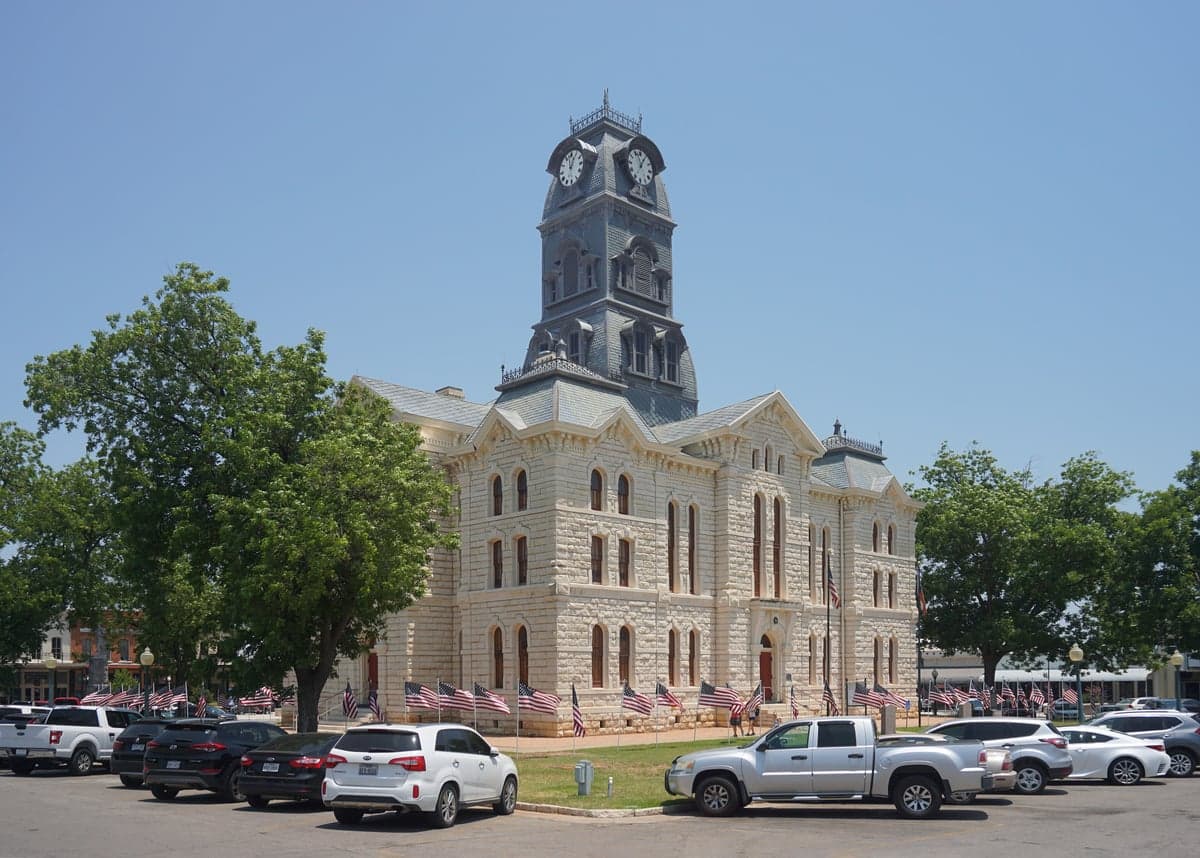
Granbury’s human history begins with its founding in 1854 as a trading post on the Brazos River, named after Confederate General Hiram B. Granbury. The original settlers were primarily Anglo-American farmers and ranchers from the Upper South—Tennessee, Kentucky, and Missouri—drawn by the promise of fertile bottomland and the establishment of Hood County in 1866. The town’s early growth was slow, with the population reaching only about 1,500 by 1900. The historic Granbury Square district, centered on the 1886 courthouse, became the commercial and social hub for these early families, many of whom built the Victorian homes that still line West Bridge Street and East Pearl Street. A second wave arrived in the 1910s and 1920s, driven by the expansion of the cotton and cattle industries, with new residents settling in the Acton area (now a historic community within city limits) and the DeCordova Bend region along the Brazos. These early decades saw almost no non-White settlement; the 1930 census recorded Granbury as 99.5% White, with a tiny Black population of fewer than 20 individuals, mostly domestic workers living in scattered rural cabins.
Modern era (post-1965)
The modern demographic transformation of Granbury began after 1965, driven not by international immigration but by domestic in-migration from the Dallas-Fort Worth metroplex. The construction of Lake Granbury in 1969—a reservoir created by the DeCordova Bend Dam—sparked a suburban and retirement boom. New subdivisions like Pecan Plantation (a gated golf-course community) and Lake Ridge attracted affluent White retirees and second-home buyers from the DFW area, while the Granbury Country Club area drew upper-middle-class families seeking a slower pace. The Hispanic population grew from negligible levels in 1970 to 9.4% by 2024, largely through the arrival of Mexican-American families working in construction, hospitality, and service industries tied to tourism and lake recreation. These families concentrated in the Westside neighborhood (west of the courthouse square) and along U.S. Highway 377 south of town. The Black population remained small (1.3%), with most families living in the Eastside area near the historic Black school site on Crockett Street. The East/Southeast Asian community (0.9%) and Indian community (0.1%) are very recent arrivals, mostly professionals drawn by healthcare jobs at Lake Granbury Medical Center or by remote work, and they are dispersed across newer subdivisions like Harbor Lakes rather than forming ethnic enclaves.
The future
Granbury’s population is projected to continue growing slowly—perhaps reaching 13,000–14,000 by 2040—driven by continued domestic migration from the DFW metroplex and by the aging of existing residents. The city is becoming slightly more diverse, with the Hispanic share expected to rise to 12–14% over the next two decades, while the White share will likely decline to around 80%. New housing developments are concentrated in the DeCordova Bend Estates area and along FM 167 east of the lake, attracting younger families and some remote workers. The foreign-born population will remain very low (likely under 2%), as Granbury lacks the industrial or agricultural jobs that draw international immigrants to other Texas towns. Culturally, the city is evolving from a purely Anglo-retirement haven into a more intergenerational community, though its conservative political character and strong local identity are unlikely to shift significantly. The next 10–20 years will see Granbury become a slightly more diverse, slightly younger version of itself, but it will remain overwhelmingly White and native-born.
For someone moving in now, Granbury offers a stable, family-oriented community with a deep sense of place, low crime, and good schools—but little ethnic or cultural diversity. The city is becoming more welcoming to newcomers, especially those from the DFW area, but its social fabric remains rooted in the Anglo-Texan traditions of its 19th-century founders. It is a place where the past is preserved, the present is comfortable, and the future is one of gradual, modest change rather than rapid transformation.

* Values derived from national, state, county, city and local statistics and may differ in a specific area. Last updated: 2026-10-07T18:19:38.000Z
Narrative content on this page is AI-generated and may contain mistakes. Verify any details that matter before acting on them.
ReloMaps may earn a commission from affiliate links at no extra cost to you.

