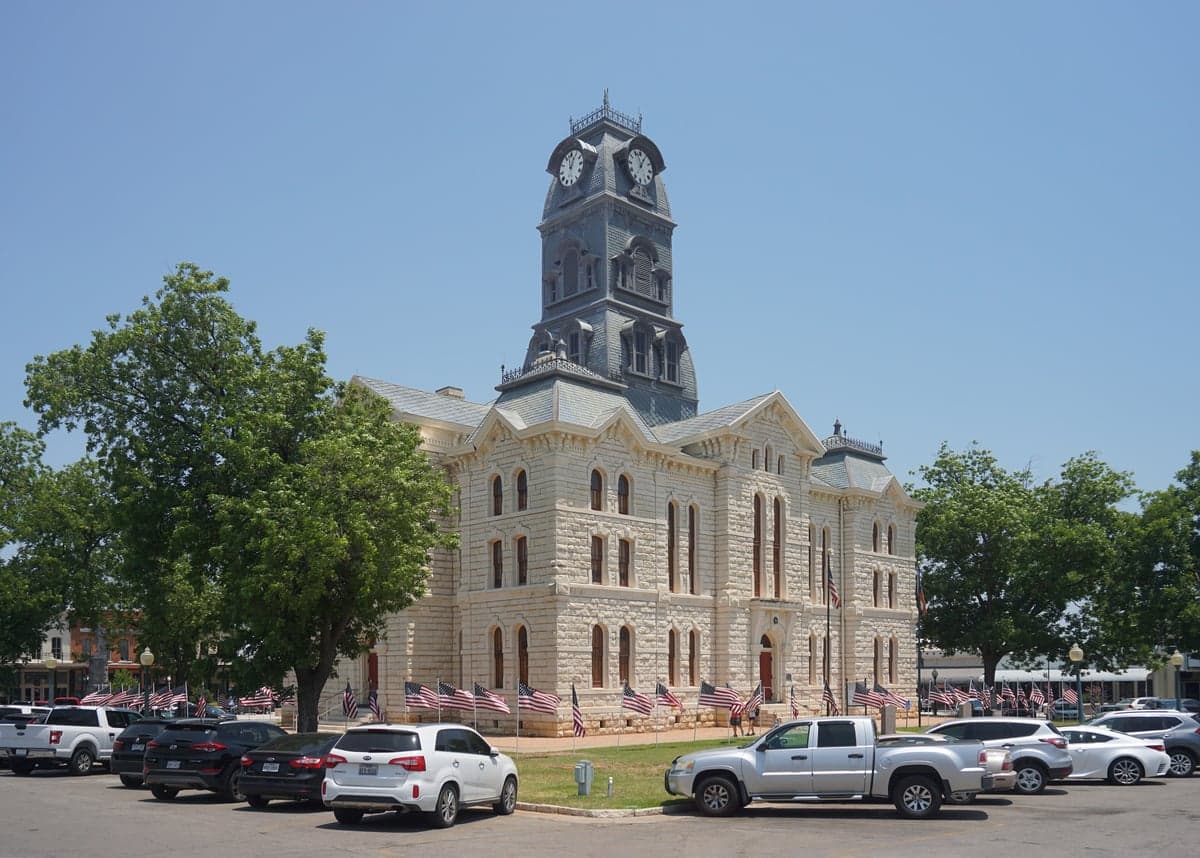
Photo: Wikipedia
Personal Sovereignty in Granbury, TX
Strong independent fundamentals that actively favor personal liberty and low regulation.
What does Personal Sovereignty tell us?
Personal Sovereignty measures your capacity for self-reliance and independence with minimal government friction. Higher scores mean fewer barriers between you and the way you want to live... but it assumes you have the space you need and good neighbors.
What does this tell us?
Personal Sovereignty measures your capacity for self-reliance and independence with minimal government friction. Higher scores mean fewer barriers between you and the way you want to live... but it assumes you have the space you need and good neighbors.
State Policy
Energy independence: Net exporter (220% of energy produced in-state)
Personal Liberty
Homesteading

Personal Liberty Analysis
Granbury, Texas, offers a personal sovereignty environment that is among the most robust in the state, driven by Texas’s broad preemption laws, low tax burden, and a deeply ingrained culture of self-reliance. For individuals and families prioritizing autonomy, the area provides a legal and regulatory framework that minimizes government intrusion in daily life, from property use to self-defense, while maintaining the practical infrastructure of a growing exurban community. This analysis examines the specific pillars of personal sovereignty in Granbury, grounded in state and local policies that shape the lived experience of independence.
Tax burden and regulatory posture: How Granbury compares to surrounding counties
Granbury’s tax and regulatory environment is notably light-touch, reflecting Texas’s absence of a state income tax and its strong property tax protections. The effective property tax rate in Hood County, where Granbury sits, typically ranges from 2.0% to 2.5% of assessed value, which is competitive with neighboring counties like Somervell (2.1%) and Johnson (2.3%), but slightly higher than Palo Pinto (1.8%). However, the Texas Property Tax Code’s 10% annual cap on appraisal increases for homesteads provides a critical shield against rapid tax escalation, a key advantage for long-term residents. Sales tax in Granbury is 8.25% (state 6.25% + local 2.0%), standard for the region. Regulatory posture is minimal: there is no county-wide zoning in unincorporated Hood County, though the city of Granbury enforces a modest zoning code focused on land use compatibility, not lifestyle restrictions. Building permits are required for new construction but are processed efficiently, typically within 2-4 weeks. The state’s strong preemption laws prevent local governments from enacting ordinances that exceed state law on matters like firearms, short-term rentals, and occupational licensing, meaning Granbury cannot impose its own stricter rules on these fronts. This creates a predictable, low-friction environment for entrepreneurs, homeowners, and those seeking to minimize regulatory overhead.
Self-defense and gun law specifics: What Texas’s permitless carry means for Granbury residents
Granbury residents operate under Texas’s permitless carry law (effective September 2021), which allows any law-abiding adult 21 or older to carry a handgun in public without a license, both openly and concealed. This is a foundational element of personal sovereignty in the area. The city itself has no local firearm ordinances beyond state law, meaning no restrictions on magazine capacity, firearm types, or storage requirements. For those who prefer a license for reciprocity purposes, the Texas License to Carry (LTC) is available through a 4-6 hour course and background check, with processing times of 30-60 days. Granbury is home to several gun ranges, including Granbury Gun Club and Rough Creek Lodge Shooting Range (a 15-minute drive), which offer training and competition facilities. Self-defense law in Texas is governed by the Castle Doctrine and Stand Your Ground statutes, which impose no duty to retreat in any place where the individual is lawfully present. This legal framework is consistently applied by Hood County courts, which lean conservative. For home defense, there are no state-level safe storage mandates, though federal law prohibits firearm possession by certain prohibited persons. The practical effect for Granbury residents is a high degree of legal certainty regarding self-defense, with minimal bureaucratic hurdles to exercising that right.
Self-reliance and homesteading viability: Lot sizes, zoning, and off-grid feasibility
Granbury’s exurban character makes it a strong candidate for self-reliance and homesteading, though with important caveats. In unincorporated Hood County, minimum lot sizes for residential development are typically 1 to 5 acres, depending on the subdivision and water availability. Many properties in the Granbury area, especially west of the city limits toward Lake Granbury, offer 2-10 acre parcels suitable for gardens, small livestock, and solar installations. The city of Granbury itself has a minimum lot size of 6,000 square feet in most residential zones, which limits serious homesteading within city limits. Off-grid feasibility is moderate: Texas law does not require grid connection for new homes, but Hood County requires a septic system permit and compliance with the Texas Commission on Environmental Quality (TCEQ) for water wells. Rainwater harvesting is legal and encouraged, with no state-level restrictions on collection volume. Solar panels are permitted without special zoning, though homeowners associations (HOAs) in some subdivisions may restrict their visibility. The county does not enforce building codes in unincorporated areas, though lenders often require them for financing. For those seeking true self-sufficiency, properties in the Acton or Lipan areas (10-20 minutes from Granbury) offer larger tracts (10-40 acres) with fewer restrictions. The primary limitation is water access: the region is in a semi-arid climate, and well drilling costs range from $10,000 to $25,000 depending on depth. Overall, Granbury provides a viable path to homesteading for those willing to navigate the practical realities of rural Texas living.
Personal liberties: Parental rights, medical autonomy, speech, and property
Granbury’s personal liberties landscape is shaped by Texas’s strong protections for parental rights, medical autonomy, and free speech. Parental rights are codified in the Texas Parental Bill of Rights (SB 1882, 2023), which affirms parents’ authority over their children’s education, healthcare, and moral upbringing. This is actively reflected in Granbury’s school district, which has a conservative school board and does not enforce mask mandates or vaccine requirements for students. Medical autonomy is robust: Texas has no state-level vaccine passport requirement, and the Texas Medical Freedom Act (SB 968, 2021) prohibits employers from mandating COVID-19 vaccines for employees. Granbury residents have access to a range of healthcare providers, including Lake Granbury Medical Center, a 73-bed hospital, and numerous independent practitioners. Free speech is protected under the Texas Religious Freedom Restoration Act (RFRA), which applies to both religious and secular expression. Property rights are a cornerstone of Texas law, with the Texas Property Code providing strong protections against eminent domain abuse. Granbury’s city council has not pursued any controversial property use restrictions, and the county’s lack of zoning in unincorporated areas means landowners have broad discretion over their property’s use, subject only to state environmental and health regulations. The only notable limitation is the Texas Open Beaches Act, which does not apply inland, and the state’s water rights doctrine, which limits groundwater extraction in certain aquifers. For most residents, these liberties create a high degree of personal autonomy in daily life.
Overall, Granbury ranks among the top-tier Texas communities for personal sovereignty, comparable to other exurban counties like Burnet or Gillespie, but with better access to amenities and a slightly lower cost of entry. The combination of permitless carry, low taxes, minimal zoning, strong parental rights, and a culture of self-reliance creates an environment where individuals and families can exercise significant control over their lives without excessive government interference. The primary trade-offs are the need to manage water access for homesteading and the higher property taxes relative to more rural counties. For the freedom-oriented relocator, Granbury offers a balanced, legally grounded autonomy that is both practical and principled.

* Values derived from national, state, county, city and local statistics and may differ in a specific area. Last updated: 2026-10-07T18:19:38.000Z
Narrative content on this page is AI-generated and may contain mistakes. Verify any details that matter before acting on them.
ReloMaps may earn a commission from affiliate links at no extra cost to you.

