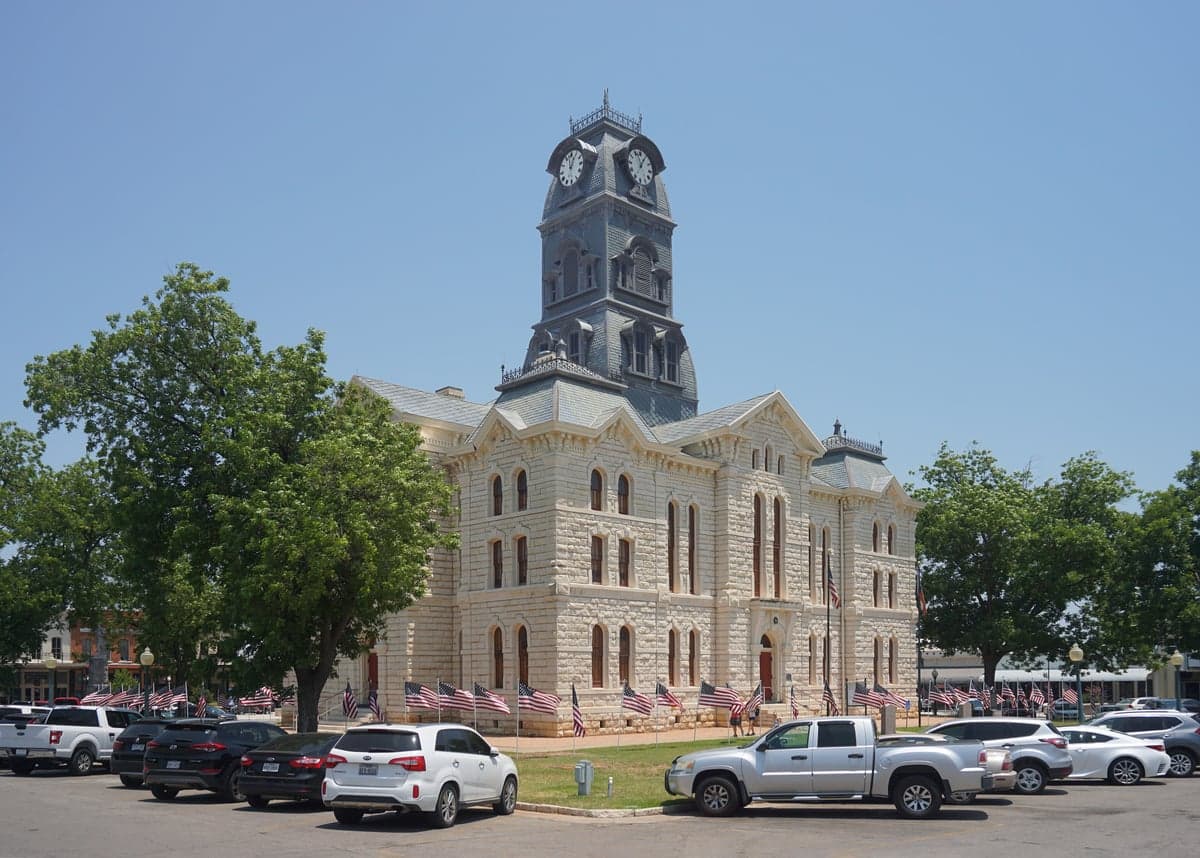
Photo: Wikipedia
Strategic Assessment of Granbury, TX
Meaningful friction. Expect exposure to either population pressure, blast zones, or natural disaster risk. Consider buying a retreat property.
What does the Strategic Assessment tell us?
Our Strategic Assessment grades tactical survivability of an area. Major population centers, military targets, fallout zones, natural disasters, and border exposure all drive risk — lower exposure means a more defensible position in a crisis.
This is heavily inspired by Joel Skousen's Strategic Relocation book. Highly recommended you checkout the book ($)What does this tell us?
Our Strategic Assessment grades tactical survivability of an area. Major population centers, military targets, fallout zones, natural disasters, and border exposure all drive risk — lower exposure means a more defensible position in a crisis.
This is heavily inspired by Joel Skousen's Strategic Relocation book. Highly recommended you checkout the book ($)Strategic Pillars

Key Distances
Regional Safe Places
Below is our recommended "safe zones" in Texas and the surrounding area based on our strategic heuristics. For most people, it's unrealistic to live in a “safe zone” full-time due to work, family or other personal reasons. They tend to be more rural. However, many of these areas are perfect for second homes and retreat properties that double as a vacation home or even a short-term rental.

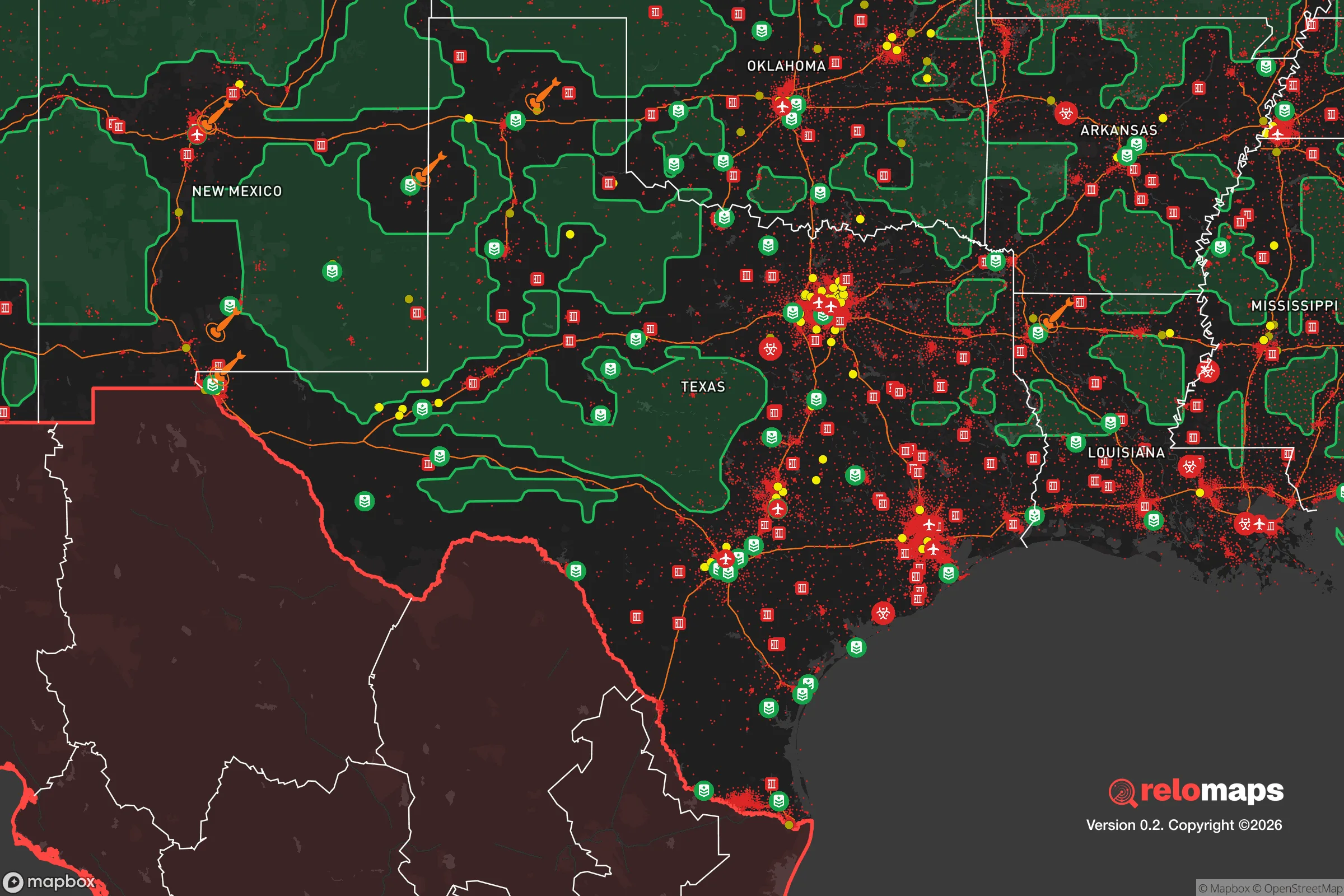


Important Note: For informational purposes only. This does not mean nothing bad ever happens in the green zones. Please use common sense. This is based on public data and modeled with AI. We tried to take a conservative approach but mistakes happen. We update this regularly as new information becomes available.
Solar Generator Recommendations
Backup power matters more here than in safer locations. We've picked three solar generators across budgets and capacity tiers — start with the budget unit if you only need a few essentials, or step up if you want to run a fridge and HVAC for days at a time.

Jackery Portable Power Station Explorer 300
Budget OptionPower on the Go: Weighing only 11 lbs, it's convenient to set up and store with book-sized foldable solar panels

BLUETTI Portable Power Station AC180
Designed for both indoor and outdoor scenarios, AC180 is highly capable as it has a robost capacity and continuous output power.

EF ECOFLOW DELTA Pro Ultra Power Station
Upgraded PickEcoFlow DELTA Pro Ultra is a whole-home energy system designed to grow with your family. Integrated with the Smart Home Panel 2, it scales to meet your evolving energy needs — keeping your home powered, intelligent, and secure through every stage of life.
We earn a commission, at no additional cost to you.
Strategic Assessment Analysis
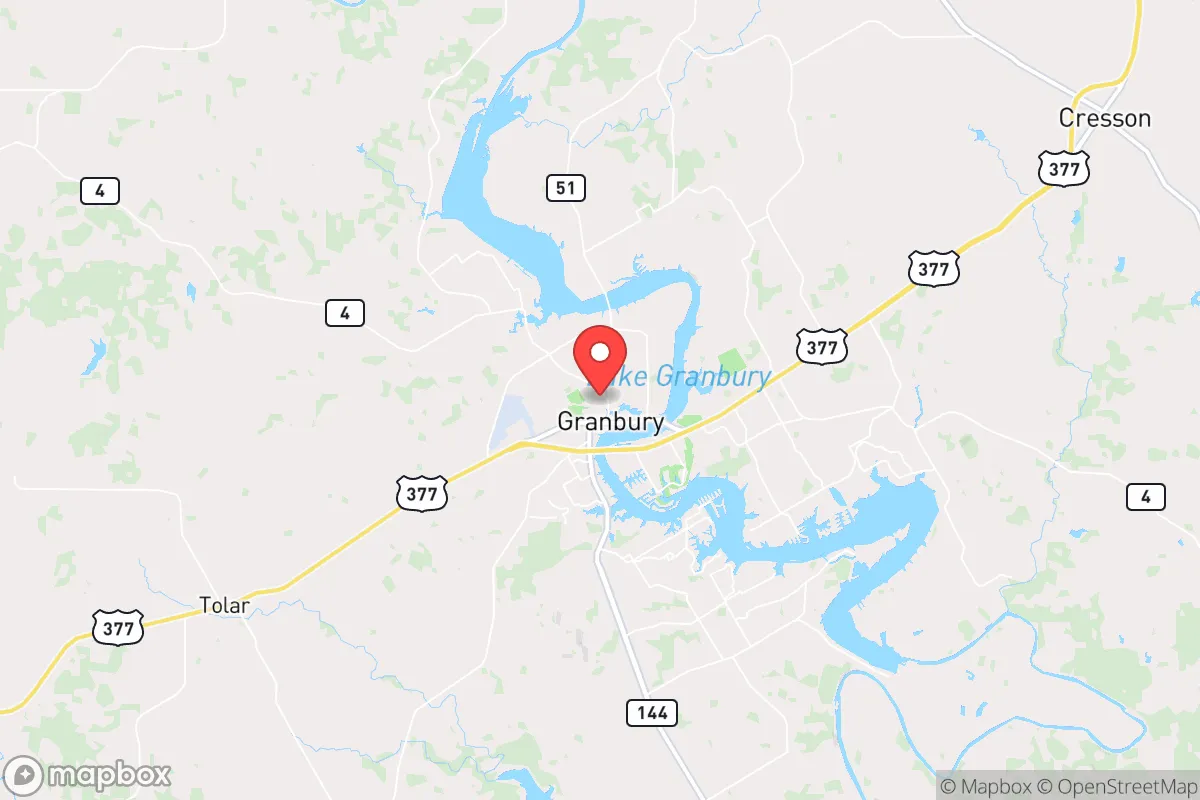
Granbury, Texas, offers a compelling mix of strategic depth and practical livability for those prioritizing resilience and self-sufficiency, sitting roughly 40 miles southwest of Fort Worth in Hood County. Its position places it just far enough from the Dallas-Fort Worth metroplex to avoid the worst of urban congestion and associated risks, while still providing access to regional infrastructure. The area’s natural geography—centered on the Brazos River and Lake Granbury—provides a solid foundation for water security, and its local governance leans heavily toward the conservative, property-rights-focused ethos that appeals to relocation-minded individuals and families. However, no location is without trade-offs, and a clear-eyed assessment of Granbury’s strengths and vulnerabilities is essential for anyone serious about long-term preparedness.
Geographic position and natural advantages for long-term security
Granbury’s location in the Cross Timbers region of North Texas gives it a distinct edge over flatter, more exposed parts of the state. The terrain is gently rolling, with limestone bluffs and oak-juniper woodlands that offer natural cover and defensible positions for rural properties. The area sits on the western edge of the Blackland Prairie, meaning soils are generally better for small-scale agriculture than the sandy soils found further west, though irrigation is still necessary during dry spells. The most significant natural asset is Lake Granbury, a 34-mile-long reservoir on the Brazos River that provides a reliable surface water source—a critical factor in drought-prone Texas. The lake is managed by the Brazos River Authority and has a storage capacity of over 150,000 acre-feet, which supports municipal supply, irrigation, and recreation. The local water table is also accessible via private wells in many unincorporated areas, though depth varies from 50 to over 300 feet depending on the specific lot. Granbury’s elevation—around 750 feet above sea level—keeps it above the flood-prone bottomlands of the Brazos, though low-lying areas near the lake and river can see flash flooding during heavy rain events. The climate is humid subtropical, with hot summers and mild winters, which supports year-round gardening and livestock keeping, but also brings the risk of severe thunderstorms, hail, and occasional tornadoes.
Risks, exposures, and proximity to fallout-relevant landmarks
While Granbury avoids many of the acute risks of coastal or border regions, it is not immune to man-made and natural threats. The most significant vulnerability is its proximity to the Dallas-Fort Worth metroplex, a major population center and economic hub that could become a target in a conflict or large-scale disruption. Granbury lies roughly 40 miles from DFW International Airport and 50 miles from the Pantex nuclear weapons plant near Amarillo—though the latter is over 300 miles away, it is still within the broader Texas nuclear infrastructure zone. More locally, the Comanche Peak Nuclear Power Plant is located about 30 miles northeast of Granbury, near Glen Rose. While the plant has a strong safety record, its presence introduces a low-probability but high-consequence risk of radiological release. In terms of natural hazards, Hood County is in the heart of Texas’s Tornado Alley, and Granbury experienced a devastating EF-4 tornado in May 2013 that killed six people and destroyed over 100 homes. Severe weather is the most frequent and immediate threat, with hail, straight-line winds, and flash flooding occurring multiple times per year. Wildfire risk is moderate, particularly in the rural, wooded areas west of the lake, where dry brush and juniper can fuel fast-moving fires. The area’s limestone karst geology also means that sinkholes are a rare but possible concern in certain subdivisions. On the positive side, Granbury is far from active fault lines, major chemical corridors, and international borders, reducing exposure to earthquakes, industrial accidents, and border-related instability.
Practical resilience for a relocator: food, water, energy, and defensibility
For a relocator focused on self-sufficiency, Granbury offers a mix of strong fundamentals and some limitations. Water is the area’s strongest asset: Lake Granbury provides a massive, accessible freshwater reservoir, and many rural properties can drill wells for independent supply. However, well drilling is expensive—typically $5,000 to $15,000 depending on depth and casing—and water rights are tied to property ownership, so due diligence on groundwater availability is essential. The lake itself is popular for recreation, but it also supports a local fishing economy and could serve as a protein source in a prolonged disruption. Food resilience is moderate: Hood County has a growing number of small farms, ranches, and farmers’ markets, but the area is not a major agricultural producer. The growing season runs from March to November, allowing for diverse vegetable gardens, and the local soil can support fruit trees like peaches and figs. Livestock—cattle, goats, and poultry—are common on acreage properties, and the county has several feed stores and veterinary services. Energy resilience is a mixed picture. Granbury is served by Oncor Electric Delivery, and the Texas grid (ERCOT) has proven vulnerable to winter storms, most notably the 2021 freeze that caused widespread blackouts. Solar potential is excellent—the area averages over 230 sunny days per year—and many rural homes already have backup generators or solar arrays. Natural gas is available in town but not in outlying areas, so propane tanks are common for heating and cooking. Defensibility is good for a suburban-rural interface: the terrain offers natural chokepoints, and the community is tight-knit, with a strong local sheriff’s office and active neighborhood watch programs. However, the town itself is accessible via multiple highways (US 377, TX 144, and TX 51), which could become evacuation routes or vectors for unwanted traffic during a crisis. The local hospital, Lake Granbury Medical Center, is a 73-bed facility with a Level IV trauma center—adequate for routine care but not for major emergencies.
The overall strategic picture for Granbury is one of balanced opportunity with clear-eyed trade-offs. It offers a rare combination of water security, moderate climate, and community cohesion that many other Texas relocation spots lack. The proximity to DFW is a double-edged sword—it provides economic access and supply chains but also introduces population-density risks and infrastructure vulnerabilities. For a family or individual willing to invest in well water, solar backup, and a defensible rural property, Granbury ranks as one of the more viable options in North Texas for long-term resilience. The key is to avoid the floodplains, secure a reliable water source, and build relationships with local growers and tradespeople before a crisis hits. Granbury is not a bunker—it is a functioning small city with a historic square, a growing population, and real exposure to severe weather. But for someone who wants to be part of a community that values preparedness without living off-grid, it is a strong contender.

* Values derived from national, state, county, city and local statistics and may differ in a specific area. Last updated: 2026-10-07T18:19:38.000Z
Narrative content on this page is AI-generated and may contain mistakes. Verify any details that matter before acting on them.
ReloMaps may earn a commission from affiliate links at no extra cost to you.

