Photo: Wikipedia
Demographics of Grand Forks, ND
Affluence Level in Grand Forks, ND
A middle-class area roughly in line with national averages across income, home values, education, and employment.
People of Grand Forks, ND
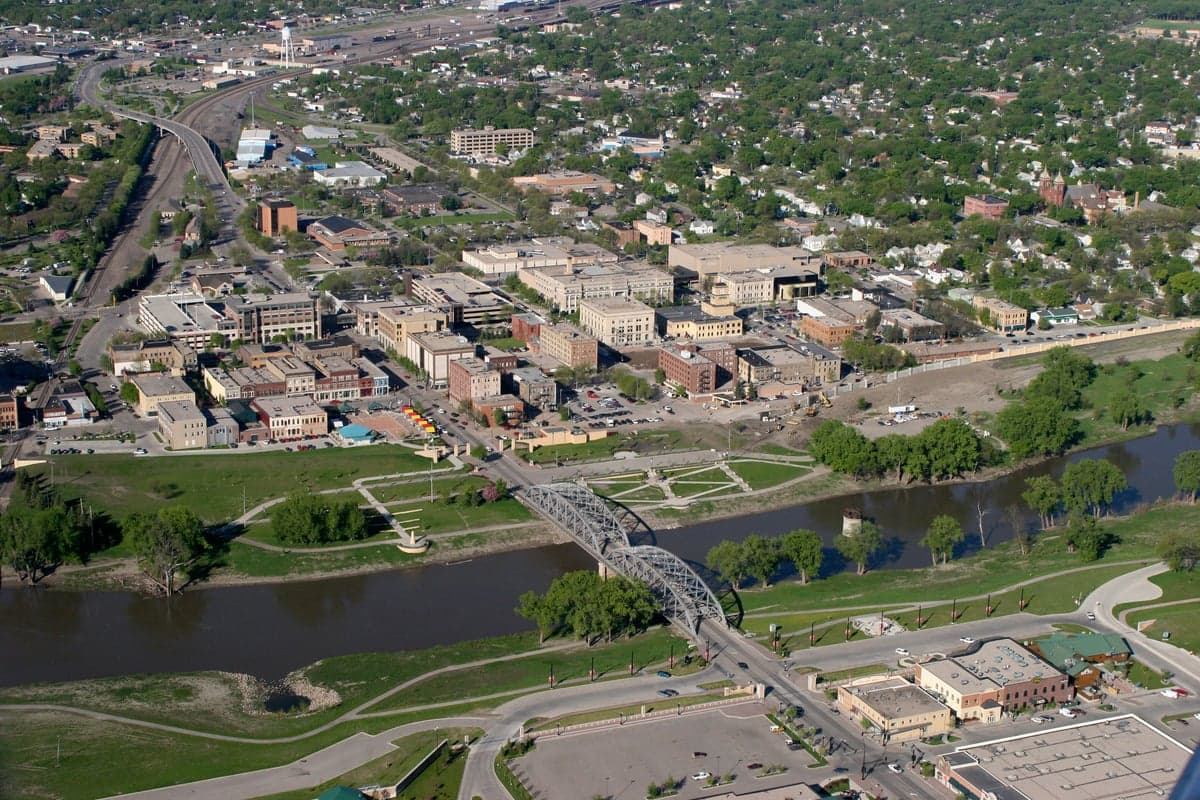
The people of Grand Forks, North Dakota, today number roughly 58,882, forming a predominantly white (80.6%) and college-educated (39.2%) population with a small but growing foreign-born share of 4.2%. The city’s identity is shaped by its roots as a railroad and agricultural hub on the Red River, producing a community that is stable, family-oriented, and politically conservative, with a noticeable Scandinavian and German cultural imprint. Distinct neighborhoods like the historic Near Southside and the newer South End reflect different eras of settlement, while the university district near the University of North Dakota (UND) adds a transient student layer to an otherwise rooted population.
How the city was settled and grew
Grand Forks was founded in 1870 as a steamboat and railroad town, with the arrival of the Great Northern Railway in the 1880s triggering the first major population wave. The original settlers were predominantly Yankee and German immigrants drawn by land grants under the Homestead Act and jobs in the burgeoning wheat and flour milling industries. By 1900, the city had grown to over 7,000 residents, with Scandinavian immigrants—Norwegians and Swedes—arriving in large numbers to work the farms and build the rail yards. These groups concentrated in the Near Southside neighborhood, where modest wood-frame houses and Lutheran churches still mark the historic core. The Downtown district, centered on DeMers Avenue, became the commercial and civic heart, housing the city’s early business elite and immigrant laborers alike. A second wave came during the 1940s and 1950s, driven by the expansion of the Grand Forks Air Force Base (established 1956), which brought military families and support workers, many settling in the South End near the base. This period solidified the city’s character as a stable, working-class community with a strong military and agricultural identity.
Modern era (post-1965)
After the 1965 Hart-Cellar Act, Grand Forks saw modest diversification, but the city’s foreign-born share remains low at 4.2%, reflecting limited immigration compared to national trends. The largest post-1965 shift came from domestic in-migration: the expansion of UND and the Altru Health System drew professionals from across the Midwest, while the 1997 Red River Flood prompted a rebuilding boom that accelerated suburbanization. The South End and Columbia Park neighborhoods absorbed most of this growth, with newer subdivisions and strip malls catering to families and retirees. The Hispanic population (5.3%) grew primarily through agricultural labor in surrounding Red River Valley farms, with many settling in the North End near the city’s industrial corridor. The Black population (4.0%) is largely tied to the Air Force base and UND, with no single concentrated neighborhood. East/Southeast Asian communities (2.1%) are mostly students and faculty at UND, living in the university district near University Park. The Indian subcontinent population (1.1%) is similarly small and university-linked. Notably, the city has not experienced the rapid ethnic enclave formation seen in larger metros; instead, these groups remain dispersed, with the university acting as a primary integration point.
The future
Grand Forks’ population is projected to remain stable or grow slowly, with the foreign-born share likely rising to 6-7% by 2035, driven by refugee resettlement programs (especially from East Africa and Southeast Asia) and continued recruitment of international students at UND. The city is not homogenizing into a single identity; rather, it is slowly tribalizing into distinct zones: the historic Near Southside retains its older, white, working-class base; the South End attracts younger families and professionals; and the North End is becoming a modestly more diverse area with Hispanic and refugee families. The Indian and East/Southeast Asian populations are expected to plateau as they assimilate into the broader community, while the Hispanic share may grow to 7-8% through natural increase and continued agricultural labor demand. The biggest demographic wildcard is the Air Force base, which could expand or contract with federal policy, directly affecting the Black and military-affiliated populations. Overall, Grand Forks will likely remain a predominantly white, conservative city with a small but stable multicultural presence, not a melting pot but a place where distinct groups coexist without significant friction.
For someone moving in now, Grand Forks offers a predictable, low-crime environment with a strong sense of community rooted in its Scandinavian and agricultural heritage. The city is becoming slightly more diverse but at a pace that will not disrupt its core conservative character. New arrivals should expect to find a place where neighbors know each other, schools are solid, and the biggest cultural shift is the gradual integration of a small but growing immigrant population into the existing social fabric.

* Values derived from national, state, county, city and local statistics and may differ in a specific area. Last updated: 2026-04-19T05:25:15.000Z
Narrative content on this page is AI-generated and may contain mistakes. Verify any details that matter before acting on them.
ReloMaps may earn a commission from affiliate links at no extra cost to you.

