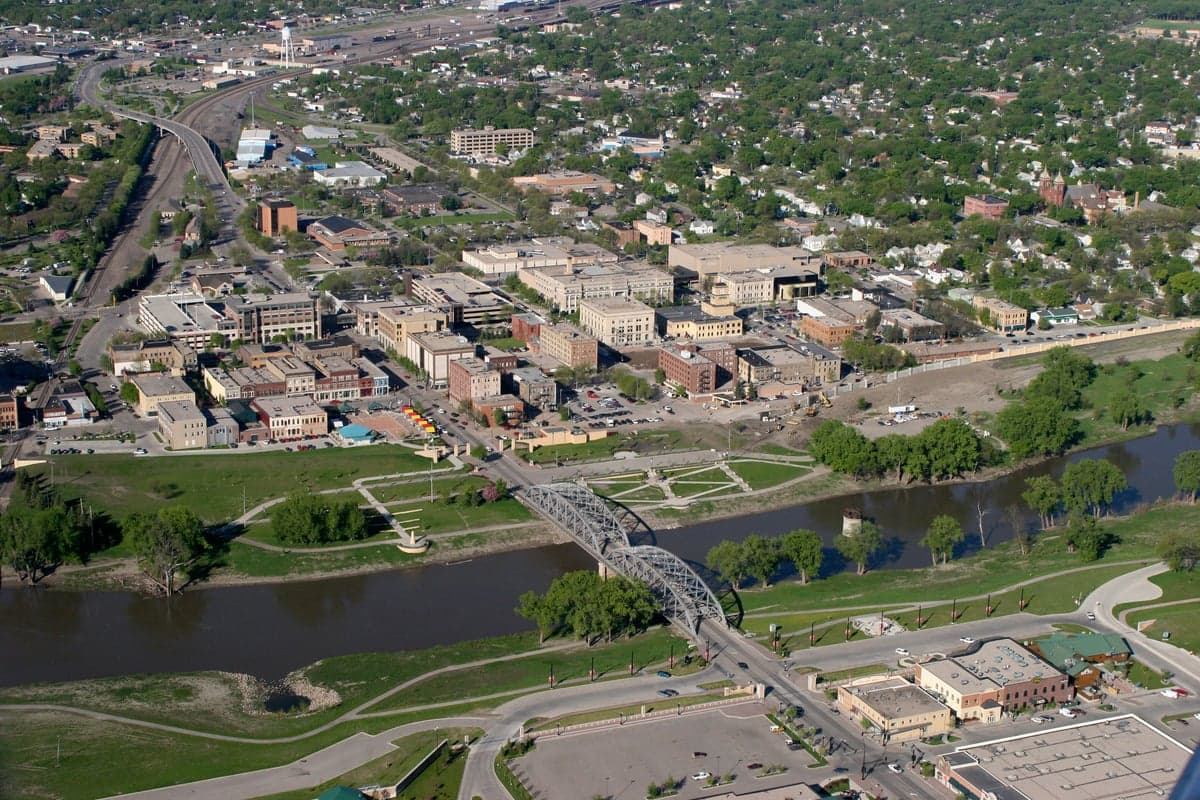
Photo: Wikipedia
Personal Sovereignty in Grand Forks, ND
Strong independent fundamentals that actively favor personal liberty and low regulation.
What does Personal Sovereignty tell us?
Personal Sovereignty measures your capacity for self-reliance and independence with minimal government friction. Higher scores mean fewer barriers between you and the way you want to live... but it assumes you have the space you need and good neighbors.
What does this tell us?
Personal Sovereignty measures your capacity for self-reliance and independence with minimal government friction. Higher scores mean fewer barriers between you and the way you want to live... but it assumes you have the space you need and good neighbors.
State Policy
Energy independence: Net exporter (500% of energy produced in-state)
Personal Liberty
Homesteading

Personal Liberty Analysis
Grand Forks, North Dakota offers a notably high degree of personal sovereignty compared to most of the United States, largely due to the state’s deeply ingrained libertarian-leaning culture and a political climate that actively resists federal overreach. For individuals and families operating from a survivalist or prepper mindset, the city provides a legal and regulatory environment where self-reliance is not just tolerated but expected. The combination of low taxes, minimal business licensing, strong property rights, and a state government that has repeatedly pushed back against federal mandates creates a strategic base for those seeking to insulate themselves from broader national instability. While no location is a perfect fortress against government overreach, Grand Forks ranks as one of the more defensible positions in the Upper Midwest for preserving personal autonomy.
Tax burden and regulatory posture in North Dakota
North Dakota’s tax structure is a major draw for those prioritizing financial sovereignty. The state has no state income tax, a policy that directly reduces the government’s claim on your earnings and allows for faster capital accumulation—critical for prepping and self-sufficiency investments. Property taxes in Grand Forks are moderate, averaging around 1.5% of assessed value, but the state offers a homestead tax credit for owner-occupied residences, which can lower the effective rate for primary homes. Sales tax in Grand Forks is 7.5% (5% state, 2.5% city), which is reasonable for a city of its size. More importantly, the regulatory climate is among the least burdensome in the nation. North Dakota has a right-to-work law, minimal occupational licensing requirements, and a state government that has actively sued the federal government over environmental and land-use overreach. For a prepper, this means fewer bureaucratic hurdles to building a workshop, storing supplies, or operating a small-scale agricultural operation without triggering inspections or permits that invite scrutiny.
Self-defense rights and gun law specifics in Grand Forks
North Dakota is a constitutional carry state, meaning that as of 2021, any legal resident 18 or older can carry a concealed firearm without a permit. This is a foundational liberty for those concerned with personal and family security. Grand Forks does not impose any additional local restrictions beyond state law, so there are no city-level magazine bans, waiting periods, or registration requirements. The state also has a strong Castle Doctrine and Stand Your Ground law, codified in ND Century Code 12.1-05-07.1, which eliminates any duty to retreat before using deadly force in self-defense, both inside and outside the home. For preppers, this legal framework is critical: it means you can defend your property and family without fear of prosecution, as long as you are lawfully present. Additionally, North Dakota has preemption laws that prevent cities like Grand Forks from enacting their own gun control ordinances, ensuring that state-level protections cannot be eroded by local government overreach. The only notable limitation is that firearms are prohibited in K-12 schools and certain government buildings, but this is standard nationwide.
Self-reliance and homesteading viability in the Red River Valley
Grand Forks sits in the fertile Red River Valley, offering some of the most productive agricultural land in the country, which directly supports a homesteading or self-sufficiency lifestyle. Residential lot sizes in the city’s outskirts and surrounding rural areas are generous—often 1 to 5 acres in unincorporated parts of Grand Forks County—allowing for substantial gardens, small livestock (chickens, goats, rabbits), and even limited crop production. Zoning within city limits is generally permissive for backyard gardens and small animal husbandry, though you’ll need to check specific neighborhood covenants. For those looking to go fully off-grid, the county’s building codes are minimal: there are no state-level mandates for solar panel permits or rainwater collection restrictions, and many rural properties rely on well water and septic systems. The harsh winters (average January high of 16°F) are a genuine challenge for year-round off-grid living, requiring robust heating and insulation, but the low population density and cheap land (undeveloped rural parcels can be found for under $5,000 per acre) make it feasible for those willing to invest in infrastructure. The state also has a strong agricultural exemption for property taxes, meaning land used for farming or ranching is taxed at a fraction of residential rates.
Personal liberties: parental rights, medical autonomy, and property protections
North Dakota has been a battleground for parental rights, and the state legislature has passed laws reinforcing parents’ authority over their children’s education and medical decisions. In 2023, the state enacted a Parents’ Bill of Rights (HB 1205), which requires schools to obtain parental consent before administering any health services or surveys and prohibits instruction on sexual orientation or gender identity in K-4 classrooms. For parents concerned about government or school overreach into family matters, this provides a legal shield. Medical autonomy is also relatively strong: North Dakota has not imposed broad vaccine mandates for adults, and while COVID-era restrictions were present, they were lifted earlier than in many states. The state has also passed laws limiting the governor’s emergency powers (SB 2295, 2021), preventing future lockdowns or business closures without legislative approval. Property rights are robust, with no state-level inheritance tax and strong protections against eminent domain abuse. The state’s constitution explicitly protects the right to keep and bear arms and the right to hunt and fish, which are seen as fundamental liberties. Free speech is protected under the First Amendment, and Grand Forks has no local ordinances that restrict political expression or assembly beyond standard time-place-manner regulations.
In the broader context of personal sovereignty, Grand Forks stands out as a pragmatic choice for those seeking to minimize government entanglement while maintaining access to modern infrastructure. It lacks the extreme libertarian enclaves of rural Idaho or Montana, but it offers a more balanced package: a functioning city with hospitals, schools, and supply chains, combined with a state government that has consistently pushed back against federal overreach. The trade-offs are real—the climate is brutal, and the city’s economy is tied to the University of North Dakota and the Air Force base, which introduces some federal dependency—but for a prepper or conservative individual, the legal and tax environment provides a solid foundation for building a self-reliant life. Compared to the coastal states or even much of the Midwest, Grand Forks offers a level of personal freedom that is increasingly rare in 2026, making it a serious contender for anyone prioritizing autonomy over convenience.

* Values derived from national, state, county, city and local statistics and may differ in a specific area. Last updated: 2026-04-19T05:25:15.000Z
Narrative content on this page is AI-generated and may contain mistakes. Verify any details that matter before acting on them.
ReloMaps may earn a commission from affiliate links at no extra cost to you.

