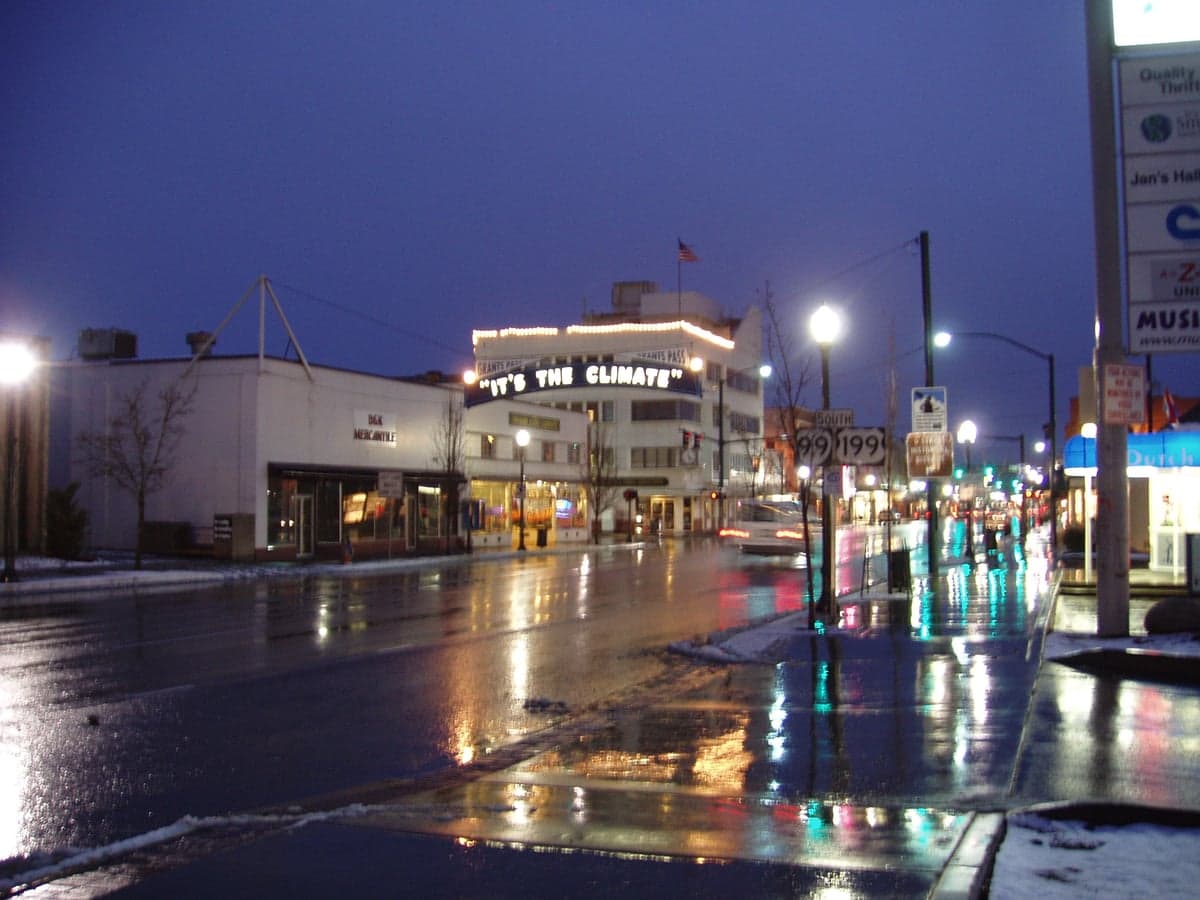
Photo: Wikipedia
Demographics of Grants Pass, OR
Affluence Level in Grants Pass, OR
A middle-class area roughly in line with national averages across income, home values, education, and employment.
People of Grants Pass, OR
The people of Grants Pass, Oregon, today number 39,183, forming a predominantly white (81.7%) and politically conservative community with a notably low foreign-born population of just 1.4%. The city’s identity is rooted in a rural, self-reliant character, with only 19.7% of adults holding a college degree, reflecting a workforce historically tied to timber, agriculture, and small business. Hispanic residents make up 10.4% of the population, while East and Southeast Asian communities account for 1.1%, and Black residents 0.5%, making Grants Pass one of Oregon’s least ethnically diverse cities of its size.
How the city was settled and grew
Grants Pass was founded in the 1860s as a stagecoach stop and river crossing on the Rogue River, named after Ulysses S. Grant. The original population consisted of white American settlers, primarily from the Midwest and Upper South, drawn by the Donation Land Claim Act of 1850 and later by gold mining in the nearby Josephine County hills. The arrival of the Oregon and California Railroad in 1884 transformed the settlement into a timber and agricultural hub, attracting Scandinavian and German immigrants who worked in the mills and farms. These early groups settled in what is now the Historic Downtown district, centered around G and H Streets, and in the Riverbanks neighborhood along the Rogue, where sawmills and packing sheds once lined the water. By 1900, the population was nearly entirely white, with a small Chinese community that had worked on railroad construction but largely dispersed by the 1920s due to exclusionary laws. The city grew steadily through the mid-20th century, reaching about 10,000 residents by 1950, with new subdivisions like Fruitdale (annexed in the 1960s) housing mill workers and their families.
Modern era (post-1965)
After the 1965 Hart-Cellar Act, Grants Pass saw negligible immigration from Asia or Latin America compared to Oregon’s larger cities. The foreign-born share remained below 2% through the 2000s, and the city’s growth came almost entirely from domestic in-migration—primarily white retirees from California and the Pacific Northwest seeking lower housing costs and a rural lifestyle. This wave settled in newer subdivisions like Redwood Estates (south of the city) and North Grants Pass along the Merlin Road corridor, areas that remain overwhelmingly white today. The Hispanic population grew from under 3% in 1990 to 10.4% by 2020, driven by agricultural labor in the surrounding pear and wine orchards, with families concentrating in the Eastside neighborhood near the Grants Pass Airport and along the Rogue River Highway corridor. East and Southeast Asian communities (1.1%) are small and dispersed, with no distinct ethnic enclave; most are professionals in healthcare or education. The Indian subcontinent population (0.1%) is negligible, and the Black population (0.5%) has remained static since the 1970s, concentrated in scattered households rather than any single neighborhood.
The future
Grants Pass is likely to remain one of Oregon’s least diverse cities over the next 10–20 years, with the white population share projected to decline only slightly as the Hispanic share slowly rises—possibly reaching 13–15% by 2040. The foreign-born population will likely stay below 3%, as the city lacks the industrial or tech job base to attract significant international immigration. Domestic in-migration from California and the Portland metro area will continue, but these newcomers are predominantly white and politically conservative, reinforcing the city’s existing demographic character. The Riverside Park area and newer developments near the Grants Pass Parkway are absorbing this growth, while older neighborhoods like Fruitdale and Redwood Estates are aging in place. No significant ethnic enclaves are forming; instead, the city is homogenizing further, with Hispanic families gradually dispersing into previously all-white subdivisions. The college-educated share (19.7%) may rise slowly as remote workers arrive, but the city’s economic base—timber, retail, and healthcare—will keep educational attainment below state averages.
For a conservative-leaning mover, Grants Pass offers a stable, culturally homogeneous environment where the population is aging but not shrinking, and where demographic change is slow enough to feel negligible. The city is becoming slightly more Hispanic but remains overwhelmingly white, with no signs of the rapid diversification seen in Portland or Salem. New arrivals should expect a community where neighborly familiarity and traditional values dominate, and where the low foreign-born share means English is the near-universal language in daily life.

* Values derived from national, state, county, city and local statistics and may differ in a specific area. Last updated: 2026-05-01T08:58:16.000Z
Narrative content on this page is AI-generated and may contain mistakes. Verify any details that matter before acting on them.
ReloMaps may earn a commission from affiliate links at no extra cost to you.

