 Popular
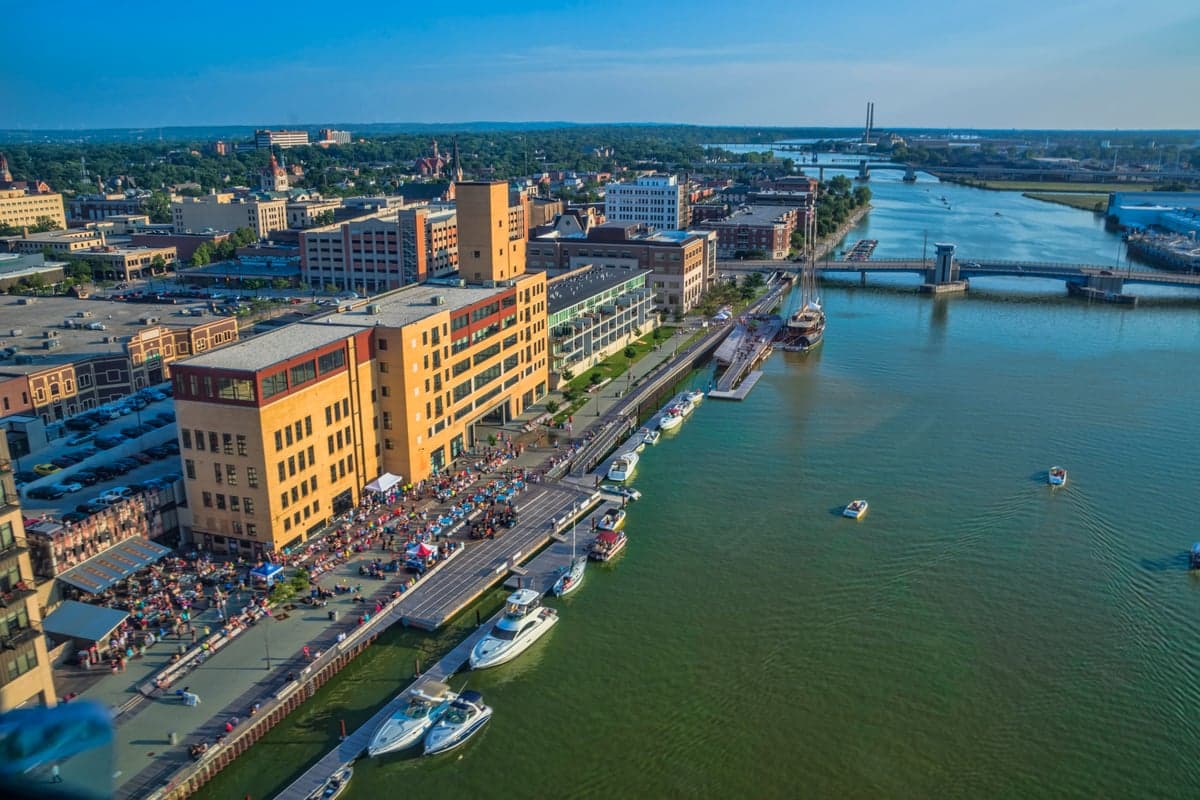
Photo: Wikipedia
Demographics of Green Bay, WI
Affluence Level in Green Bay, WI
A middle-class area roughly in line with national averages across income, home values, education, and employment.
People of Green Bay, WI
The people of Green Bay, Wisconsin, today form a predominantly white, working- and middle-class community of roughly 107,000, marked by a strong Catholic and Lutheran heritage, a deep connection to the Packers, and a growing Hispanic population that now accounts for nearly one in five residents. The city is denser and more ethnically diverse than its surrounding suburbs, with a foreign-born share of 5.2% that is modest by national standards but rising. Distinctive identity markers include a palpable civic pride rooted in the Packers, a relatively high rate of homeownership, and a social fabric still shaped by the waves of European immigration that built the city’s neighborhoods.
How the city was settled and grew
Green Bay’s population history begins with the Menominee and Ho-Chunk peoples, but the first permanent European settlers were French-Canadian fur traders and missionaries who established a presence along the Fox River in the late 1600s. The city’s modern growth began in earnest after the Erie Canal opened in 1825, drawing Yankees from New England and New York who founded the town’s early commercial and political institutions. The defining population wave, however, came between 1850 and 1920, when tens of thousands of immigrants from Belgium, Germany, Poland, and Ireland arrived to work in the region’s lumber mills, paper factories, and shipyards. Belgian Walloons settled heavily on the east side, particularly in the Astor neighborhood, where their brick homes and Catholic churches still stand. German and Polish immigrants clustered on the near west side and in Fort Howard, building the breweries, meatpacking plants, and parishes that anchored working-class life. By 1910, over 40% of Green Bay’s population was foreign-born, with Germans and Poles forming the largest blocs. The city’s character was set during this era: heavily Catholic, union-oriented, and ethnically insular, with neighborhoods organized around parish boundaries and mutual-aid societies.
Modern era (post-1965)
After the 1965 Hart-Cellar Act, Green Bay did not experience the large-scale immigration from Asia or Africa seen in larger Midwestern cities. Instead, the post-1965 period was defined by suburbanization and the gradual arrival of Hispanic migrants, primarily from Mexico and Puerto Rico, who came for work in the region’s meatpacking plants, dairies, and construction trades. These families concentrated on the city’s south side, especially in the Broadway district and the Joannes Park area, where Spanish-language groceries, churches, and small businesses now form a visible corridor. The Hispanic share of the city’s population rose from under 2% in 1980 to 18.1% by the 2020s, making it the largest minority group. Meanwhile, the white population declined from over 90% in 1970 to 65.4% today, driven by aging, lower birth rates, and out-migration to suburbs like Allouez and Howard. East and Southeast Asian communities (3.6% of the population) are smaller and more dispersed, with Hmong and Vietnamese families concentrated in the Navarino neighborhood near the university. The Indian-subcontinent population remains tiny at 0.4%, clustered around the medical and engineering sectors. The Black population (3.7%) is modest and largely resides in the central city near the Washington Park area. Suburbanization has been the dominant domestic trend: middle-class white families have moved to the surrounding villages, leaving Green Bay proper with a slightly younger, more diverse, and more rental-heavy population than its neighbors.
The future
Green Bay’s population is heading toward greater Hispanic plurality and a slow homogenization of its white ethnic enclaves. The Hispanic share is projected to reach 25–30% by 2040, driven by higher birth rates and continued migration for meatpacking and food-processing jobs. This growth is concentrated on the south side, where the Broadway corridor is becoming a distinct Hispanic commercial and residential enclave, while the historically Belgian and German east side neighborhoods like Astor are aging and seeing modest infill from younger professionals and university affiliates. The white population will continue to shrink as a share, but the city is not tribalizing into sharply divided enclaves; rather, it is experiencing a gradual, spatially uneven assimilation, with second-generation Hispanic families increasingly moving into west-side and suburban neighborhoods. The East and Southeast Asian and Indian populations are likely to remain small, tied to the university and healthcare sectors, and will not drive major demographic change. The city is becoming less insular and more bilingual, but it remains a predominantly white, culturally conservative place where the Packers, parish life, and family ties still dominate social life. For someone moving in now, Green Bay offers a stable, affordable, and community-oriented environment with a growing Hispanic cultural presence, but little of the rapid diversification or cosmopolitanism seen in larger Midwestern cities.

* Values derived from national, state, county, city and local statistics and may differ in a specific area. Last updated: 2026-04-21T10:17:26.000Z
Narrative content on this page is AI-generated and may contain mistakes. Verify any details that matter before acting on them.
ReloMaps may earn a commission from affiliate links at no extra cost to you.

