
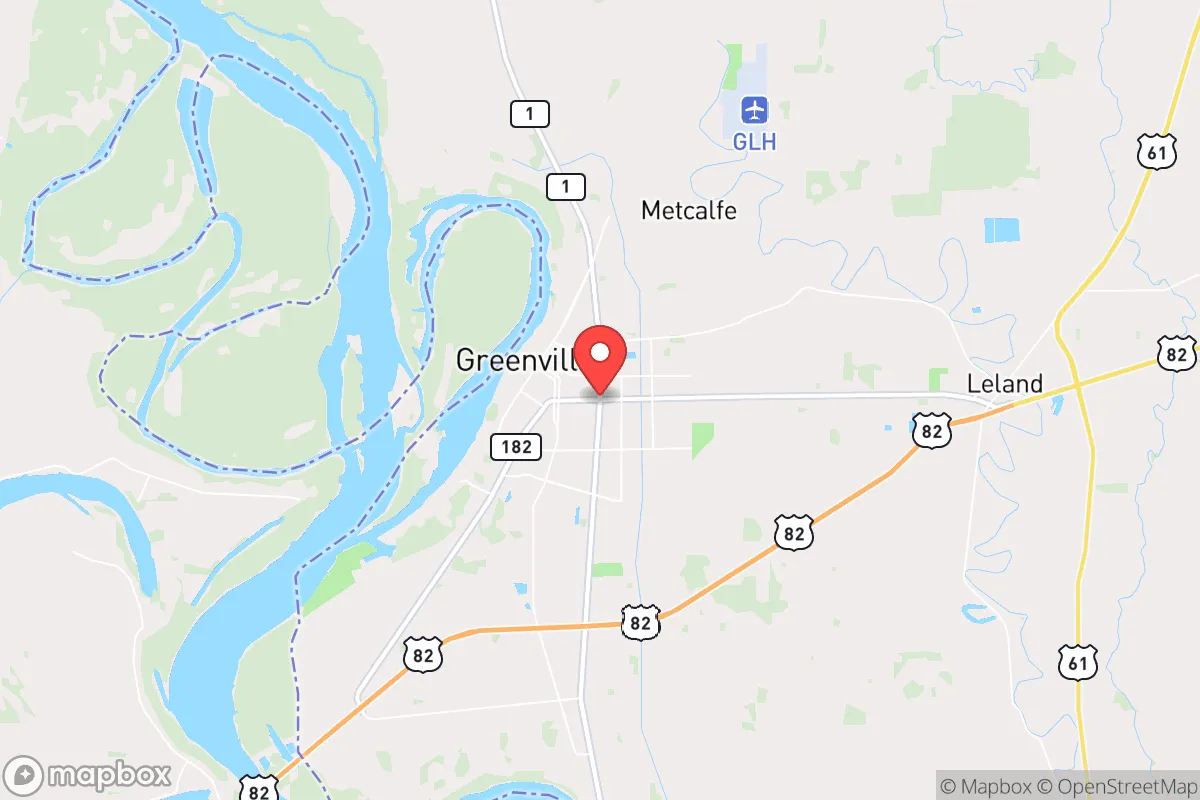
Photo: Wikipedia
Demographics of Greenville, MS
Affluence Level in Greenville, MS
A low-income area with significant economic hardship. Household wealth and educational attainment are well below national averages.
People of Greenville, MS
The people of Greenville, Mississippi, today form a predominantly Black (81.8%) community of 28,833 residents, a population that is notably homogenous compared to the state and national averages. The city’s character is shaped by a deep-rooted African American cultural heritage, a small White minority (15.7%), and a foreign-born population of just 0.1%, making it one of the least ethnically diverse cities in the Delta. With a college-educated rate of 20.2%, Greenville’s population is less formally educated than the national average, reflecting the economic challenges of a region historically tied to agriculture and manufacturing. The city’s identity is one of resilience and tradition, but it faces ongoing population decline and a lack of new immigration.
How the city was settled and grew
Greenville’s human history begins with its founding in 1824 as a river port on the Mississippi, drawing early settlers—mostly White planters and their enslaved Black laborers—to the fertile Delta soil for cotton cultivation. By the mid-19th century, the city was a hub for the plantation economy, with enslaved Africans making up the majority of the labor force. After the Civil War, freedmen established communities like Nelson Street, which became the commercial and cultural heart of Black Greenville, and Lake Village, a historically Black neighborhood near the river. The early 20th century brought a second wave: Jewish and Lebanese immigrants, who settled in the Downtown area and built retail and wholesale businesses along Washington Avenue. The Great Migration (1910–1970) saw tens of thousands of Black residents leave the Delta for Northern cities, but Greenville’s Black population remained substantial, anchored by agricultural work and the emerging catfish and timber industries. By 1950, the city’s population peaked at around 41,000, with a roughly equal Black-White split.
Modern era (post-1965)
After the 1965 Hart-Cellar Act, Greenville saw virtually no new immigration—its foreign-born share today is 0.1%, among the lowest in the nation. Instead, the post-1965 era was defined by White flight and suburbanization. As school desegregation took hold in the 1970s, many White families moved to unincorporated areas like Leland and Stoneville, or to the Deer Creek area south of the city, which developed as a predominantly White, higher-income enclave. The Black population, meanwhile, consolidated in historic neighborhoods like Nelson Street and Lake Village, as well as newer subdivisions such as Briarwood and Fairview. The city’s White share dropped from roughly 50% in 1960 to 15.7% today, while the Black share rose to 81.8%. The small Asian (0.2%) and Indian (0.9%) populations are concentrated in a few professional households, often tied to the local hospital or Delta State University, but they do not form distinct ethnic neighborhoods. The Hispanic share (0.3%) is negligible, with most Latino workers in the region living in rural agricultural camps rather than within city limits.
The future
Greenville’s population is heading toward further homogenization and decline. The city lost roughly 30% of its residents between 2000 and 2020, and the trend continues as younger, educated residents—both Black and White—leave for job opportunities in Jackson, Memphis, or Atlanta. The Black population is aging in place, with few new arrivals to replace out-migrants. The White population is also shrinking, concentrated in the Deer Creek area and a few older subdivisions. No significant immigrant community is growing to offset the losses; the Indian and East/Southeast Asian populations are tiny and stable, not expanding. Over the next 10–20 years, Greenville will likely become even more predominantly Black and older, with a shrinking tax base and continued economic strain. The city is not tribalizing into new enclaves but rather consolidating into a single, majority-Black demographic with a small, aging White minority.
For someone moving in now, Greenville offers a deeply rooted, culturally rich community with a strong sense of place, but it is a city in demographic decline with limited diversity and few signs of reversal. The population is stable in its composition but shrinking in size, making it a place for those seeking a quiet, traditional Delta lifestyle rather than growth or new opportunities.

* Values derived from national, state, county, city and local statistics and may differ in a specific area. Last updated: 2026-04-19T14:58:41.000Z
Narrative content on this page is AI-generated and may contain mistakes. Verify any details that matter before acting on them.
ReloMaps may earn a commission from affiliate links at no extra cost to you.

