

Photo: Wikipedia
Political ClimatePolitical Climate in Greenville, MS
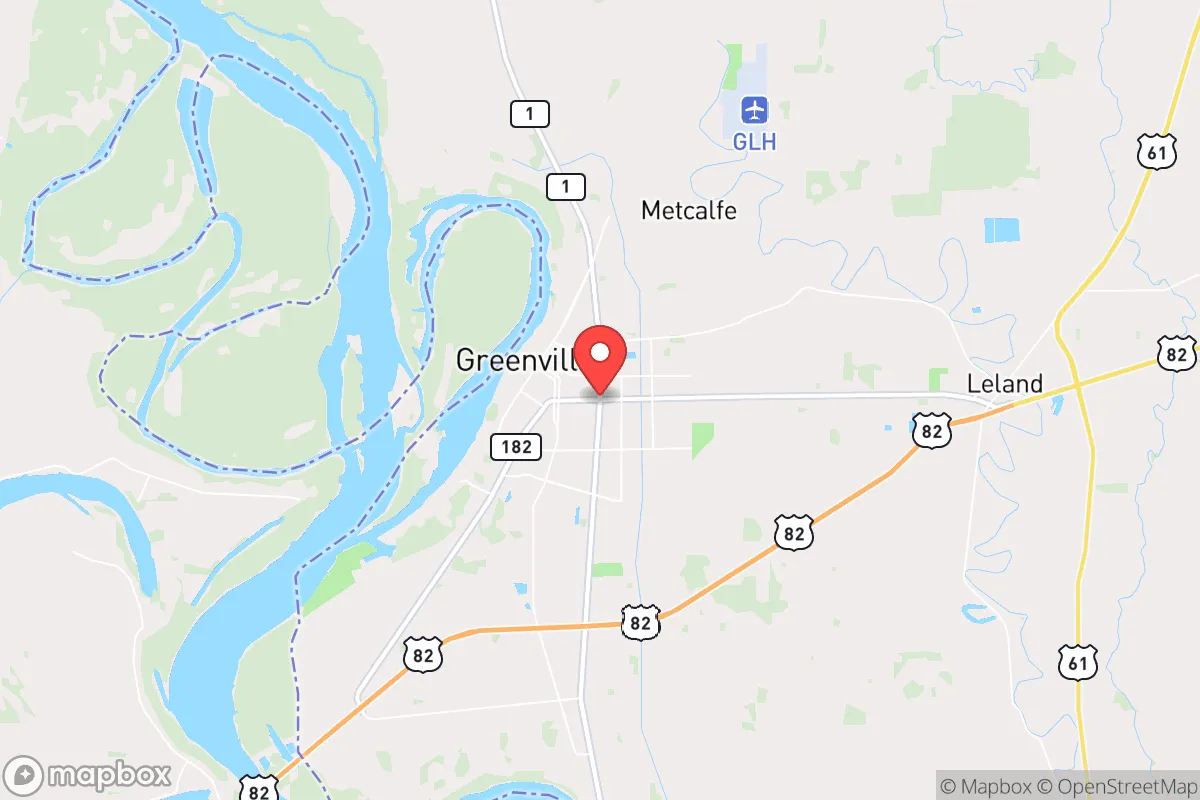
District shown is the primary district for this city’s centroid. Cities may span multiple districts.
Local Political AnalysisPolitical Analysis of Greenville, MS
Greenville, Mississippi, has long been a Democratic stronghold in the Delta, with a Cook PVI of D+11 that reflects its solidly blue voting record. But if you’ve lived here as long as I have, you know the political climate isn’t just about party labels—it’s about a slow, creeping shift away from the traditional, hands-off values that used to define this community. The city’s lean is deeply tied to federal programs and state-level policies that have, over the years, traded local control for government dependency, and that’s something that ought to give any freedom-loving resident pause.
How it compares
Drive just 30 miles north to Cleveland, and you’ll find a similar D+10 tilt, but the real contrast is in the surrounding rural areas. Washington County as a whole leans Democratic, but towns like Leland and Arcola—smaller, more agricultural—tend to vote more conservatively, especially on local issues like property rights and school board decisions. Head east to Indianola (D+12) or south to Vicksburg (D+9), and you see the same pattern: the Delta’s urban cores vote blue, while the outlying communities push back against progressive overreach. Greenville itself, though, has seen a noticeable uptick in progressive activism over the last decade—more focus on identity politics, less on the kind of neighborly self-reliance that used to be our backbone. It’s a shift that feels less like organic change and more like a top-down push from outside groups.
What this means for residents
For folks living here, the political climate translates directly into daily life—and not always in a good way. You’ve got city council decisions that lean toward expanding government programs rather than cutting red tape for small businesses. Property taxes have crept up, and there’s a growing sense that your personal freedoms—like how you use your land or what you teach your kids—are being nudged aside for a one-size-fits-all agenda. The school board, for instance, has faced pressure to adopt curriculum changes that prioritize social justice over core academics, which is a red flag if you value parental rights. On the flip side, the strong Democratic lean means federal funding flows into the area for infrastructure and healthcare, but it often comes with strings attached that limit local say-so. It’s a trade-off, and one that’s left a lot of us wondering if we’re gaining more than we’re losing.
What really sets Greenville apart culturally is its deep-rooted sense of community—church suppers, hunting clubs, and family-owned diners where everyone knows your name. But that’s being tested as progressive policies push into areas like gun rights and religious expression. The long-term trajectory? If the current trend holds, expect more government involvement in your daily choices, from how you heat your home to what your kids read. For now, the best advice is to stay engaged locally—vote in every city election, show up at school board meetings, and keep an eye on those state-level bills that try to chip away at your freedoms. Greenville’s still a good place to live, but it’s only as free as its residents are willing to fight for it.

State Political ClimatePolitical Climate in Mississippi
State Political AnalysisPolitical Environment in the State
Mississippi is one of the most reliably conservative states in the country, with a deep-rooted Republican lean that has only strengthened over the past two decades. The state hasn’t voted for a Democratic presidential candidate since 1976, and in 2024, Donald Trump carried it by over 17 points. The dominant coalition is a mix of rural and suburban conservatives, evangelical Christians, and a growing number of fiscally conservative transplants from other Southern states. Over the last 10-20 years, the shift has been unmistakable: Democrats once held a majority in the state legislature as recently as 2010, but today Republicans hold supermajorities in both chambers, and every statewide elected office is held by the GOP. This isn’t a purple state trending blue—it’s a red state that’s gotten redder.
Urban vs. rural divide
The political map of Mississippi is a textbook study in the urban-rural split. The state’s three major metro areas—Jackson, the Gulf Coast (Biloxi-Gulfport), and the Memphis suburbs in DeSoto County—tell very different stories. Jackson, the capital and largest city, is a Democratic stronghold, driven by a majority-Black population and a progressive city council that has clashed repeatedly with the state’s Republican legislature over issues like policing, taxes, and Confederate monuments. Hinds County, which contains most of Jackson, voted over 80% for Joe Biden in 2020. Meanwhile, DeSoto County, just south of Memphis, is the most reliably Republican suburban county in the state, often delivering 70%+ margins for GOP candidates. The Gulf Coast is more mixed: Harrison County (Biloxi, Gulfport) leans Republican but has a significant Democratic minority, while Jackson County (Pascagoula) is solidly red, thanks to a strong military and shipbuilding presence. The rural Delta region—places like Greenville and Clarksdale—votes heavily Democratic, but those areas are losing population fast. The real political engine of the state is the sprawling, conservative exurban and rural territory between these islands of blue.
Policy environment
Mississippi’s policy environment is aggressively conservative, with a low-tax, low-regulation posture that appeals to freedom-minded residents. The state has no individual income tax on most wages—a flat 4% rate was phased down from 5% in 2022, with a goal of full elimination by 2026. Property taxes are among the lowest in the nation, and the state has a right-to-work law that keeps unions weak. Education policy is a mixed bag: the state has a school choice program (the Mississippi Education Scholarship Account) that lets parents use public funds for private or homeschool expenses, but it’s capped and not universal. On healthcare, Mississippi has not expanded Medicaid under the Affordable Care Act, keeping the state’s uninsured rate high but also limiting federal entanglement. Election laws are strict: voter ID is required, early voting is limited (no-excuse absentee voting was only expanded in 2024), and the state has purged inactive voter rolls aggressively. Governor Tate Reeves has signed laws banning critical race theory in schools and restricting transgender athletes from competing in women’s sports. For a conservative, the policy environment is largely aligned with limited government principles, though the state’s heavy reliance on federal funding (about 40% of the budget) is a lingering concern.
Trajectory & freedom
Mississippi is trending toward more personal freedom in several key areas, but not without some worrying countercurrents. On the positive side, the state passed a constitutional carry law in 2016, allowing permitless carry of firearms, and has resisted federal gun control efforts. In 2023, the legislature passed the Mississippi Parental Rights Act, which requires schools to notify parents before any medical or mental health services are provided to minors—a direct response to progressive school policies elsewhere. The state also has a strong medical freedom record: it banned vaccine passports in 2021 and has resisted federal mandates on COVID-19 shots. On the downside, the state’s medical marijuana program, approved by voters in 2020, was heavily restricted by the legislature in 2022, limiting access and driving up costs. Property rights are generally strong, but the state’s eminent domain laws have been used aggressively for economic development projects, like the Nissan plant in Canton, which displaced some landowners. The trajectory is toward more freedom on guns, education, and medical choice, but the state’s tendency toward crony capitalism and regulatory capture in certain industries (like timber and agriculture) is a persistent concern.
Civil unrest & political movements
Mississippi has seen relatively little large-scale civil unrest compared to other states, but there are flashpoints. The Jackson water crisis of 2022-2023 sparked protests and a political battle between the city’s Democratic leadership and the state’s Republican-controlled legislature, which ultimately took over the city’s water system. This was a major issue for residents, with some seeing it as a necessary intervention and others as a power grab. On the right, the Mississippi Freedom Caucus—a group of hardline conservative state legislators—has been active in pushing for school choice, tax cuts, and anti-abortion legislation. Immigration politics are less heated than in border states, but the state has passed laws requiring local law enforcement to cooperate with federal immigration authorities, and there have been occasional protests over ICE detention centers in Hinds County. Election integrity is a live issue: after the 2020 election, the state passed a law requiring absentee ballots to be received by election day (no postmark grace), and there have been ongoing debates about the security of electronic voting machines. The most visible political movement is the pro-life activism, which has been energized since the Dobbs decision; Mississippi’s trigger law banning nearly all abortions went into effect in 2022, and there have been annual protests at the state capitol from both sides.
Projection
Over the next 5-10 years, Mississippi is likely to remain deeply conservative, but with some demographic and economic shifts that could moderate the edges. The state is losing population in the rural Delta and gaining in the suburban counties around Jackson (Madison and Rankin counties) and the Gulf Coast. These suburban areas are growing more diverse but still vote heavily Republican. The biggest wildcard is in-migration: Mississippi is seeing a slow but steady influx of retirees and remote workers from higher-tax states like California and Illinois, drawn by low housing costs and no income tax. These newcomers tend to be fiscally conservative but may be more libertarian on social issues like marijuana and gambling. The state’s aging population (median age 38) could push it toward more moderate policies on healthcare and infrastructure. However, the Republican supermajority is unlikely to be threatened—the state’s legislative districts are heavily gerrymandered, and the Democratic base is concentrated in shrinking rural areas. Expect continued fights over school choice expansion, further income tax cuts, and ongoing battles with Jackson over local control. A new resident moving in now should expect a state that remains firmly red, with a government that is generally friendly to business and personal liberty, but with a persistent undercurrent of tension between rural conservatives and urban progressives.
For a conservative relocating to Mississippi, the bottom line is this: you’ll find a state that largely respects your right to live as you see fit, with low taxes, strong gun rights, and a government that pushes back against federal overreach. The downsides are a weak economy in many areas, poor infrastructure, and a political establishment that can sometimes be too cozy with special interests. If you’re looking for a place where your values are the norm and the government stays out of your way, Mississippi delivers—just be prepared for the trade-offs that come with a state that’s more focused on freedom than on services.
* Values derived from national, state, county, city and local statistics and may differ in a specific area. Last updated: 2026-04-19T14:58:41.000Z
Narrative content on this page is AI-generated and may contain mistakes. Verify any details that matter before acting on them.
ReloMaps may earn a commission from affiliate links at no extra cost to you.

