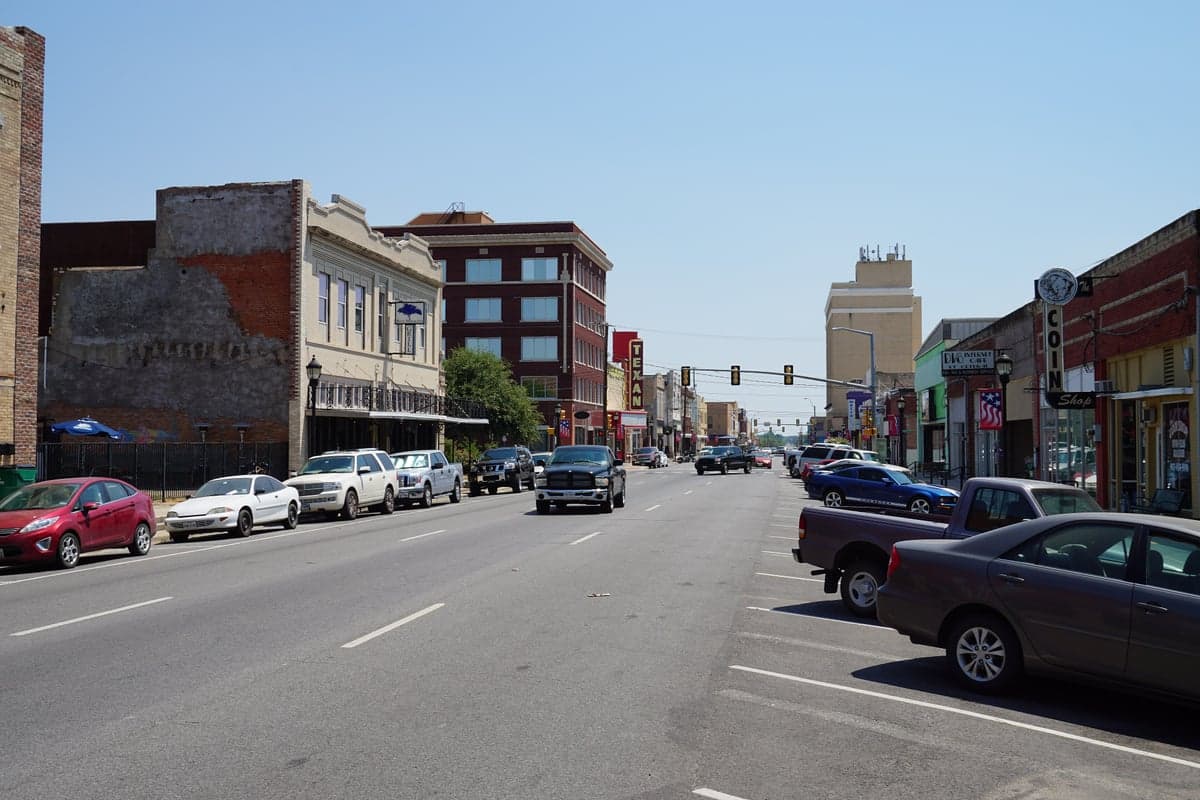
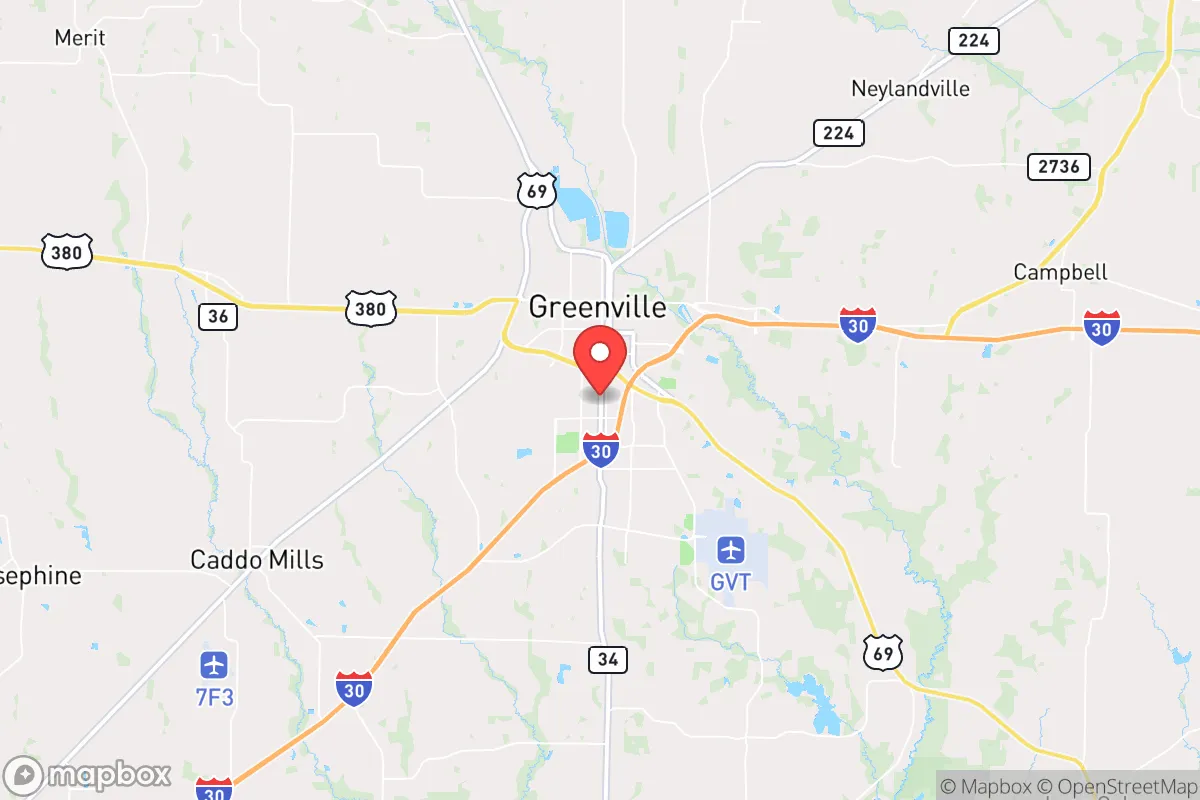
Photo: Wikipedia
Demographics of Greenville, TX
Affluence Level in Greenville, TX
A middle-class area roughly in line with national averages across income, home values, education, and employment.
People of Greenville, TX
The people of Greenville, Texas today number 29,936, forming a community that is 56.0% White, 23.9% Hispanic, 15.0% Black, and 1.1% East/Southeast Asian, with a foreign-born population of 6.6%. The city carries a distinctly working-to-middle-class character, with only 21.4% of adults holding a college degree, and its identity is shaped by a blend of historic Deep South roots and newer suburban growth from the Dallas-Fort Worth metroplex. Greenville is neither a wealthy enclave nor a struggling rural town, but a place where old families, Hispanic newcomers, and Black residents live in largely separate neighborhoods, creating a city that feels both small and segmented.
How the city was settled and grew
Greenville was founded in 1846 as the seat of Hunt County, drawing its first wave of settlers—primarily Anglo-American farmers from Tennessee, Kentucky, and the Upper South—who were attracted by the rich blackland prairie soil for cotton cultivation. The city’s early growth was fueled by the arrival of the Houston and Texas Central Railway in 1872, which turned Greenville into a regional cotton and livestock shipping hub. The original Anglo settlers built their homes in the Historic Downtown district and along the Lee Street corridor, while the city’s Black population, which arrived as enslaved laborers before the Civil War and as freedmen after, established the Wesley Chapel and East Greenville neighborhoods east of the railroad tracks. By the early 1900s, a small wave of Mexican laborers came to work on the cotton farms and railroads, settling in the La Vista area near the southern edge of town. The city remained overwhelmingly White and Black through the 1960 census, with the Hispanic share below 5%.
Modern era (post-1965)
The post-1965 period brought significant demographic change, driven by the Immigration and Nationality Act and the broader suburbanization of the Dallas-Fort Worth region. Greenville’s Hispanic population grew steadily from the 1970s onward, as Mexican-American families moved from South Texas and rural Mexico for work in the city’s expanding manufacturing base—including the E-Systems (now L3Harris) defense plant and the Hunt County industrial parks. These newcomers concentrated in the La Vista and South Greenville neighborhoods, where Hispanic-owned businesses and Spanish-language churches now anchor the community. The Black population, which had been stable at around 15-18% since the 1950s, saw a modest out-migration of younger families to Dallas suburbs in the 1990s and 2000s, but the Wesley Chapel and East Greenville areas remain predominantly Black. The White population, while still the majority, has aged in place in the Oak Creek and Country Club Estates subdivisions, with younger White families often choosing newer developments on the city’s northern and western fringes. The East/Southeast Asian community (1.1%) is small and recent, composed mainly of Vietnamese and Filipino professionals working at the local hospital and L3Harris, with no distinct ethnic enclave yet formed.
The future
Greenville’s population is trending toward greater Hispanic growth and a slowly diversifying White base, but the city is not homogenizing—it is tribalizing into distinct enclaves. The Hispanic share is projected to rise from 23.9% toward 30-35% by 2040, driven by both natural increase and continued migration from South Texas and Mexico, with the La Vista and South Greenville neighborhoods becoming more densely Hispanic. The Black population is expected to remain stable at 14-16%, as out-migration to Dallas suburbs is balanced by in-migration from rural East Texas. The White share will likely decline to around 50% by 2040, but the city’s northern and western subdivisions will remain overwhelmingly White, creating a clear geographic divide. The East/Southeast Asian community is growing slowly from a tiny base and will likely remain below 3% for the next decade, with no signs of forming a concentrated neighborhood. The foreign-born share (6.6%) is almost entirely Hispanic, and there is no significant Arab or Indian-subcontinent population. For a newcomer, Greenville is becoming a city where your neighborhood largely determines your social world, with the Hispanic south side and the White north side growing further apart rather than blending.
For someone moving in now, Greenville offers a low-cost, family-oriented environment with a clear sense of its own history, but the demographic future is one of increasing ethnic separation rather than integration. The city’s character is shifting from a historically Black-and-White Southern town to a tri-ethnic community where Hispanic growth is reshaping the south side while the north side remains predominantly White and suburban. This is not a melting pot, but a place where distinct communities coexist with limited crossover—a reality that matters for anyone choosing a neighborhood and school district.

* Values derived from national, state, county, city and local statistics and may differ in a specific area. Last updated: 2026-05-23T03:33:11.000Z
Narrative content on this page is AI-generated and may contain mistakes. Verify any details that matter before acting on them.
ReloMaps may earn a commission from affiliate links at no extra cost to you.

