
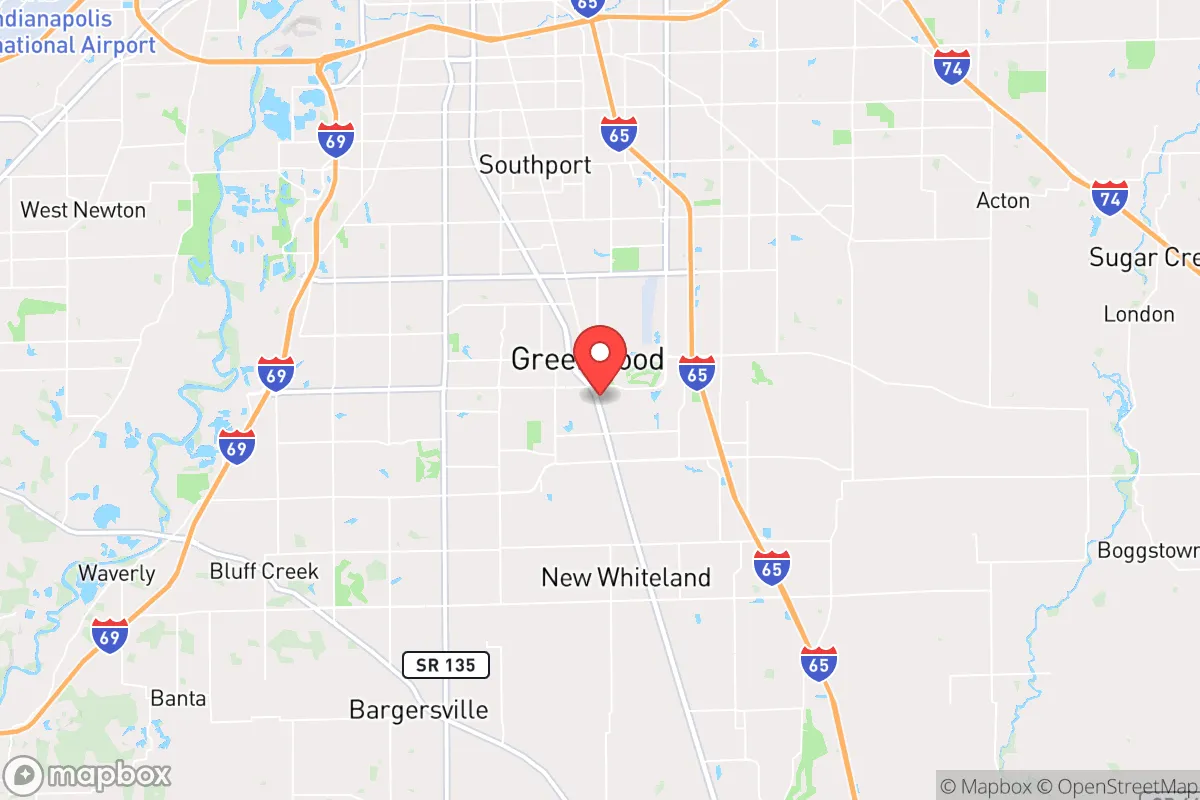
Photo: Wikipedia
Personal Sovereignty in Greenwood, IN
Viable for self-reliance. Generally workable, though some barriers may limit total independence.
What does Personal Sovereignty tell us?
Personal Sovereignty measures your capacity for self-reliance and independence with minimal government friction. Higher scores mean fewer barriers between you and the way you want to live... but it assumes you have the space you need and good neighbors.
What does this tell us?
Personal Sovereignty measures your capacity for self-reliance and independence with minimal government friction. Higher scores mean fewer barriers between you and the way you want to live... but it assumes you have the space you need and good neighbors.
State Policy
Energy independence: Importer (35% of energy produced in-state)
Personal Liberty
Homesteading

Personal Liberty Analysis
Greenwood, Indiana, offers a notably high degree of personal sovereignty relative to many other Midwestern suburbs, largely due to Indiana’s consistently conservative state-level governance and a local culture that prizes self-reliance. For the strategic relocation researcher with a survivalist or prepper mindset, the key takeaway is that Greenwood sits within a legal and regulatory environment that generally respects individual autonomy—especially in areas like self-defense, property rights, and parental control—while maintaining a low tax burden that leaves more resources in your hands. However, it’s not a libertarian free-for-all; zoning and building codes are present, and the state’s preemption laws are strong but not absolute. This analysis digs into the specifics that matter most for those prioritizing personal freedom and preparedness.
Tax burden and regulatory posture: How much of your money and choices stay yours
Indiana’s tax structure is a clear win for those seeking to minimize government extraction. The state imposes a flat income tax rate of 3.05% (as of 2025, with scheduled reductions toward 2.9% by 2027), and Greenwood’s combined state and local sales tax is 7%—competitive for the region. Property taxes are capped at 1% of assessed value for owner-occupied homes, a constitutional limit that prevents runaway levies. For a prepper household, this means more disposable income for supplies, land improvements, or investments in self-sufficiency. On the regulatory side, Indiana is a “right-to-work” state and has a generally pro-business climate, which translates to fewer occupational licensing hurdles and less bureaucratic friction for starting a home-based business or workshop. Greenwood itself operates under a home rule charter, but state preemption laws limit local overreach—for example, cities cannot ban short-term rentals or impose stricter building codes than the state mandates. That said, the city does enforce standard subdivision regulations and stormwater management rules, so don’t expect to build a bunker without permits. The overall posture is one of low interference compared to states like California or Illinois, but you’ll still need to navigate a modest layer of local ordinances.
Self-defense and gun law specifics: What you can carry, where, and how to store it
Indiana is a constitutional carry state as of July 2022, meaning any law-abiding adult 18 or older can carry a handgun openly or concealed without a permit. This is a foundational liberty for the prepper community, and Greenwood residents enjoy it fully. There is no state-level waiting period, no magazine capacity limit, and no requirement to register firearms. The state also has a “Stand Your Ground” law, codified in Indiana Code 35-41-3-2, which removes the duty to retreat before using deadly force if you are lawfully present and reasonably believe it’s necessary to prevent serious bodily harm or death. For parents, this extends to protecting your home and family without legal ambiguity. One practical note: while Greenwood is in Johnson County, which is generally sheriff-friendly, the city itself has a police department that enforces state law—no local gun bans are allowed due to state preemption. Storage-wise, there are no state mandates on how you secure firearms in your home, though federal law applies to sales. For those with a survivalist bent, this means you can stockpile ammunition and maintain a defensive arsenal without worrying about local ordinances changing overnight. The only real restriction is that carrying in schools (K-12) is prohibited unless you have a specific license or are a retired law enforcement officer, so plan accordingly for drop-offs and pickups.
Self-reliance and homesteading viability: Lot sizes, zoning, and off-grid feasibility
Greenwood is a suburban city of about 63,000 people, so true homesteading within city limits is limited. Standard residential lots in established neighborhoods range from 0.15 to 0.5 acres, with newer subdivisions often having smaller parcels. Zoning codes allow for backyard chickens (hens only, no roosters) on lots of at least 7,500 square feet, and you can keep up to six birds without a special permit. Beekeeping is also permitted with registration. However, larger livestock like goats or pigs are not allowed within city limits, and there are restrictions on the height and placement of fences, sheds, and outbuildings. For serious off-grid living—think solar panels, rainwater collection, or a private well—you’ll need to look at unincorporated Johnson County, just a few miles south or east of Greenwood. There, lot sizes of 1 to 5 acres are common and affordable (prices around $15,000–$40,000 per acre), and county zoning is much more permissive. Off-grid solar is legal statewide, but rainwater collection for potable use is technically regulated by the Indiana Department of Environmental Management; non-potable use (irrigation) is unrestricted. Composting toilets are allowed in rural areas with proper septic permits. For the prepper, the strategic play is to live in Greenwood for its schools and infrastructure while owning a small rural plot nearby for a bug-out location or garden expansion. The city’s proximity to I-65 and State Road 135 makes this dual-property setup feasible.
Personal liberties: Parental rights, medical autonomy, speech, and property
Indiana has been a battleground for parental rights, and recent legislation tilts strongly in favor of family autonomy. House Bill 1608 (2023) requires schools to notify parents of any changes in a student’s health or well-being, and it prohibits instruction on human sexuality in grades K-3. This aligns with a conservative view that parents, not the state, should guide children’s moral and medical decisions. Medical autonomy is more nuanced: Indiana has a religious exemption for vaccine mandates, and the state does not require COVID-19 vaccinations for school attendance. However, standard childhood immunizations are required unless you file a religious or medical exemption. For adults, there is no state-level mask or vaccine mandate, and the governor’s emergency powers were curtailed by the legislature in 2021. On free speech, Indiana has no hate speech laws that criminalize political expression, and Greenwood’s public forums (parks, sidewalks, city council meetings) are open for protest and assembly without a permit for small groups. Property rights are strong: the state has a “right to farm” law that protects agricultural operations from nuisance lawsuits, and eminent domain is limited to public projects with fair compensation. Greenwood does enforce a property maintenance code (tall grass, junk vehicles, etc.), so don’t expect to let your yard go wild without a fine. Overall, the legal climate respects individual choice in parenting, speech, and property, with the caveat that public health emergencies can still trigger state-level actions—but those are now checked by legislative oversight.
In the broader landscape of American personal sovereignty, Greenwood ranks well above the national median. It lacks the extreme libertarian permissiveness of rural Idaho or Alaska, but it also avoids the heavy-handed regulation of the Northeast or West Coast. For the strategic relocator who values low taxes, strong gun rights, and parental control, Greenwood offers a stable, predictable environment where government overreach is the exception, not the rule. The city’s suburban character means you’ll trade some homesteading flexibility for excellent infrastructure and community resilience, but the surrounding county provides a safety valve for those who want more land and fewer rules. If your priority is maximizing personal autonomy while staying within striking distance of a major metro (Indianapolis is 15 minutes north), Greenwood is a solid, defensible choice.

* Values derived from national, state, county, city and local statistics and may differ in a specific area. Last updated: 2026-04-22T09:22:53.000Z
Narrative content on this page is AI-generated and may contain mistakes. Verify any details that matter before acting on them.
ReloMaps may earn a commission from affiliate links at no extra cost to you.

