Strategic Assessment of Gretna, NE
Meaningful friction. Expect exposure to either population pressure, blast zones, or natural disaster risk. Consider buying a retreat property.
What does the Strategic Assessment tell us?
Our Strategic Assessment grades tactical survivability of an area. Major population centers, military targets, fallout zones, natural disasters, and border exposure all drive risk — lower exposure means a more defensible position in a crisis.
This is heavily inspired by Joel Skousen's Strategic Relocation book. Highly recommended you checkout the book ($)What does this tell us?
Our Strategic Assessment grades tactical survivability of an area. Major population centers, military targets, fallout zones, natural disasters, and border exposure all drive risk — lower exposure means a more defensible position in a crisis.
This is heavily inspired by Joel Skousen's Strategic Relocation book. Highly recommended you checkout the book ($)Strategic Pillars

Key Distances
Regional Safe Places
Below is our recommended "safe zones" in Nebraska and the surrounding area based on our strategic heuristics. For most people, it's unrealistic to live in a “safe zone” full-time due to work, family or other personal reasons. They tend to be more rural. However, many of these areas are perfect for second homes and retreat properties that double as a vacation home or even a short-term rental.
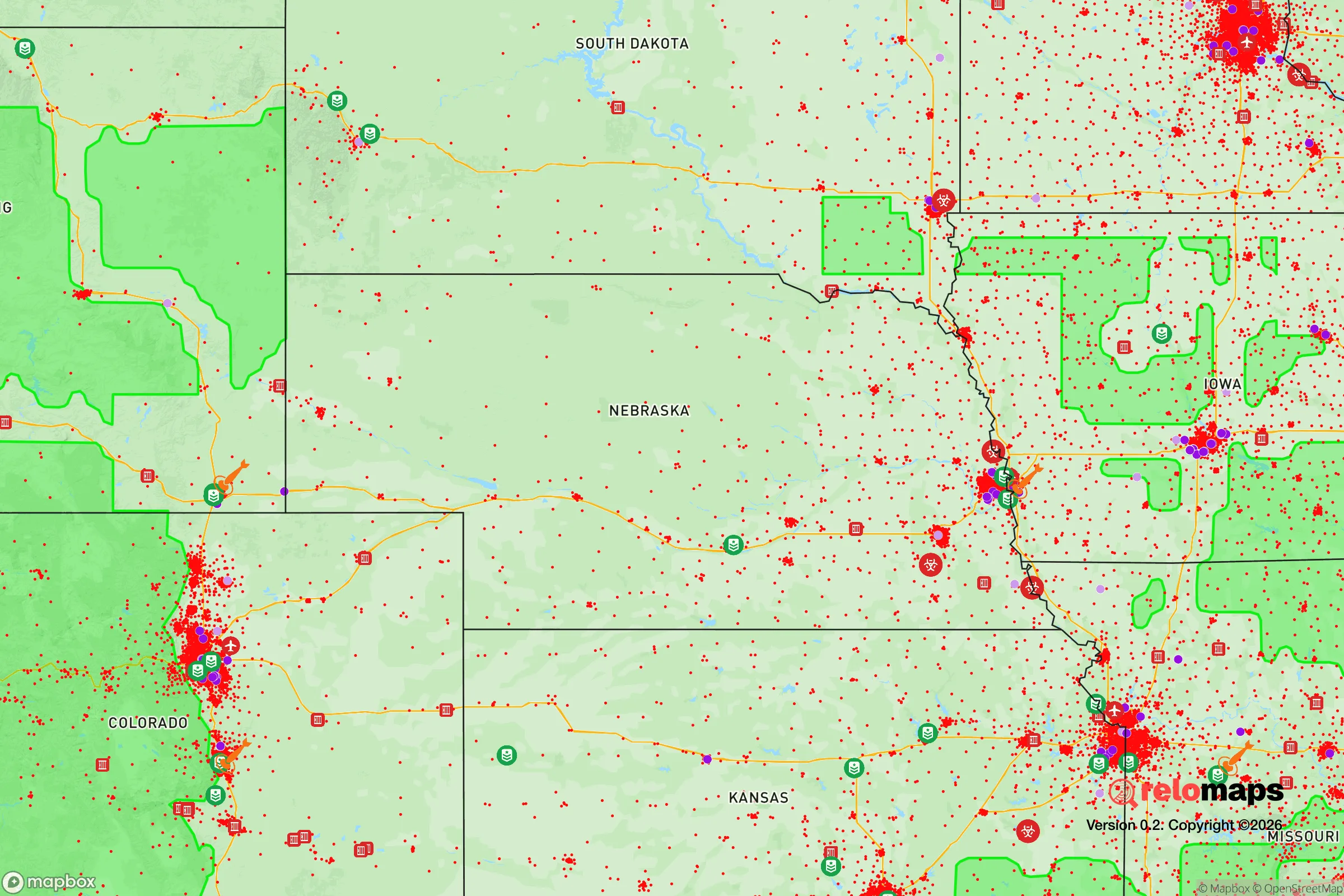
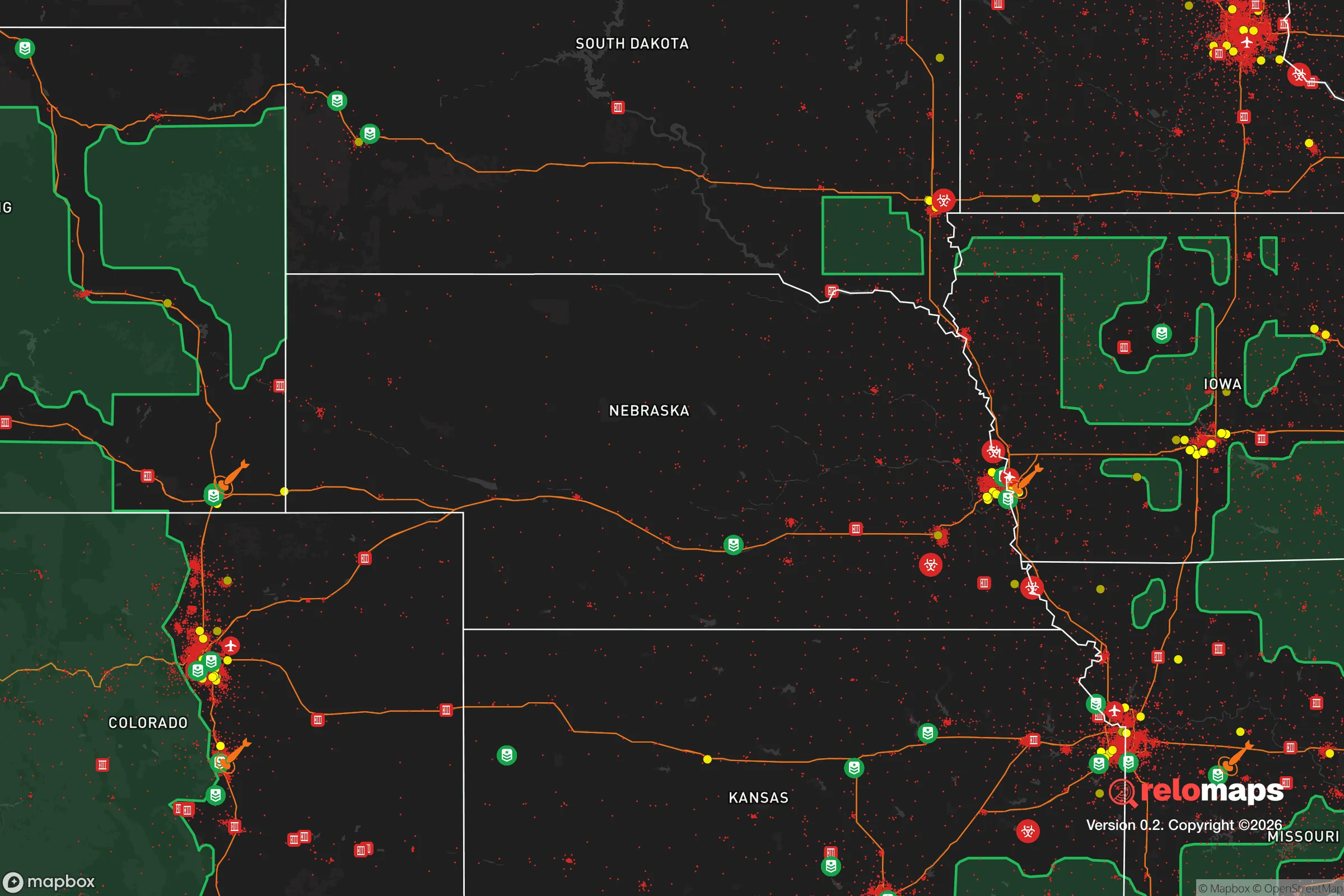


Important Note: For informational purposes only. This does not mean nothing bad ever happens in the green zones. Please use common sense. This is based on public data and modeled with AI. We tried to take a conservative approach but mistakes happen. We update this regularly as new information becomes available.
Solar Generator Recommendations
Backup power matters more here than in safer locations. We've picked three solar generators across budgets and capacity tiers — start with the budget unit if you only need a few essentials, or step up if you want to run a fridge and HVAC for days at a time.

Jackery Portable Power Station Explorer 300
Budget OptionPower on the Go: Weighing only 11 lbs, it's convenient to set up and store with book-sized foldable solar panels

BLUETTI Portable Power Station AC180
Designed for both indoor and outdoor scenarios, AC180 is highly capable as it has a robost capacity and continuous output power.

EF ECOFLOW DELTA Pro Ultra Power Station
Upgraded PickEcoFlow DELTA Pro Ultra is a whole-home energy system designed to grow with your family. Integrated with the Smart Home Panel 2, it scales to meet your evolving energy needs — keeping your home powered, intelligent, and secure through every stage of life.
We earn a commission, at no additional cost to you.
Strategic Assessment Analysis
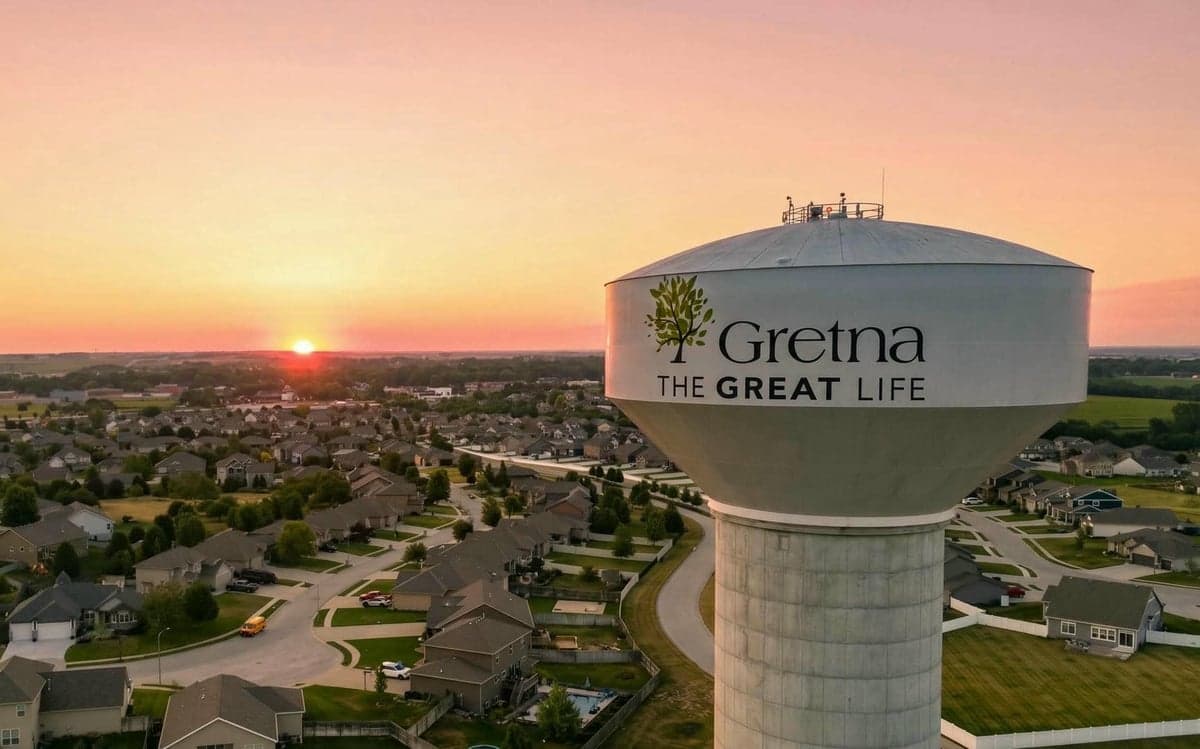
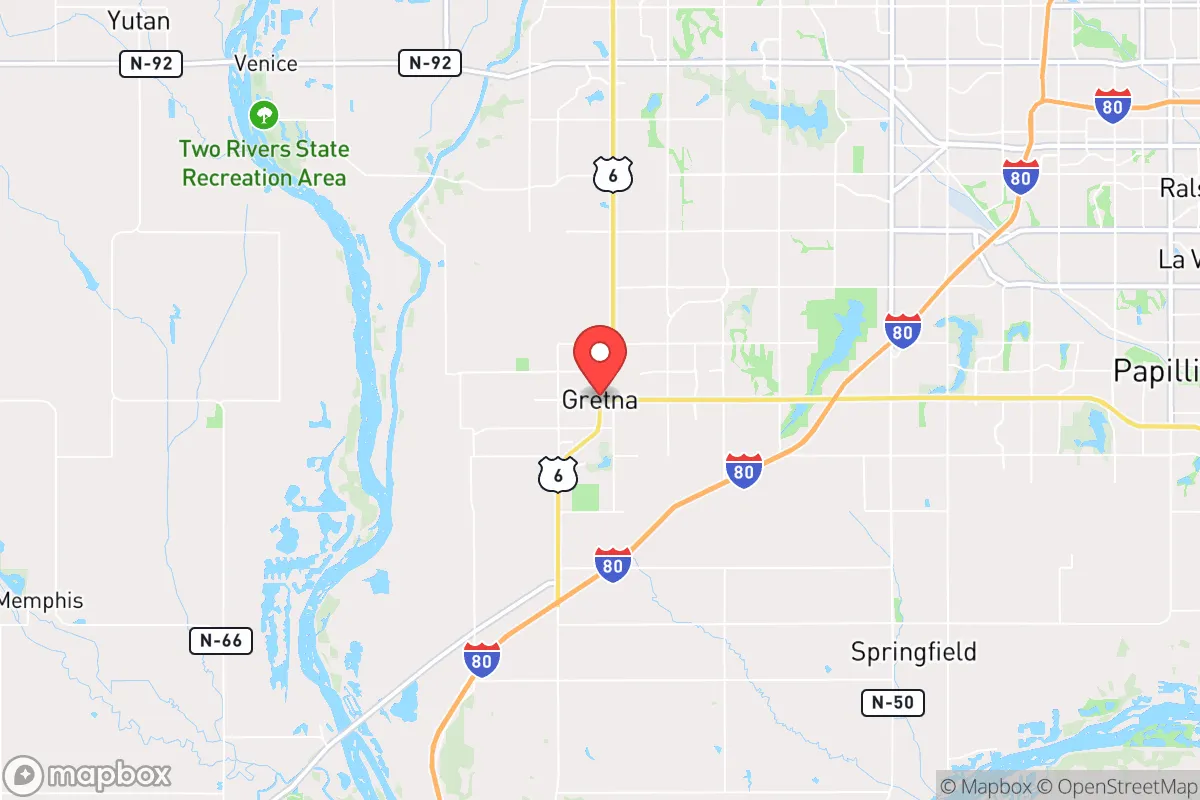
Gretna, Nebraska, positioned just southwest of Omaha along the Platte River, offers a strategic blend of proximity to urban resources and genuine separation from the risks that come with dense population centers. For a relocator thinking in terms of long-term resilience, this town of roughly 5,000 people sits in a sweet spot: close enough to access medical care, supply chains, and employment in Omaha and Lincoln, yet far enough to avoid being caught in the immediate chaos of a major metro area during a crisis. The area’s flat terrain, agricultural base, and relatively low population density make it a defensible and sustainable location for those prioritizing self-sufficiency and security in an increasingly uncertain national landscape.
Geographic position and natural advantages for long-term security
Gretna’s location at the intersection of the Platte River valley and the Loess Hills provides a rare combination of water access, elevated terrain, and agricultural richness. The Platte River, while shallow and braided, is a reliable surface water source that can support irrigation, livestock, and basic filtration systems for a prepared household. The Loess Hills to the west offer natural elevation changes that can aid in line-of-sight security and drainage, reducing flood risk compared to the river’s immediate floodplain. The surrounding soil is among the most productive in the nation, part of the Nebraska corn belt, meaning that even in a supply chain disruption, local food production capacity is high. The area’s continental climate brings cold winters and hot summers, but the lack of major seismic activity, hurricane risk, or wildfire threat makes it a low-hazard zone for natural disasters. For a prepper, this means fewer unpredictable events that could force a relocation or destroy infrastructure. The region’s position in the central time zone also places it away from coastal choke points, reducing the likelihood of being affected by port closures, naval blockades, or cascading failures from coastal population centers.
Risks, exposures, and proximity to fallout-relevant landmarks
No location is without vulnerabilities, and Gretna’s primary risk stems from its proximity to Offutt Air Force Base, located roughly 15 miles east in Bellevue. Offutt is a major command center for U.S. Strategic Command (STRATCOM) and a primary target in any large-scale conflict involving nuclear or conventional strikes. In a worst-case scenario, a detonation at Offutt would place Gretna within the moderate-to-severe fallout zone, depending on wind patterns. The prevailing westerly winds in the region would carry fallout eastward, which slightly mitigates the risk for Gretna, but it remains within a 20-mile radius of a high-value military asset. Additionally, the nearby Omaha metro area, with its population of nearly one million, presents risks of civil unrest, supply chain disruption, and disease spread during a crisis. The interstate highway system (I-80) running directly through Gretna is a double-edged sword: it provides evacuation routes and supply access, but also serves as a funnel for refugees fleeing Omaha or Lincoln during a collapse. The presence of the Platte River and the Union Pacific rail lines nearby also means that any disruption to these critical transportation arteries could affect Gretna’s access to goods. For a strategic relocator, these risks are manageable with proper planning—maintaining a 30-minute buffer from Offutt, storing supplies for at least 90 days, and having a secondary retreat location further west in the Sandhills region.
Practical resilience for a relocator: food, water, energy, and defensibility
Gretna’s practical resilience is strong for a small town, but it requires active preparation. The municipal water supply comes from groundwater wells in the Platte River aquifer, which is generally reliable but vulnerable to contamination from agricultural runoff or upstream industrial accidents. A prepper should invest in a deep-well hand pump or a Berkey-style filtration system, and consider drilling a private well if purchasing land outside city limits. The area’s agricultural infrastructure means that local farmers’ markets, co-ops, and direct-from-farm purchasing are viable options for food security, but a serious relocator should plan to grow a significant portion of their own calories. The growing season is roughly 150 days, suitable for corn, beans, squash, and cold-hardy greens, with a greenhouse extending that window. Energy resilience is a mixed bag: the grid is served by the Omaha Public Power District, which has a decent reliability record, but winter storms can cause outages. Solar panels are viable, with the region averaging 4.5 peak sun hours per day, but battery storage is essential for winter months. Natural gas is widely available for heating, but a backup wood stove or propane system is wise. Defensibility is where Gretna shines relative to suburban Omaha. The town’s layout, with a mix of older homes on larger lots and newer subdivisions, allows for perimeter security measures like fencing, motion lights, and clear sightlines. The surrounding farmland provides a natural buffer zone, and the Loess Hills to the west offer elevated positions for observation. The local law enforcement presence is adequate for day-to-day safety, but in a prolonged crisis, a neighborhood watch or mutual assistance group would be critical. The community itself is predominantly conservative, with a strong sense of self-reliance and a low tolerance for crime, which aligns well with a prepper mindset.
The overall strategic picture for Gretna is one of cautious optimism for a relocator willing to invest in preparation. It is not a remote bunker location, nor is it a high-risk urban center. It is a middle-ground option that offers access to resources, a supportive community, and a defensible position, while requiring active mitigation of the risks posed by nearby military and metro areas. For a single individual or family looking to balance modern convenience with long-term security, Gretna represents a viable base of operations—provided you treat it as a starting point, not a final destination. The key is to build redundancy into every system: water, food, energy, and security. If you do that, Gretna can serve as a stable anchor in an unstable world, with the option to relocate further west if conditions deteriorate. The area’s agricultural productivity, low natural disaster risk, and cultural alignment with self-sufficiency make it a strong candidate for those who view relocation as a strategic decision, not just a lifestyle change.

* Values derived from national, state, county, city and local statistics and may differ in a specific area. Last updated: 2026-05-03T20:29:47.000Z
Narrative content on this page is AI-generated and may contain mistakes. Verify any details that matter before acting on them.
ReloMaps may earn a commission from affiliate links at no extra cost to you.

