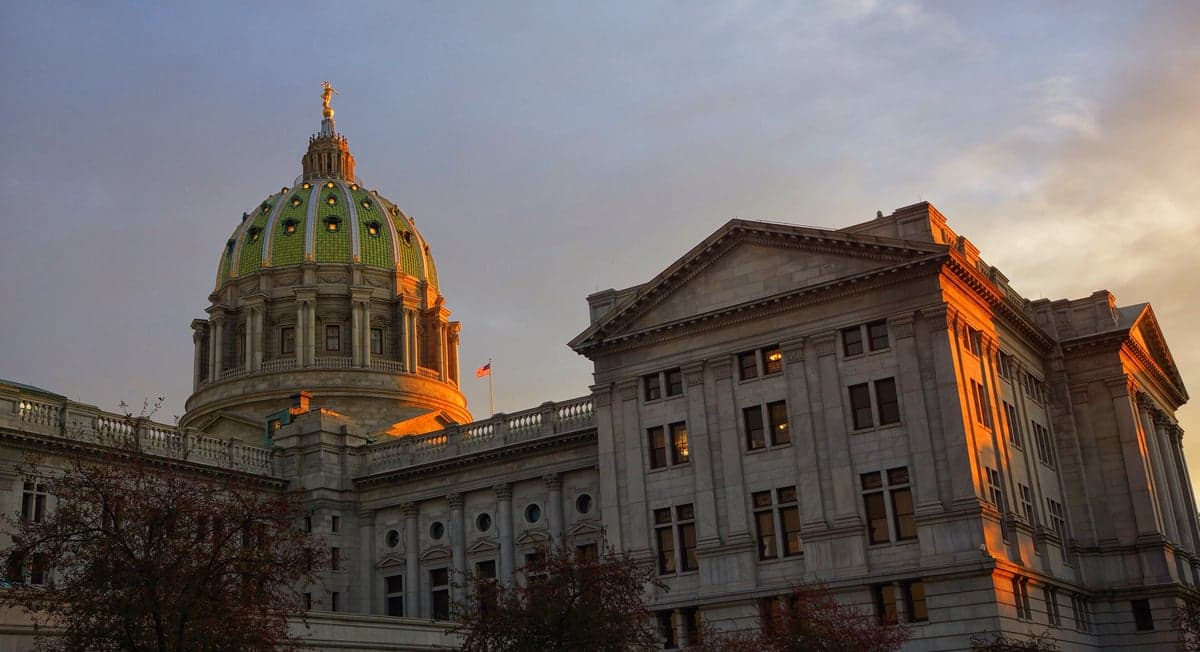
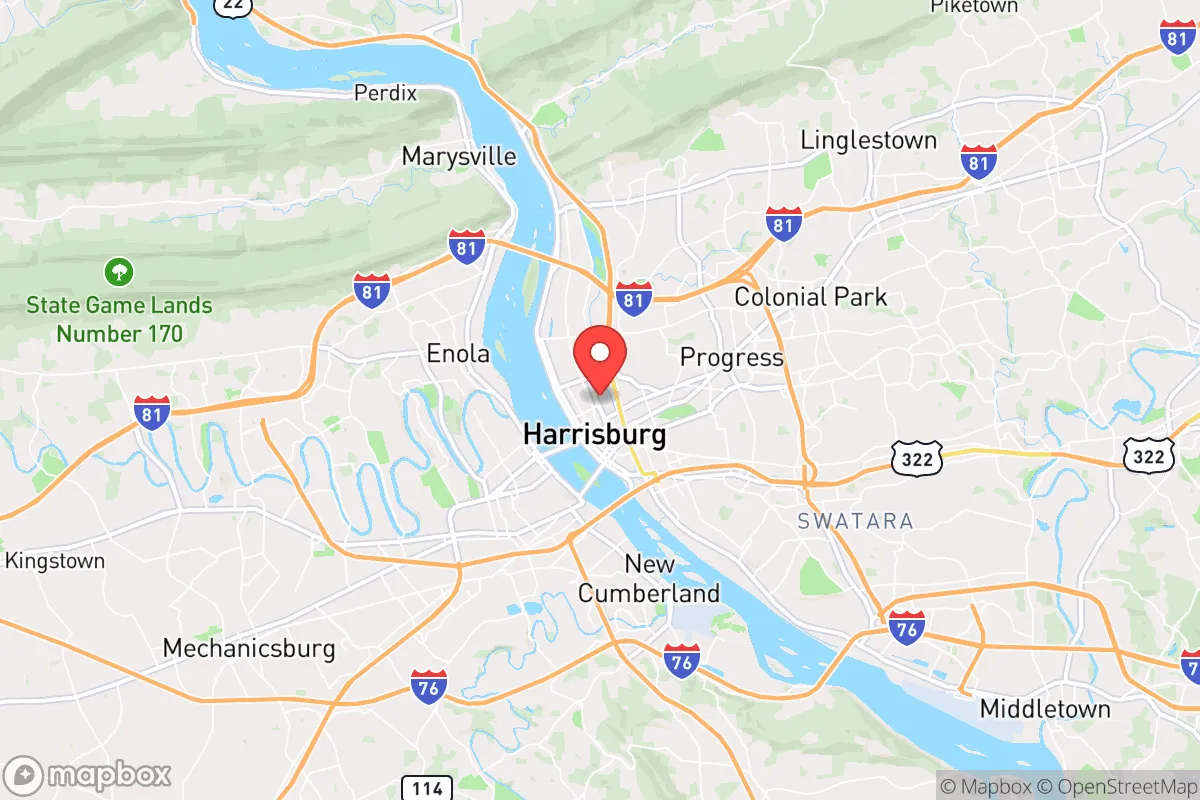
Photo: Wikipedia
Demographics of Harrisburg, PA
Affluence Level in Harrisburg, PA
A low-income area with significant economic hardship. Household wealth and educational attainment are well below national averages.
People of Harrisburg, PA
Harrisburg, Pennsylvania, is a small, dense capital city of roughly 50,000 residents, characterized by a majority-minority population that is predominantly Black (41.5%) and Hispanic (25.0%), with a White population of 25.9%. The city’s identity is shaped by a history of industrial boom, post-war suburban flight, and recent waves of Hispanic immigration, creating a community that is both deeply rooted and in demographic transition. With a foreign-born share of just 4.8% and a college-educated rate of 26.3%, Harrisburg is a working-class city where distinct ethnic enclaves and neighborhoods tell the story of who came, when, and why.
How the city was settled and grew
Harrisburg’s population history begins with its founding in 1785 by John Harris Jr., whose family operated a ferry across the Susquehanna River. The city’s early growth was driven by its role as the state capital (established 1812) and as a transportation hub for the Pennsylvania Canal and later the Pennsylvania Railroad. The first major wave of European settlers were German and Scotch-Irish farmers and craftsmen, who built the city’s early neighborhoods like Shipoke (the oldest residential district, with 18th-century row homes) and Midtown (a mixed-use area of Victorian homes and commercial corridors). By the late 19th century, Harrisburg’s industrial expansion—especially in steel, iron, and railroad manufacturing—drew a second wave of immigrants: Irish, Italian, and Eastern European laborers (Poles, Slovaks, Ukrainians). These groups settled in working-class enclaves like Uptown and Allison Hill, where ethnic churches and social clubs anchored communities. The Great Migration (1910–1970) brought a third wave: African Americans from the rural South, seeking industrial jobs in Harrisburg’s factories and railroad yards. By 1950, the Black population had grown to roughly 15% of the city, concentrated in Allison Hill and parts of South Allison Hill, which became the historic heart of the city’s Black community.
Modern era (post-1965)
The post-1965 era reshaped Harrisburg’s demographics dramatically. The Hart-Cellar Immigration Act opened doors to new immigrant groups, but Harrisburg’s foreign-born share remained low (4.8% today) compared to larger cities. Instead, the major shift was domestic: suburbanization and white flight accelerated after the 1960s, as middle-class White families moved to suburbs like Susquehanna Township and Lower Paxton Township. Between 1960 and 2020, the city’s White population fell from over 70% to 25.9%, while the Black population grew to 41.5% and the Hispanic population surged from near-zero to 25.0%. The Hispanic wave, primarily Puerto Rican and Dominican, began in the 1980s and 1990s, driven by job opportunities in warehousing, distribution, and service industries. These newcomers settled in South Allison Hill and Uptown, creating vibrant Latino commercial corridors along Derry Street and Cameron Street. The East/Southeast Asian community (1.7%) is small but visible, with a concentration of Vietnamese and Korean families in Midtown and parts of Shipoke, often running small restaurants and nail salons. The Indian-subcontinent population (0.9%) is even smaller, with professionals working in state government and healthcare, scattered across the city rather than forming a distinct enclave. The city’s college-educated rate of 26.3% reflects a modest professional class tied to state government, healthcare (UPMC Pinnacle), and education (Harrisburg University), but the overall population remains working-class, with a poverty rate above 25%.
The future
Harrisburg’s population is trending toward further diversification, but the city is not homogenizing—it is tribalizing into distinct enclaves. The Hispanic share is the fastest-growing segment, projected to approach 30–35% by 2040, driven by continued migration from Puerto Rico and the Dominican Republic, as well as natural increase. This growth is concentrated in South Allison Hill and Uptown, where Latino-owned businesses and churches are expanding. The Black population, while still the largest group, is plateauing as younger Black families move to suburbs like Steelton or Swatara Township for better schools and housing. The White population is stabilizing at around 25%, with a small but growing number of young professionals and empty-nesters moving into Midtown and Shipoke, attracted by historic architecture and proximity to the Capitol. The East/Southeast Asian and Indian communities are likely to remain small, as Harrisburg lacks the tech or academic sectors that drive larger Asian immigration in other state capitals. The city’s future is one of a tri-ethnic working-class core—Black, Hispanic, and White—with increasing economic stratification between gentrifying pockets (Midtown, Shipoke) and struggling neighborhoods (Allison Hill, Uptown).
For someone moving in now, Harrisburg is a city of distinct, neighborhood-based communities where demographic change is ongoing but not chaotic. The city offers affordable housing and a central location, but newcomers should expect a place where race and ethnicity strongly correlate with neighborhood boundaries and economic opportunity. The next decade will likely see continued Hispanic growth, a stable Black plurality, and modest White professional in-migration, making Harrisburg a more diverse but still economically divided capital.

* Values derived from national, state, county, city and local statistics and may differ in a specific area. Last updated: 2026-05-02T00:54:50.000Z
Narrative content on this page is AI-generated and may contain mistakes. Verify any details that matter before acting on them.
ReloMaps may earn a commission from affiliate links at no extra cost to you.

