
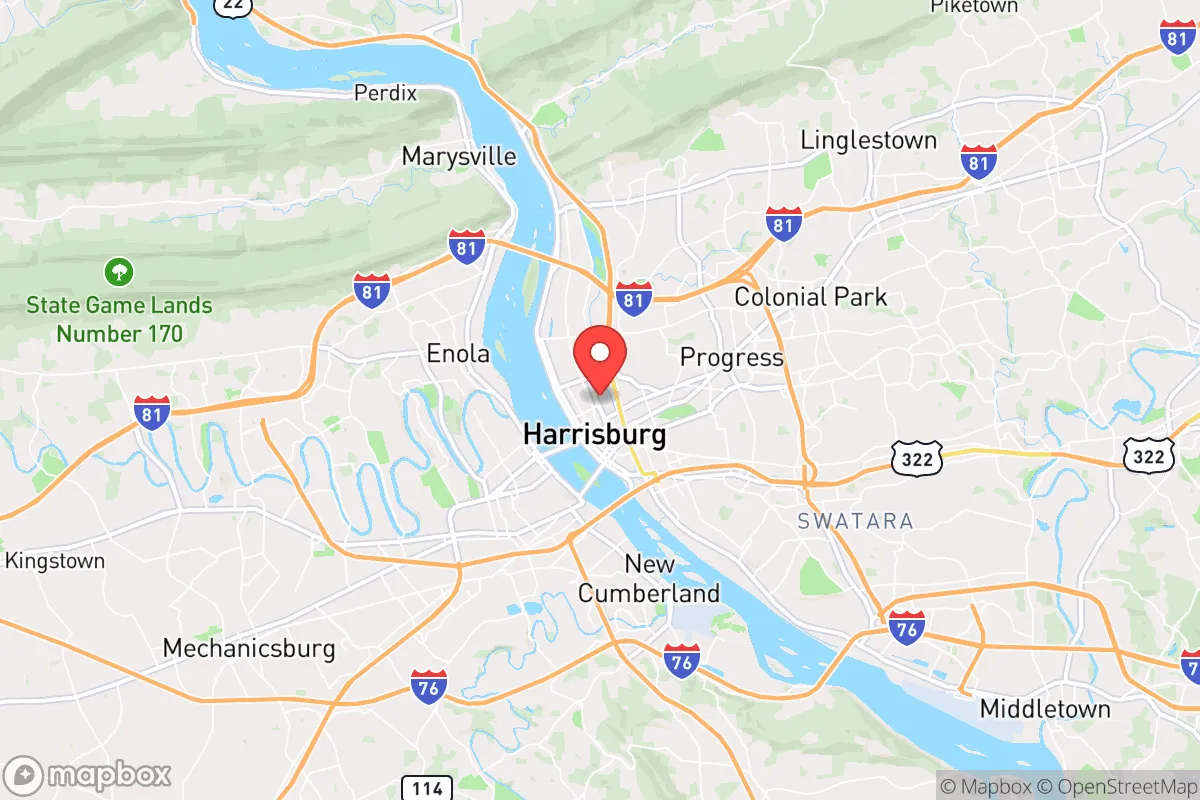
Photo: Wikipedia
Personal Sovereignty in Harrisburg, PA
Strong independent fundamentals that actively favor personal liberty and low regulation.
What does Personal Sovereignty tell us?
Personal Sovereignty measures your capacity for self-reliance and independence with minimal government friction. Higher scores mean fewer barriers between you and the way you want to live... but it assumes you have the space you need and good neighbors.
What does this tell us?
Personal Sovereignty measures your capacity for self-reliance and independence with minimal government friction. Higher scores mean fewer barriers between you and the way you want to live... but it assumes you have the space you need and good neighbors.
State Policy
Energy independence: Net exporter (150% of energy produced in-state)
Personal Liberty
Homesteading

Personal Liberty Analysis
For the survivalist or prepper evaluating Harrisburg, Pennsylvania, as a potential relocation hub, the personal sovereignty picture is a mixed bag of state-level overreach and local-level opportunity. Pennsylvania is not a free state in the mold of Idaho or Montana, but it is far from the most restrictive jurisdictions on the East Coast. The capital city itself sits in a regulatory and tax environment that demands careful navigation, particularly for those who prioritize self-reliance, minimal government intrusion, and the ability to keep what they earn and own. The key question is whether the trade-offs—moderate taxes, restrictive gun laws in the city, and limited homesteading potential—are acceptable for your strategic goals.
Tax burden and regulatory posture: How much of your income and property stays yours
Pennsylvania’s tax structure is a relative bright spot for those seeking to minimize government extraction, though it is not without its own creeping costs. The state levies a flat personal income tax of 3.07%, which is low compared to many Northeastern states, and there is no tax on retirement income, including Social Security, pensions, and 401(k) withdrawals. This is a significant advantage for preppers looking to preserve capital and reduce dependency on government checks. However, Harrisburg itself imposes a local earned income tax of 1% for residents, plus a school district tax that can push the effective rate higher. Property taxes in Dauphin County are moderate but not negligible; the median effective property tax rate hovers around 1.5% of home value, which is roughly in line with the national average but higher than many Southern or Western states. The regulatory posture in Pennsylvania is a mixed signal for the self-reliant. The state has a reputation for bureaucratic red tape, particularly around environmental regulations and building permits, which can frustrate off-grid or homesteading projects. For example, the Pennsylvania Department of Environmental Protection (DEP) has stringent rules on water rights, septic systems, and land use that can delay or derail independent infrastructure. In Harrisburg proper, city zoning is dense and restrictive, favoring multi-family units over large lots, which limits the ability to raise livestock or install alternative energy systems without jumping through hoops. The regulatory climate is not hostile to personal sovereignty, but it is not friendly either—it is a slow, grinding bureaucracy that rewards patience and local connections.
Self-defense and gun law specifics: What you can carry, where, and how the state restricts you
For the armed citizen, Pennsylvania is a shall-issue state for concealed carry permits, meaning the county sheriff must issue a License to Carry Firearms (LTCF) to any applicant who passes a background check and meets basic criteria. This is a solid foundation for self-defense, but the devil is in the details. Harrisburg is in Dauphin County, where the sheriff’s office generally processes LTCF applications within 45 days, and there are no local ordinances that ban open carry—though open carry is legal without a permit outside of Philadelphia. However, the state preempts local gun laws, meaning Harrisburg cannot enact its own bans on assault weapons or magazine capacity, which is a win for uniformity. The major downside is that Pennsylvania does not have constitutional carry; you must have a permit to carry a concealed firearm. Additionally, the state imposes a 48-hour waiting period on handgun purchases and requires a Pennsylvania State Police background check for all firearm transfers, including private sales. For the prepper, this means building a personal armory requires planning and patience. The state also has a "stand your ground" law, but it is not as robust as in Florida or Texas; the law allows you to use deadly force if you reasonably believe it is necessary to prevent death or great bodily harm, but you have a duty to retreat if you can do so safely outside your home. In practice, this means a self-defense shooting in Harrisburg will face scrutiny, and you should expect a legal battle even if justified. The bottom line: Pennsylvania is a decent state for gun owners, but it is not a sanctuary. You can defend yourself, but the state will hold you to a high standard of justification.
Self-reliance and homesteading viability: Lot sizes, zoning, and off-grid feasibility
If your vision of personal sovereignty involves a few acres, a garden, chickens, and solar panels, Harrisburg itself is not your destination. The city is dense, with typical residential lots ranging from 0.1 to 0.25 acres, and zoning codes heavily restrict agricultural activities. Raising chickens is technically allowed in some residential zones, but only with a permit and strict limits on the number of birds, and no roosters are permitted. Keeping goats, pigs, or larger livestock is effectively banned within city limits. For off-grid systems, the city requires connection to municipal water and sewer in most areas, and installing solar panels requires building permits that can take months to approve. The real opportunity lies in the surrounding townships and rural areas of Dauphin County, such as Lower Paxton, Swatara, or Middle Paxton townships, where lot sizes of 1 to 5 acres are common and zoning is more permissive. In these areas, you can realistically keep a small flock of chickens, maintain a substantial garden, and install a backup generator or solar array without excessive red tape. However, full off-grid living—well water, septic, no grid connection—is difficult to achieve legally in Pennsylvania due to state health and environmental codes. The DEP requires permits for wells and septic systems, and many townships mandate a minimum lot size of 2 to 5 acres for such systems. For the serious prepper, the Harrisburg metro area offers a compromise: you can live in a suburban or exurban setting with some self-reliance capacity, but you will not achieve the total independence of a remote homestead in the Appalachians. The trade-off is proximity to supply chains, medical facilities, and a larger community of like-minded individuals.
Personal liberties: Parental rights, medical autonomy, speech, and property
Pennsylvania’s record on personal liberties is a study in contradictions that should concern the liberty-minded. On parental rights, the state has a mixed history. There is no explicit "parental bill of rights" in state law, but parents do have the legal authority to direct their children’s education, including the option to homeschool with relatively simple requirements (a notarized affidavit and annual evaluations). However, the state Department of Education has been known to overreach, and there have been legislative battles over curriculum transparency and medical mandates for children. For the prepper concerned about government overreach into family decisions, this is a yellow flag. Medical autonomy is a more troubling area. Pennsylvania has not enacted broad medical freedom legislation; vaccine mandates for schoolchildren remain in place, and during the COVID-19 pandemic, the state imposed some of the most restrictive lockdowns in the nation, including business closures and gathering limits that lasted for months. The state also has a prescription drug monitoring program that tracks controlled substances, which can be a concern for those who stockpile medications for emergencies. On speech and property rights, Pennsylvania is generally protective. There are no state-level laws that restrict political speech or assembly, and the state constitution explicitly protects the right to keep and bear arms. Property rights are strong, with no statewide rent control and relatively low eminent domain abuse compared to states like New York. However, the state’s environmental regulations can effectively limit how you use your land, particularly if you want to build a bunker, dig a pond, or harvest timber. The overall picture is that Pennsylvania respects some liberties more than others, and the prepper must be vigilant about legislative trends in Harrisburg that could erode these rights further.
In the broader landscape of personal sovereignty, Harrisburg and its surrounding area offer a middle-ground option for the survivalist. You get a low income tax, a shall-issue gun permit system, and a legal framework that allows for homeschooling and property ownership. But you also get a state government that has shown a willingness to impose mandates, restrict medical freedom, and regulate land use to a degree that can frustrate off-grid ambitions. Compared to states like New Hampshire or Texas, Pennsylvania is a compromise. Compared to New York or New Jersey, it is a haven. For the strategic relocator who values self-reliance but needs access to urban infrastructure and a community of fellow preppers, the Harrisburg metro area is worth a serious look—just know that you will be fighting the bureaucracy, not escaping it entirely.

* Values derived from national, state, county, city and local statistics and may differ in a specific area. Last updated: 2026-05-02T00:54:50.000Z
Narrative content on this page is AI-generated and may contain mistakes. Verify any details that matter before acting on them.
ReloMaps may earn a commission from affiliate links at no extra cost to you.

