Photo: Wikipedia
Demographics of Harrison, AR
Affluence Level in Harrison, AR
A below-average socioeconomic profile. Incomes, home values, and educational attainment trail the U.S., with higher poverty and unemployment.
People of Harrison, AR
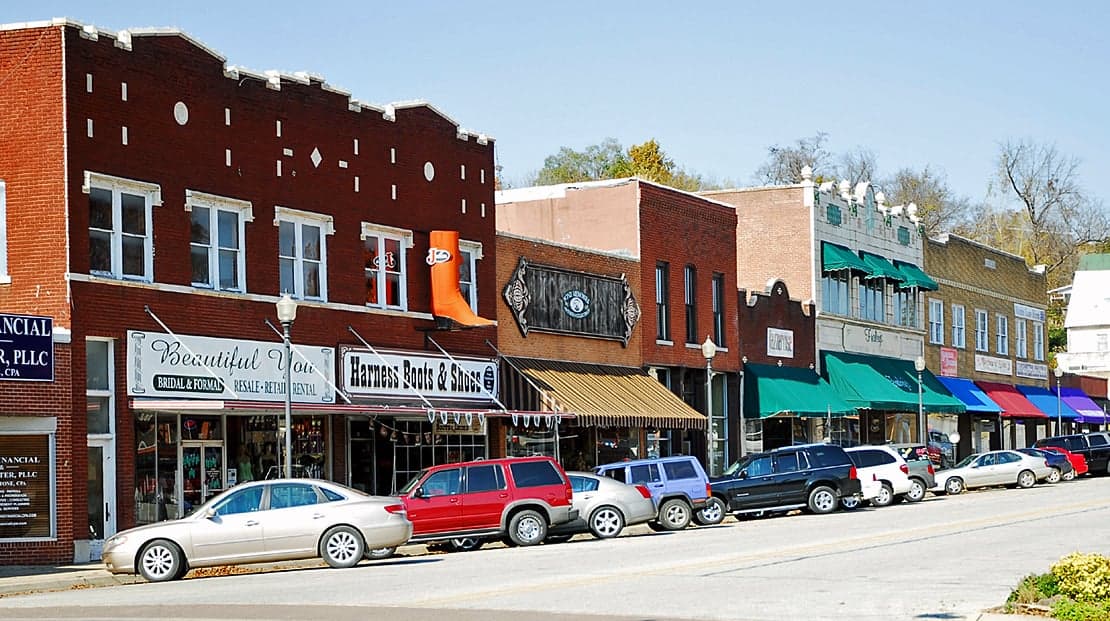
The people of Harrison, Arkansas, today form a predominantly white, native-born population of 13,217, characterized by a strong sense of local identity and a slower pace of life. With 90.7% of residents identifying as white and only 1.6% foreign-born, the city is notably less diverse than the national average, a fact that shapes its social and cultural landscape. The population is also less college-educated (16.5%) than the state or national average, reflecting a community rooted in blue-collar and service-sector employment. This demographic profile gives Harrison a distinctive character as a place where generational roots run deep and newcomers often have specific reasons—family, work, or a deliberate choice for a quieter, more homogeneous environment—for relocating.
How the city was settled and grew
Harrison’s founding population arrived in the 1860s and 1870s, drawn by the promise of cheap land and the region’s timber and agricultural potential. The city was officially incorporated in 1876, and its early growth was fueled by the railroad’s arrival in the 1880s, which connected the Ozarks to outside markets. The original settlers were overwhelmingly of Scots-Irish and English descent, migrating from the Upper South—Tennessee, Kentucky, and Missouri—seeking homesteads in the rugged hills. These early families built the core of what is now Downtown Harrison, centered around the courthouse square, and established the first residential blocks along Ridge Avenue and Stephenson Avenue, where many of the city’s oldest homes still stand. A second wave arrived in the early 1900s, drawn by the timber boom and the opening of the first fruit orchards and poultry operations. These workers settled in the South Maple Street area and the East Central Avenue corridor, creating modest working-class neighborhoods that remain largely intact today. By 1950, Harrison’s population had reached roughly 5,000, and the city’s character as a quiet, self-reliant Ozark community was firmly established.
Modern era (post-1965)
After the 1965 Hart-Cellar Act, Harrison experienced virtually none of the immigration-driven diversification seen in larger U.S. cities. The foreign-born population today stands at just 1.6%, and the city’s racial composition has remained remarkably stable. The most notable demographic shift since the 1970s has been the gradual suburbanization of the city’s existing white population, with new subdivisions spreading outward from the historic core. The Northwood Estates neighborhood, developed in the 1970s and 1980s, attracted families seeking larger lots and newer homes, while the Oakmont Addition area, built in the 1990s and 2000s, became a destination for retirees and professionals. The Hispanic population, now 5.2%, is the only minority group with a measurable presence, and its growth has been concentrated in the West Freeman Avenue corridor and parts of South Pine Street, where a small number of service-industry and construction workers have settled. The Black population (0.2%) and East/Southeast Asian population (0.2%) remain negligible, and the Indian-subcontinent population is effectively zero. This post-1965 era has been one of demographic continuity rather than transformation, with the city’s population growing slowly—from about 9,000 in 1970 to 13,217 today—primarily through natural increase and limited domestic in-migration from other parts of Arkansas and the Midwest.
The future
Looking ahead, Harrison’s population is likely to continue its slow, homogeneous growth, with no major forces driving rapid diversification. The Hispanic share may inch upward as families already in the area have children and as a small number of workers are drawn to jobs in poultry processing and construction, but the overall foreign-born percentage is unlikely to exceed 3-4% in the next decade. The city is not tribalizing into distinct ethnic enclaves; rather, it is homogenizing around its existing white majority, with new subdivisions like Bellefonte Estates attracting the same demographic profile as older neighborhoods. The low college attainment rate (16.5%) suggests that out-migration of young adults for education and white-collar careers will continue, tempering overall growth. The next 10-20 years will likely see Harrison remain a predominantly white, native-born community with a stable population size, modest new construction on the city’s fringes, and little change in its fundamental character.
For someone moving in now, Harrison offers a community where the population is predictable, the pace is slow, and the social fabric is woven from generations of shared local history. It is not a place of rapid demographic change or cultural flux, but rather a steady, insular Ozark town where newcomers who fit the existing mold will find a welcoming, if insular, environment. Those seeking diversity or a rapidly evolving population will need to look elsewhere, but for those who value stability and a tight-knit, predominantly white community, Harrison remains what it has been for over a century.

* Values derived from national, state, county, city and local statistics and may differ in a specific area. Last updated: 2026-04-30T01:37:21.000Z
Narrative content on this page is AI-generated and may contain mistakes. Verify any details that matter before acting on them.
ReloMaps may earn a commission from affiliate links at no extra cost to you.

