Demographics of Hartford, SD
Affluence Level in Hartford, SD
A middle-class area roughly in line with national averages across income, home values, education, and employment.
People of Hartford, SD
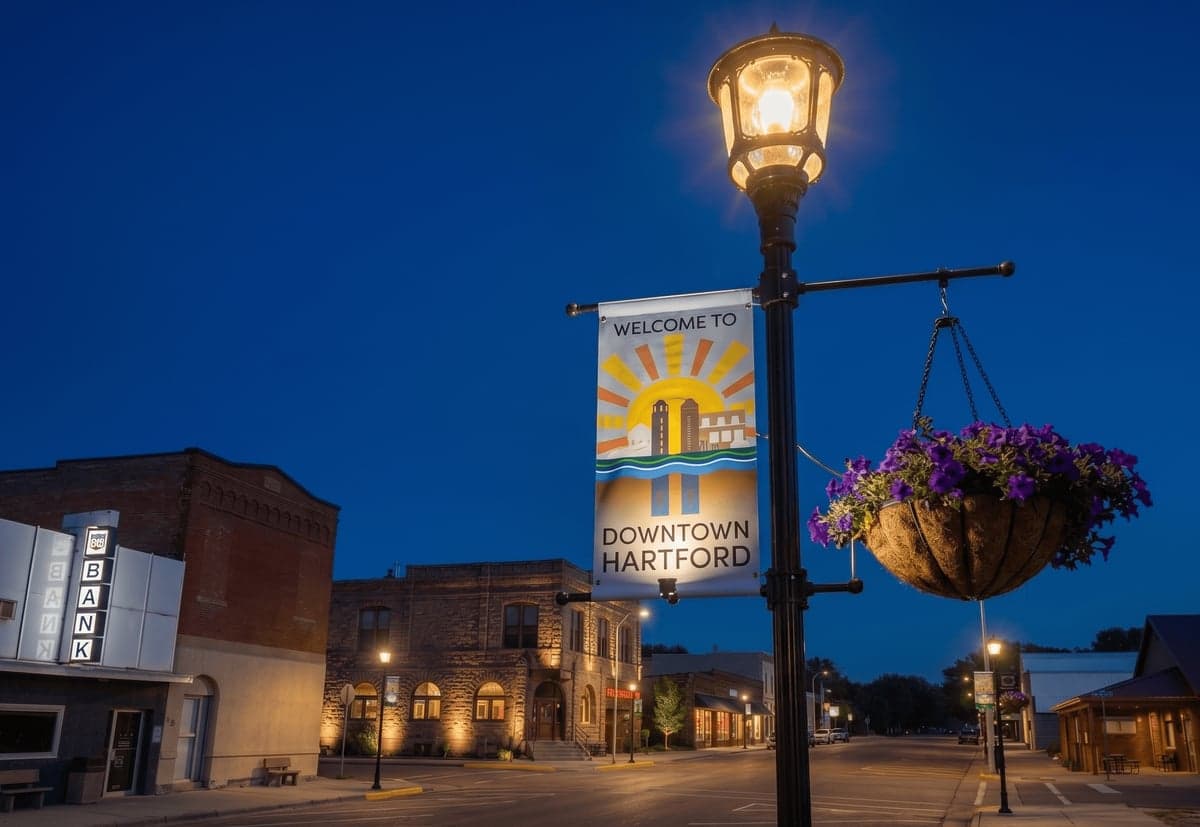
The people of Hartford, South Dakota today form a predominantly white, family-oriented community of 3,412 residents, with a notably low foreign-born share of just 1.6% and a population that is 90.2% white. The city’s character is shaped by its role as a quiet, affordable bedroom community for nearby Sioux Falls, combined with a strong agricultural heritage that still anchors local identity. Distinctive markers include a high rate of homeownership, a median age slightly below the state average, and a civic culture centered on schools, churches, and youth sports. With only 2.0% of residents identifying as Hispanic and no measurable Black, East/Southeast Asian, or Indian-subcontinent populations, Hartford remains one of the least ethnically diverse cities in Minnehaha County.
How the city was settled and grew
Hartford’s founding population arrived in the 1870s and 1880s, drawn by the federal Homestead Act and the promise of fertile farmland in the Big Sioux River valley. The original settlers were overwhelmingly Northern European—primarily Norwegian, German, and Dutch families—who established small grain and livestock operations. The city was platted in 1878 along the route of the Chicago, Milwaukee & St. Paul Railroad, which made it a shipping point for agricultural goods. These early homesteaders built their homes in what is now known as Old Town Hartford, the historic core centered around Main Street and the railroad depot. A second wave of German-Russian immigrants arrived around 1900, settling on farms to the north and west, and many of their descendants still live in the North Hartford area, where older farmsteads have been subdivided into acreages. The city remained a small agricultural service center through the mid-20th century, with population hovering around 300 until the 1970s.
Modern era (post-1965)
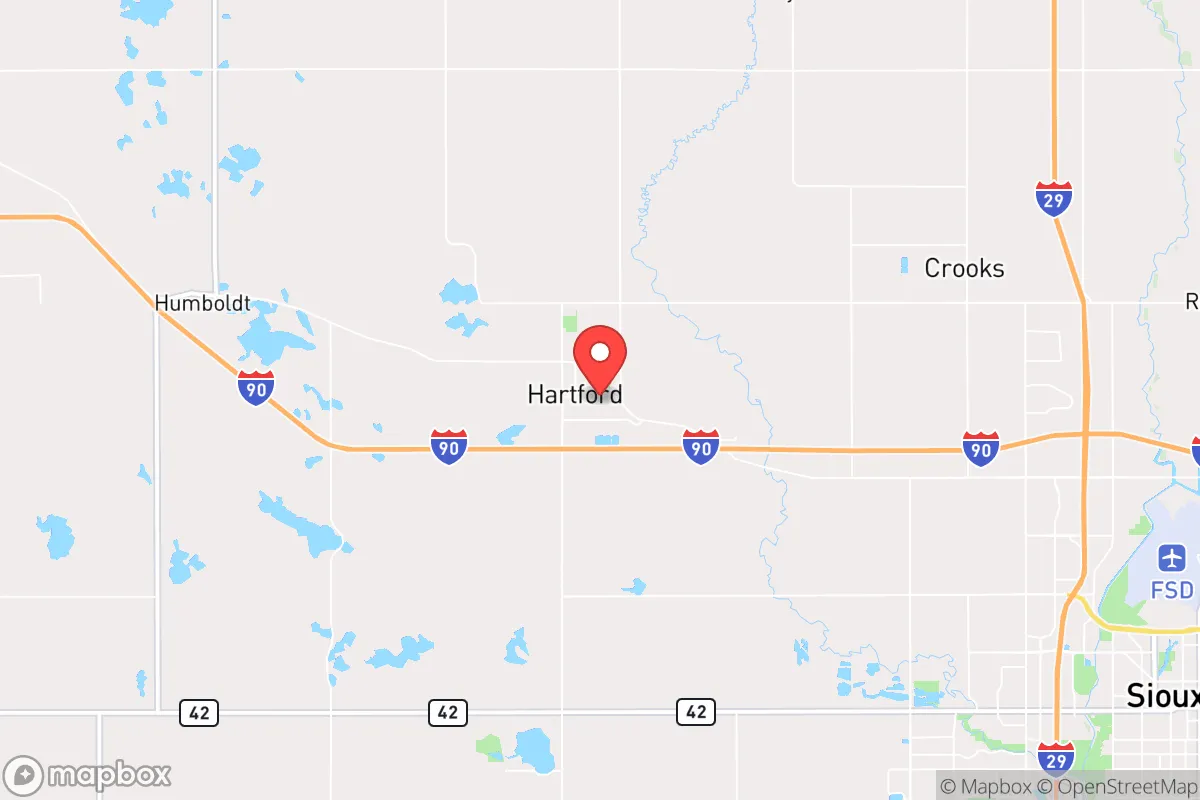
The modern transformation of Hartford’s population began in earnest after the 1965 Hart-Cellar Act, though its direct effect was minimal—the city saw almost no immigration from Asia, Latin America, or the Indian subcontinent. Instead, the major demographic shift was domestic: the suburbanization of Sioux Falls. Starting in the 1990s, families seeking larger lots, lower taxes, and smaller schools began moving east from Sioux Falls into Hartford. This wave settled primarily in two newer subdivisions: Prairie Hills, a master-planned development of single-family homes built between 1995 and 2010, and Sunset Ridge, a more recent addition of mid-priced homes on the city’s south side. These neighborhoods attracted a mix of young families and empty-nesters, many employed in Sioux Falls’ healthcare, finance, and manufacturing sectors. The population more than doubled between 2000 and 2020, from roughly 1,500 to over 3,400. The foreign-born share remained negligible throughout this period, and the Hispanic share grew only slightly, from 0.5% in 2000 to 2.0% today, concentrated in a handful of rental properties near the Hartford Business Park on the east edge of town.
The future
Hartford’s population is projected to continue growing, likely reaching 4,500–5,000 by 2040, driven entirely by domestic in-migration from Sioux Falls and other parts of Minnehaha County. The city’s demographic profile is expected to remain overwhelmingly white and native-born, with only modest increases in Hispanic and Asian shares as the broader Sioux Falls metro diversifies. New construction is concentrated in the Hartford Crossing development on the west side, a 200-acre mixed-use project that will add both single-family homes and townhouses, and in the East Hartford corridor along Highway 38, where several large-lot subdivisions are planned. These areas will likely attract the same profile of residents as Prairie Hills and Sunset Ridge: married couples with children, employed in white-collar or skilled trades, and seeking a small-town lifestyle within commuting distance of a major city. The cultural identity of Hartford is evolving from a purely agricultural community to a hybrid of farm-town roots and suburban convenience, though the pace of change is slow enough that long-time residents still dominate local leadership and civic life.
For someone moving in now, Hartford offers a stable, low-diversity, family-focused environment where the population is growing but not rapidly changing in character. The city is becoming more suburban and slightly more connected to Sioux Falls’ economy, but it remains a place where neighbors know each other, schools are small, and the pace of life is deliberately slower. The lack of significant ethnic or cultural diversity means newcomers will find a community that is welcoming but relatively homogeneous, with social life organized around church, school, and local events like the Hartford Corn Feed. This is not a city undergoing demographic transformation—it is a city quietly expanding while preserving its core identity.

* Values derived from national, state, county, city and local statistics and may differ in a specific area. Last updated: 2026-09-27T15:22:50.000Z
Narrative content on this page is AI-generated and may contain mistakes. Verify any details that matter before acting on them.
ReloMaps may earn a commission from affiliate links at no extra cost to you.

