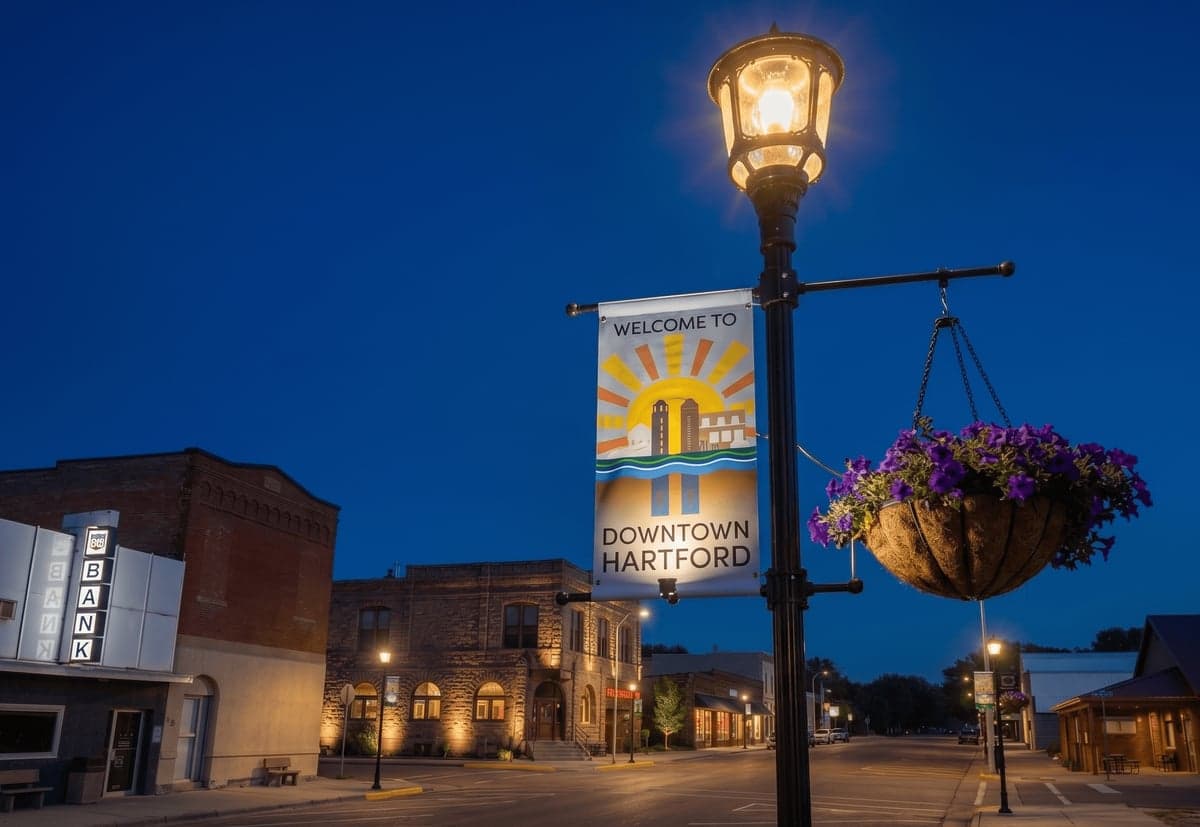
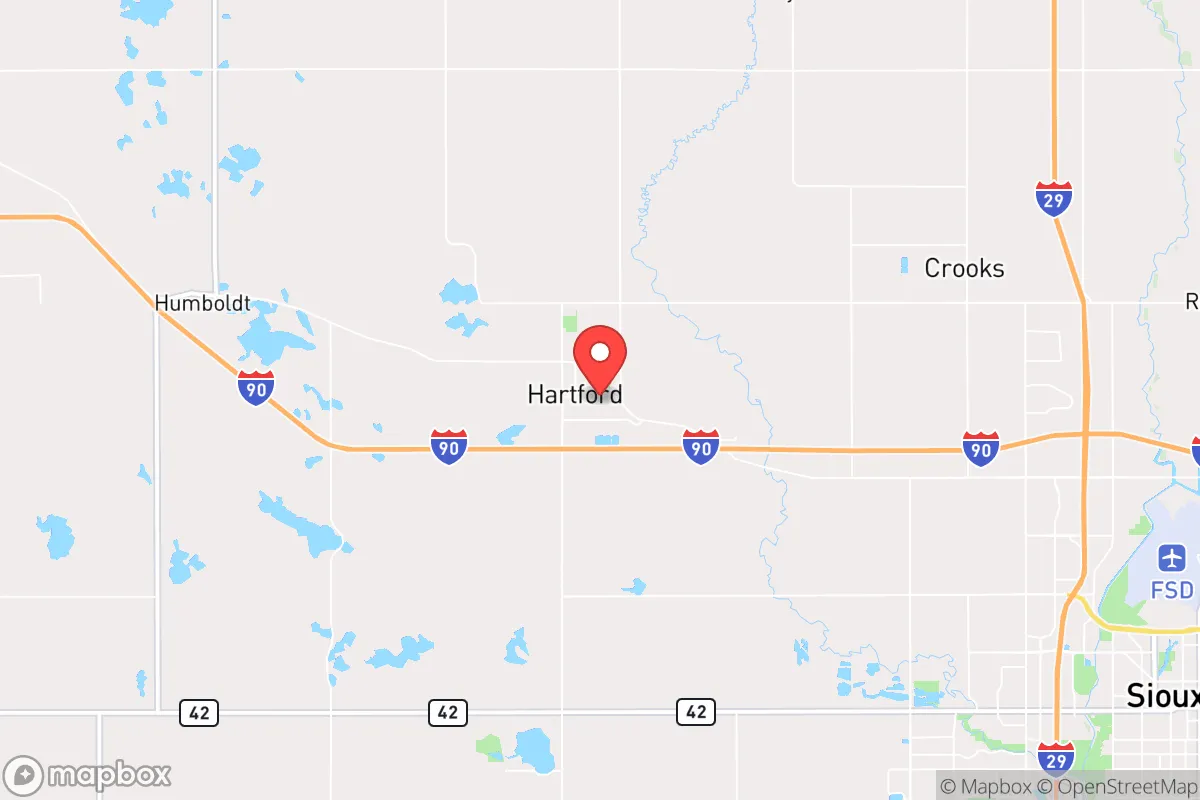
Strategic Assessment of Hartford, SD
Workable tactical position. Some exposure to population density or targets, but generally defensible in a crisis.
What does the Strategic Assessment tell us?
Our Strategic Assessment grades tactical survivability of an area. Major population centers, military targets, fallout zones, natural disasters, and border exposure all drive risk — lower exposure means a more defensible position in a crisis.
This is heavily inspired by Joel Skousen's Strategic Relocation book. Highly recommended you checkout the book ($)What does this tell us?
Our Strategic Assessment grades tactical survivability of an area. Major population centers, military targets, fallout zones, natural disasters, and border exposure all drive risk — lower exposure means a more defensible position in a crisis.
This is heavily inspired by Joel Skousen's Strategic Relocation book. Highly recommended you checkout the book ($)Strategic Pillars

Key Distances
Regional Safe Places
Below is our recommended "safe zones" in South Dakota and the surrounding area based on our strategic heuristics. For most people, it's unrealistic to live in a “safe zone” full-time due to work, family or other personal reasons. They tend to be more rural. However, many of these areas are perfect for second homes and retreat properties that double as a vacation home or even a short-term rental.
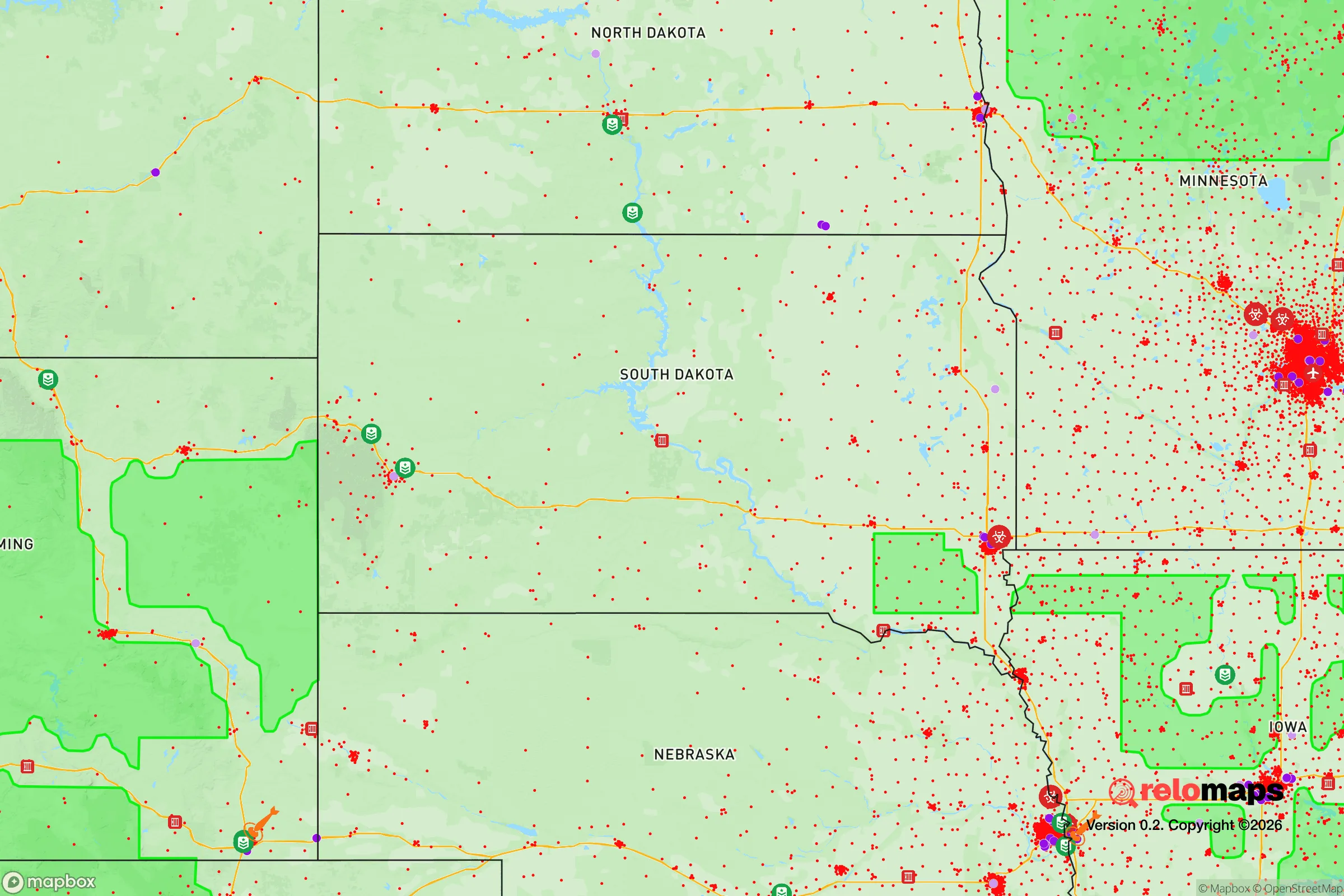


Important Note: For informational purposes only. This does not mean nothing bad ever happens in the green zones. Please use common sense. This is based on public data and modeled with AI. We tried to take a conservative approach but mistakes happen. We update this regularly as new information becomes available.
Solar Generator Recommendations
Backup power matters more here than in safer locations. We've picked three solar generators across budgets and capacity tiers — start with the budget unit if you only need a few essentials, or step up if you want to run a fridge and HVAC for days at a time.

Jackery Portable Power Station Explorer 300
Budget OptionPower on the Go: Weighing only 11 lbs, it's convenient to set up and store with book-sized foldable solar panels

BLUETTI Portable Power Station AC180
Designed for both indoor and outdoor scenarios, AC180 is highly capable as it has a robost capacity and continuous output power.

EF ECOFLOW DELTA Pro Ultra Power Station
Upgraded PickEcoFlow DELTA Pro Ultra is a whole-home energy system designed to grow with your family. Integrated with the Smart Home Panel 2, it scales to meet your evolving energy needs — keeping your home powered, intelligent, and secure through every stage of life.
We earn a commission, at no additional cost to you.
Strategic Assessment Analysis
Hartford, South Dakota, offers a surprisingly strong strategic position for those prioritizing resilience and self-sufficiency, balancing small-town stability with proximity to Sioux Falls’ resources without being swallowed by its vulnerabilities. Located in Minnehaha County, roughly 20 miles west of Sioux Falls, this community of around 3,500 people sits in a zone that avoids the worst of the region’s natural threats while maintaining access to critical infrastructure. For a relocator weighing disaster readiness, Hartford’s combination of agricultural surroundings, low population density, and distance from major fallout targets makes it a defensible base camp rather than a front-line exposure.
Geographic position and natural advantages for long-term stability
Hartford’s location in the Big Sioux River valley provides fertile soil and reliable water access, but its elevation—roughly 1,500 feet above sea level—keeps it above most floodplains. The area experiences a continental climate with cold winters and hot summers, but it sits outside tornado alley’s core, with an average of only 2-3 tornado warnings per year compared to 10-15 in central Oklahoma. Severe thunderstorms are common, but the flat terrain allows for early warning and easy evacuation routes via Interstate 29 and Highway 38. The region’s primary natural risk is blizzards and ice storms, which can knock out power for 24-72 hours annually, but these are predictable and manageable with basic preparation. Unlike coastal or earthquake-prone zones, Hartford faces no hurricane, tsunami, or seismic threats, making it a low-volatility environment for long-term habitation.
Risks, exposures, and proximity to fallout-relevant landmarks
The most significant strategic risk for Hartford is its proximity to Sioux Falls, a city of 200,000 that could become a secondary target in a major conflict or a chokepoint during a regional crisis. Sioux Falls hosts the Sanford Health system, the largest employer in the state, and the Joe Foss Field Air National Guard base, which operates F-16s and C-130s—assets that could draw attention in a national emergency. Hartford sits 20 miles west, placing it outside the immediate blast radius of a ground-level nuclear detonation at the base (which would be roughly 5-10 miles for severe damage), but within the fallout plume zone depending on wind direction. Prevailing winds in South Dakota blow west to east, meaning fallout from a strike on Sioux Falls would likely drift toward Minnesota, not back toward Hartford. The Ellsworth Air Force Base near Rapid City, 350 miles west, is a higher-value target but too distant to pose direct fallout risk. For man-made hazards, the area has no major chemical plants, refineries, or nuclear power stations within 50 miles—the closest nuclear facility is the Fort Calhoun plant in Nebraska, 120 miles south. The primary man-made risk is a derailment on the BNSF rail line that runs through town, which carries ethanol and anhydrous ammonia, but these are localized and survivable with proper sheltering.
Practical resilience for a relocator: food, water, energy, and defensibility
Hartford’s agricultural setting gives it a major self-sufficiency advantage. The surrounding Minnehaha County is among the top corn and soybean producers in the state, with dozens of family farms within a 10-mile radius. Local food sources include the Hartford Farmers Market (June-October) and several u-pick orchards near Dell Rapids, 10 miles north. For long-term food storage, the area’s cold winters allow for natural refrigeration for 4-5 months of the year, and root cellaring is feasible in the well-drained loam soil. Water access is strong: the Big Sioux River runs along the town’s eastern edge, and the underlying Dakota Aquifer provides reliable well water at depths of 100-200 feet. Most homes in Hartford use municipal water from the Sioux Falls aquifer, but rural properties with private wells are common and affordable—a 2025 well permit costs around $500. Energy resilience is mixed. The local grid is served by Xcel Energy, which has a 96% reliability rating but is vulnerable to ice storms. Solar potential is moderate: South Dakota averages 4.5 peak sun hours per day in summer, dropping to 1.5 in winter, so a solar-plus-battery system would need oversizing for winter months. Wood heating is practical, with abundant timber along the Big Sioux River and state-managed forests within 30 miles. Defensibility is a key strength: Hartford’s layout is a compact grid with clear sightlines, and the surrounding farmland provides a natural buffer zone. The town has a single police department with 6 officers, but the Minnehaha County Sheriff’s Office has a substation 8 miles east in Sioux Falls, ensuring response times under 15 minutes for most incidents. The nearest hospital is Avera Heart Hospital in Sioux Falls, 20 minutes away, but the Hartford Clinic offers basic urgent care. For a relocator, the biggest practical gap is the lack of a dedicated emergency shelter or community bunker—residents would need to rely on basements or storm cellars for tornado and fallout protection. New construction homes in the area typically include basements, but older homes may not, so a pre-1970s house purchase should include a retrofit plan.
Overall, Hartford presents a balanced strategic picture for the disaster-conscious relocator. It avoids the high-risk profiles of coastal, seismic, or industrial zones while offering genuine agricultural self-sufficiency and a low population density that reduces competition for resources in a crisis. The primary trade-off is proximity to Sioux Falls—close enough to access jobs, healthcare, and supplies in normal times, but close enough to feel the ripple effects of a major event there. For a family or individual willing to invest in a well, solar backup, and a basement shelter, Hartford provides a defensible, low-volatility base that can sustain itself through most regional disruptions. It’s not a remote survivalist retreat, but a practical, middle-ground option for those who want resilience without isolation.

* Values derived from national, state, county, city and local statistics and may differ in a specific area. Last updated: 2026-09-27T15:22:50.000Z
Narrative content on this page is AI-generated and may contain mistakes. Verify any details that matter before acting on them.
ReloMaps may earn a commission from affiliate links at no extra cost to you.

