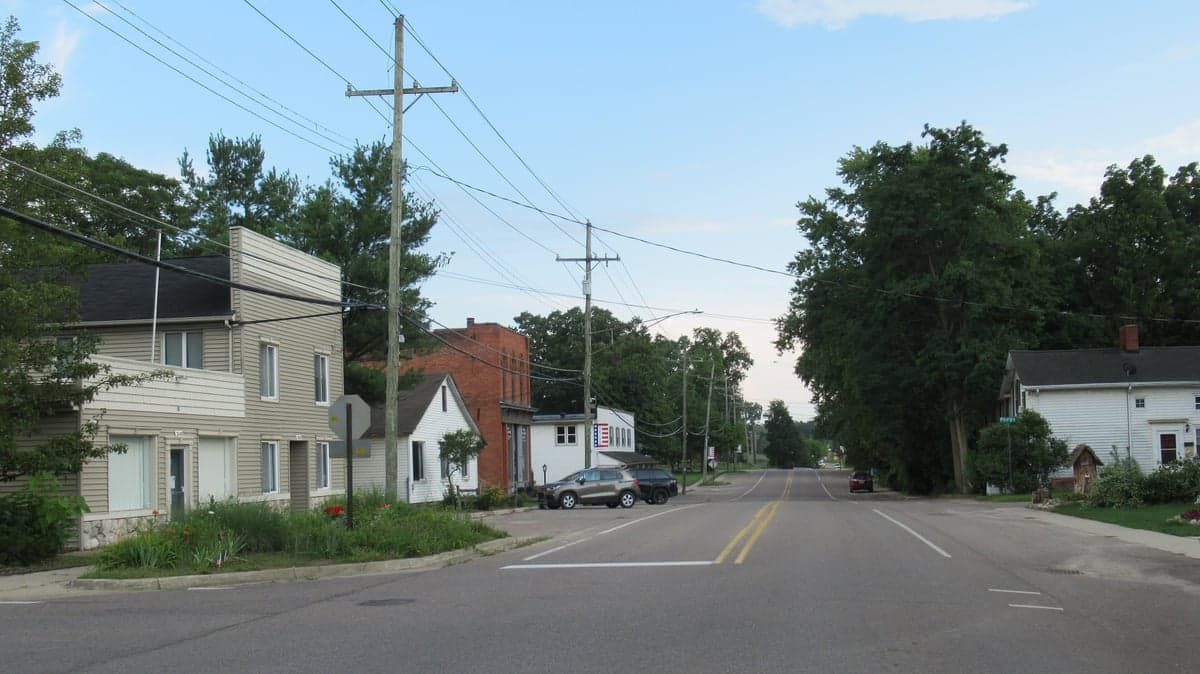
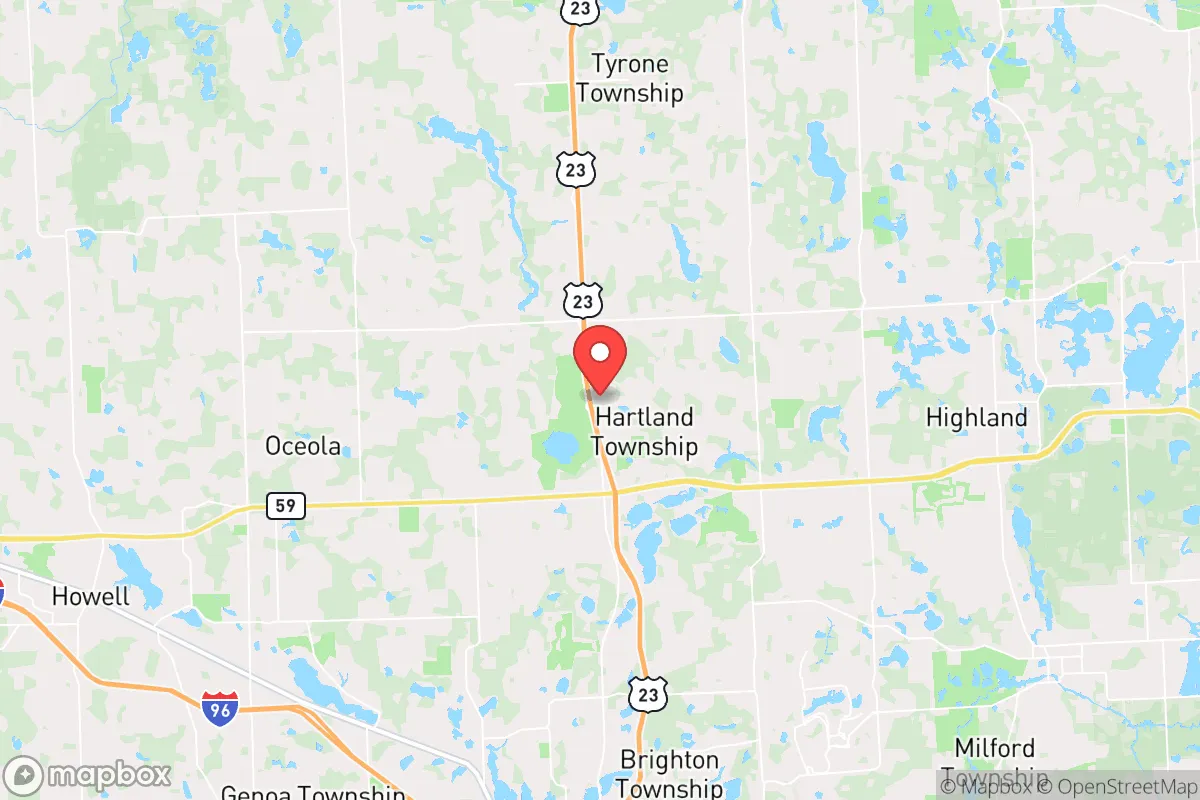
Photo: Wikipedia
Demographics of Hartland, MI
Historical data isn't available for Hartland, MI. Trends shown are for Livingston County, MI.
Affluence Level in Hartland, MI
An upper-middle-class area. Household wealth, education levels, and homeownership run ahead of national benchmarks.
People of Hartland, MI
The people of Hartland, Michigan, today form a remarkably homogeneous community of just 722 residents, where 99.7% of the population identifies as White and the foreign-born share stands at 0.0%. This is a small, tight-knit village within Livingston County that has retained its historic character as a rural service center, with a college-educated rate of 39.2% reflecting a population that values education but has seen little demographic change over generations. Hartland’s identity is rooted in its role as a quiet, family-oriented hub for surrounding farm country and lake communities, not as a diversifying suburb.
How the city was settled and grew
Hartland’s original population arrived in the 1830s, drawn by the promise of fertile farmland and water power from the Shiawassee River. The village was platted in 1836 by early settlers from New York and New England, who established a mill and a handful of stores at the crossroads of what is now M-59 and Clyde Road. The first wave of residents built homes in what is now the Hartland Historic District, centered around the old mill pond and the village green, where many of the original Greek Revival and Italianate houses still stand. A second wave of German and Irish immigrants arrived in the 1850s and 1860s, working as farmers and laborers; they settled along the edges of the village in areas like Old US-23 (now Hartland Road) and the Parshallville area to the north, where small farmsteads dotted the landscape. The railroad never came directly through Hartland, which kept the village small and insulated from the industrial growth that transformed nearby cities like Howell and Brighton. By 1900, the population hovered around 400, and the economy remained tied to agriculture, with a few sawmills and a gristmill serving the surrounding countryside.
Modern era (post-1965)
After the 1965 Hart-Cellar Act, Hartland saw virtually no immigration-driven change. The foreign-born population has remained at 0.0% in every census since 1970, and the racial composition has stayed overwhelmingly White. Instead, the modern era has been defined by domestic in-migration from within Michigan. Beginning in the 1970s, families from the Detroit metro area began moving to Hartland for its rural character, lower crime rates, and highly regarded Hartland Consolidated Schools. These newcomers built homes in newer subdivisions such as Woodland Shores (a lakefront community on Woodland Lake) and Hartland Meadows (a cluster of single-family homes off M-59 west of the village center). The village itself remained largely static, but the surrounding township—Hartland Township—grew rapidly, swelling from about 4,000 residents in 1970 to over 15,000 by 2020. This created a dynamic where the village of Hartland functions as the historic core and commercial node, while most new residents live in the township’s subdivisions and lake communities. The 0.0% Hispanic, Black, and Asian figures reflect that this in-migration has been almost entirely White, drawn from other parts of Michigan rather than from out of state or abroad.
The future
Hartland’s population is projected to remain small and demographically stable over the next 10–20 years. The village itself has little room for new development, hemmed in by existing homes and the river, so future growth will continue to occur in the surrounding township. The population is likely to become slightly older as younger families are priced out by rising home values in Livingston County, though the school district’s reputation will continue to attract some new families. There is no indication of significant diversification: the foreign-born share has been zero for decades, and the racial composition has not shifted. New residential construction is concentrated in subdivisions like Spring Mill Pond and Hartland Glen, both of which are marketed to families seeking a rural-suburban lifestyle with access to Brighton and Howell. The cultural identity of Hartland—conservative, family-focused, and oriented around outdoor recreation (lakes, golf, and the Hartland Music Festival)—is unlikely to change meaningfully. The village will remain a white, native-born enclave, with diversity limited to the occasional out-of-state transplant from other predominantly white regions of the Midwest.
For someone moving in now, Hartland offers a stable, predictable community where the population is not growing or diversifying but rather consolidating around its existing character. It is a place for those who value small-town schools, low crime, and a homogeneous social environment, with the understanding that the village itself is a historic anchor rather than a growing suburb. The people of Hartland are likely to look much the same in 2040 as they do today: white, native-born, and rooted in the rhythms of rural Livingston County life.

* Values derived from national, state, county, city and local statistics and may differ in a specific area. Last updated: 2026-10-20T18:52:06.000Z
Narrative content on this page is AI-generated and may contain mistakes. Verify any details that matter before acting on them.
ReloMaps may earn a commission from affiliate links at no extra cost to you.

