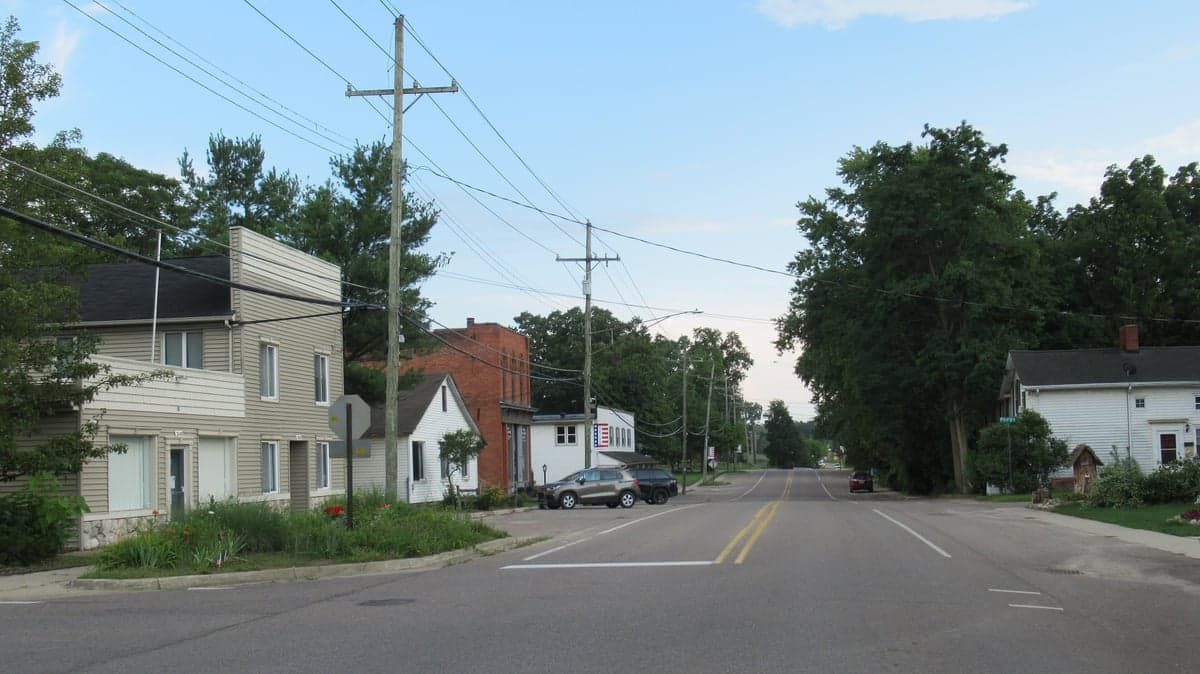
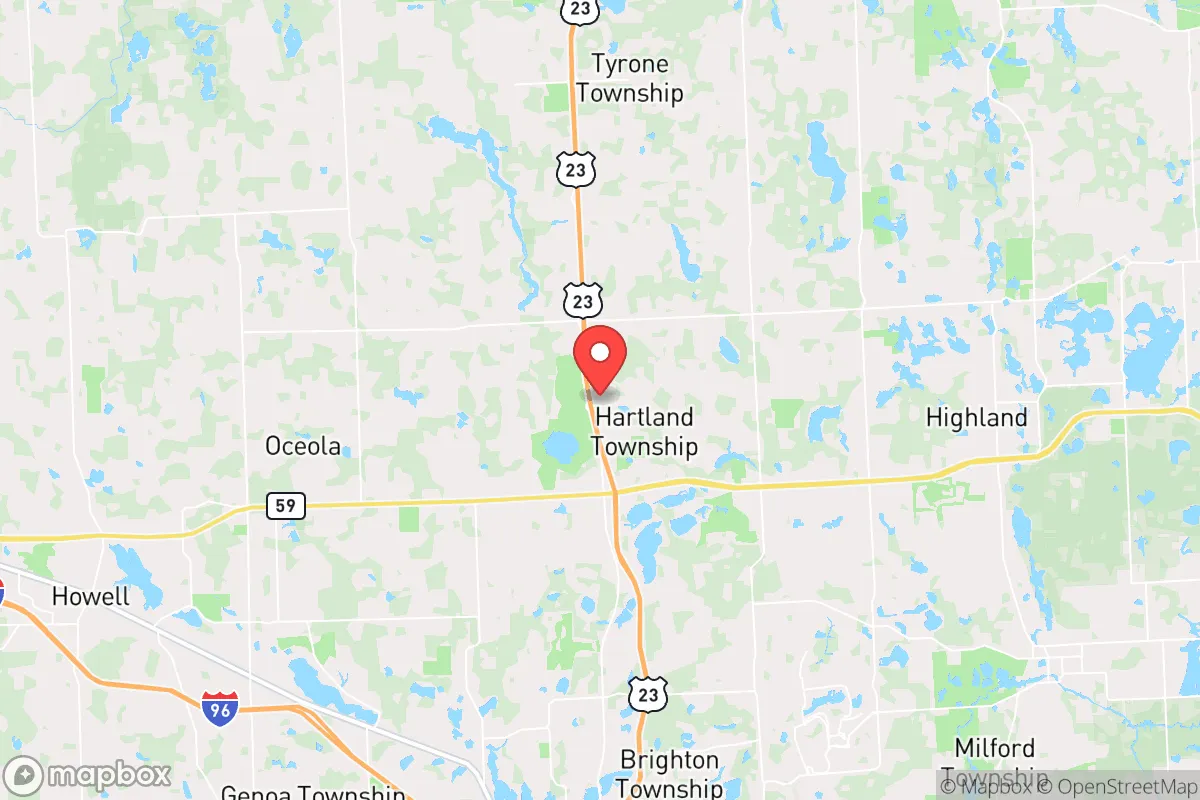
Photo: Wikipedia
Political ClimatePolitical Climate in Hartland, MI
District shown is the primary district for this city’s centroid. Cities may span multiple districts.
Local Political AnalysisPolitical Analysis of Hartland, MI
Hartland Township and the surrounding Livingston County area have long been a Republican stronghold in Michigan, but the political reality here is more nuanced than the raw numbers suggest. The Cook Partisan Voting Index (PVI) for the area is rated EVEN, meaning the district as a whole votes almost exactly in line with the national average. However, that EVEN rating masks a deep internal split: Hartland itself leans reliably conservative, while the district’s overall balance is pulled toward the center by more moderate and Democratic-leaning precincts in nearby communities like Brighton, Howell, and especially the fast-growing areas of western Oakland County. In the 2024 presidential election, Livingston County as a whole voted about 58% Republican, but Hartland’s precincts were closer to 62-65% Republican, reflecting a solidly red base that has softened only slightly since the Trump-era realignments.
How it compares
Compared to the state of Michigan as a whole—which also carries a Cook PVI of EVEN—Hartland is noticeably more conservative. Michigan’s EVEN rating is a product of a deeply polarized state where Detroit and Ann Arbor offset rural and exurban areas like Hartland. In practice, Hartland’s politics are closer to those of mid-Michigan’s rural counties (like Shiawassee or Lapeer) than to the swing suburbs of Grand Rapids or Macomb County. The key difference is that Hartland’s conservatism is less populist and more traditionally suburban: residents here tend to prioritize low taxes, school choice, and Second Amendment rights, but they also support local millages for schools and roads at higher rates than in more rural, anti-tax areas. The nearby city of Brighton, just 10 minutes east, votes slightly more moderate, while Howell (the county seat) is a bit more conservative but still within the same broad Republican orbit. The real contrast is with communities like Milford or Walled Lake, just over the county line in Oakland County, where Democratic votes are significantly higher.
What this means for residents
For conservative residents, Hartland offers a comfortable environment where their views are the local norm. Local government, school board meetings, and community events tend to reflect a center-right consensus, and Republican candidates can expect to win township-level races by comfortable margins. For liberal residents, the experience is more mixed: they are a clear minority, but not an isolated one. Many find community through regional networks in Brighton or Ann Arbor (about 25 minutes away), and local Democratic clubs are active, if small. The practical impact is that policy debates here are usually about how much to spend, not whether to spend—Hartland’s schools are well-funded by local millages, and the township has invested in parks and infrastructure without the kind of tax revolt seen in more libertarian-leaning rural areas. Social issues occasionally surface, but the dominant political conversation is about development, traffic, and maintaining the area’s semi-rural character.
One cultural distinction that sets Hartland apart from both the state and the surrounding region is its strong sense of local identity, which often transcends party lines. The Hartland Area Project, a community foundation, and the annual Hartland Founders Day celebration draw broad participation. Politically, this means that even heated debates—like the 2023 school board controversy over library books—tend to resolve with a focus on local control rather than ideological purity. Looking ahead, the area’s trajectory is toward slow, steady growth, which will likely nudge it slightly toward the center as new residents arrive from more diverse parts of Metro Detroit. But for the foreseeable future, Hartland will remain a reliably conservative pocket in a swing state, where the national EVEN rating feels like a distant abstraction compared to the local reality of red precincts and community-driven governance.

State Political ClimatePolitical Climate in Michigan
State Political AnalysisPolitical Environment in the State
Michigan is the ultimate swing state, with a Cook PVI of EVEN that perfectly captures its knife-edge balance. Over the past 20 years, it’s lurched from reliably blue in the 1990s and early 2000s, to a shocking Trump win in 2016 (by 0.2 points), back to Biden in 2020 (by 2.8 points), and then saw Republicans sweep the state legislature and win a U.S. Senate seat in 2022. The dominant coalitions are a shrinking, union-heavy blue vote in the southeast and a growing, populist-conservative coalition in the rest of the state, with the Detroit suburbs and Grand Rapids area acting as the permanent battlegrounds. For a relocator, this means your vote genuinely counts, but the state’s direction depends entirely on which Michigan you move to.
Urban vs. rural divide
The political map of Michigan is a story of three distinct regions. Wayne County (Detroit) and Washtenaw County (Ann Arbor) are the Democratic anchor, delivering margins of 60-70% for Democrats. This is the old industrial core, still heavily unionized and racially diverse. In contrast, the rural Upper Peninsula and northern Lower Peninsula are deeply Republican, often voting 65-70% for the GOP. The real action is in the suburbs and mid-sized cities. Oakland County, the wealthy Detroit suburb, has been trending blue for a decade, flipping from a Republican stronghold to a Democratic lean. Kent County (Grand Rapids) was historically Republican but has become a true swing county, with Grand Rapids itself turning blue while the outer suburbs stay red. The Flint and Saginaw areas are classic Rust Belt swing zones — working-class, racially mixed, and economically anxious — that flipped from Obama to Trump and back to Biden. The Macomb County suburbs north of Detroit are the ultimate bellwether: heavily white, union, and culturally conservative, they went for Trump by double digits in 2016 and 2020, but also elected a Democratic county executive in 2022. This urban-rural split means a conservative moving to Traverse City will find a very different political environment than one moving to Ann Arbor.
Policy environment
Michigan’s policy environment is a mixed bag that reflects its swing-state status. Taxes: the state has a flat 4.25% income tax, with a 6% sales tax. Property taxes are moderate but vary wildly by district. There is no tax on Social Security benefits, which is a plus for retirees. Regulation: Michigan is a right-to-work state (though Democrats repealed the law in 2023, effective 2024), meaning union membership is no longer mandatory for private-sector workers. This is a major shift. Education: school choice is robust, with charter schools and inter-district open enrollment widely available. The state’s election laws are relatively open: no-excuse absentee voting, same-day voter registration, and automatic voter registration are all in place, passed by a Democratic trifecta in 2023. Healthcare: Michigan expanded Medicaid under the Affordable Care Act, and the state has a strong public health infrastructure. For conservatives, the regulatory environment for business is generally favorable, but the recent repeal of right-to-work and the expansion of voting access are clear shifts leftward.
Recent policy direction
The 2023-2024 Democratic trifecta (Governor Gretchen Whitmer, state House, and state Senate) passed a flurry of legislation that signals a sharp left turn on several fronts. Gun and self-defense law: Michigan passed universal background checks and a red flag law (extreme risk protection order) in 2023, a major change in a state with a strong hunting and gun culture. Parental and education rights: the state repealed a 1976 law that banned LGBTQ+ discrimination in schools, and passed a repeal of the 1931 abortion ban, codifying abortion rights. Speech and privacy: no major changes, but the state has not passed any digital privacy laws comparable to California or Virginia. Medical and bodily autonomy: the 2022 ballot proposal (Prop 3) enshrined abortion rights in the state constitution, a decisive victory for the pro-choice side. Property rights: no major changes, but the state’s strong environmental regulations (especially around the Great Lakes) can impact development. Taxation: the 2023 budget included a temporary income tax rate cut from 4.25% to 4.05%, but it’s tied to revenue triggers and may not last. Voting and ballot access: the 2022 Prop 2 passed, enshrining no-excuse absentee voting, early voting, and ballot drop boxes in the constitution. For a conservative relocator, the key takeaway is that Michigan has moved left on guns, abortion, and voting access, but remains centrist on taxes and business regulation.
Civil unrest & political movements
Michigan has been a flashpoint for political activism on both sides. The 2020 Whitmer kidnapping plot and the armed protests at the state capitol over COVID-19 restrictions put Michigan in the national spotlight. The “Operation Gridlock” protest in April 2020, where thousands of conservative activists (many from the Macomb County area) clogged downtown Lansing, was a defining moment of the pandemic-era right-wing movement. On the left, the 2020 George Floyd protests in Detroit and Grand Rapids were large and occasionally violent. Immigration politics: Michigan is not a border state, but the city of Detroit has a “Welcoming City” ordinance that limits cooperation with ICE. Election integrity: the 2020 election saw intense scrutiny, with Trump’s legal team filing multiple lawsuits in Michigan. The Republican-led legislature conducted an investigation that found no widespread fraud, but the issue remains a live wire in conservative circles. Secession/nullification: there is a small but vocal movement in the Upper Peninsula to secede from Michigan and form a new state (Superior), driven by feeling ignored by Lansing. It’s not serious, but it reflects the deep rural-urban divide. A new resident will notice the political polarization most in the “Trump 2024” vs. “Whitmer 2026” yard signs that dominate every neighborhood.
Projection
Over the next 5-10 years, Michigan is likely to remain a swing state, but the demographic trends favor the Democrats in the long run. The Detroit suburbs (Oakland, Washtenaw) are becoming more diverse and educated, trends that typically boost Democrats. The Grand Rapids area is growing fast, and its influx of young professionals and immigrants is slowly turning it blue. However, the rural areas are depopulating, which hurts the GOP. The wildcard is Macomb County: if it continues to trend Republican, the state stays competitive; if it flips back to blue, Michigan becomes a solid Democratic state. The 2024 election will be a critical test. For a conservative moving in now, expect to live in a state where your party can win statewide (as it did in 2022 for Senate and governor’s race was close), but where the cultural and policy winds are blowing left on social issues. For a liberal, the state offers a chance to consolidate gains, but the GOP is still very competitive at the legislative level.
Bottom line for a new resident: Michigan is a state where your vote truly matters, but your daily political experience will depend heavily on where you live. If you move to Grand Rapids or Traverse City, you’ll find a mix of conservative and liberal neighbors. If you move to Ann Arbor or Detroit, you’ll be in a deep blue bubble. If you move to Macomb County or northern Michigan, you’ll be in a red stronghold. The state’s tax and regulatory environment is moderate, but the recent leftward shift on guns, abortion, and voting access is real. For a conservative, the best bet is to target the Grand Rapids suburbs (like Holland or Rockford) or the Traverse City area, where you’ll find a strong conservative community within a state that still has a competitive political landscape. For a liberal, the Ann Arbor or Ferndale areas offer a deep blue haven. Either way, Michigan is not a state where you can ignore politics — it’s a state where you’ll be engaged, for better or worse.
* Values derived from national, state, county, city and local statistics and may differ in a specific area. Last updated: 2026-10-20T18:52:06.000Z
Narrative content on this page is AI-generated and may contain mistakes. Verify any details that matter before acting on them.
ReloMaps may earn a commission from affiliate links at no extra cost to you.

