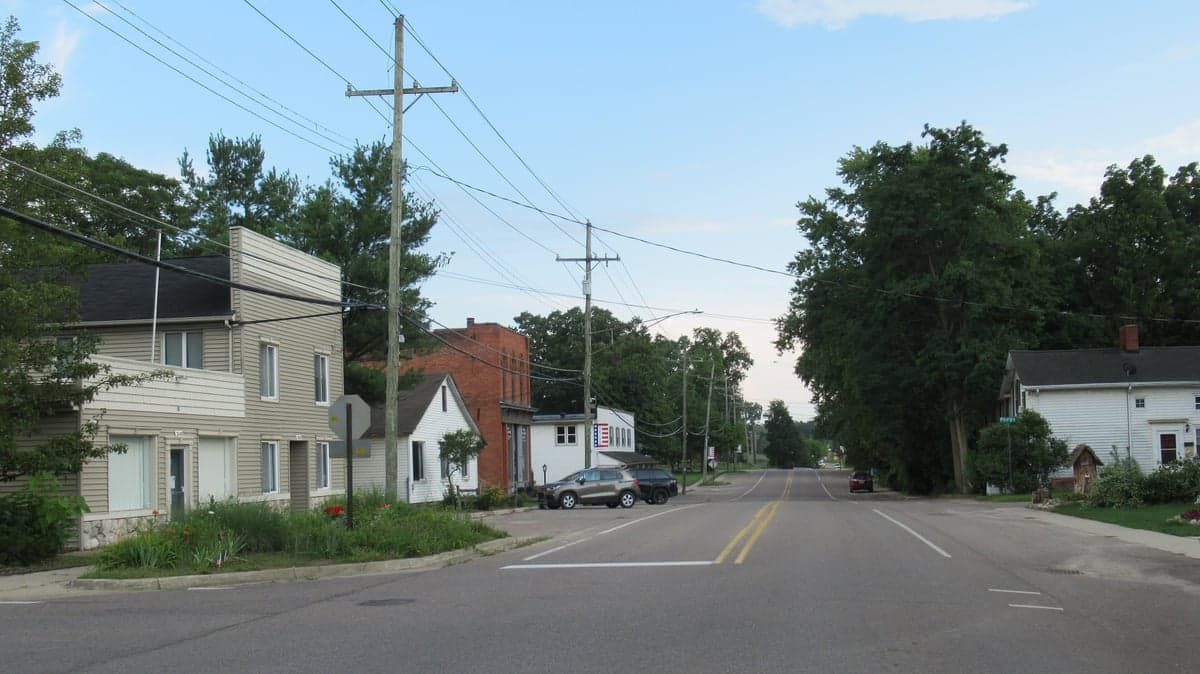
Photo: Wikipedia
Personal Sovereignty in Hartland, MI
Strong independent fundamentals that actively favor personal liberty and low regulation.
What does Personal Sovereignty tell us?
Personal Sovereignty measures your capacity for self-reliance and independence with minimal government friction. Higher scores mean fewer barriers between you and the way you want to live... but it assumes you have the space you need and good neighbors.
What does this tell us?
Personal Sovereignty measures your capacity for self-reliance and independence with minimal government friction. Higher scores mean fewer barriers between you and the way you want to live... but it assumes you have the space you need and good neighbors.
State Policy
Energy independence: Importer (20% of energy produced in-state)
Personal Liberty
Homesteading

Personal Liberty Analysis
Hartland, Michigan, offers a notably high degree of personal sovereignty within a state that balances traditional Midwestern independence with a moderately regulated framework. For individuals and families prioritizing autonomy, Hartland’s environment is defined by low property taxes relative to neighboring counties, permissive self-defense laws, and a regulatory posture that generally favors private property rights over government intervention. While Michigan is not a libertarian stronghold, Hartland’s location in Livingston County—one of the state’s most conservative and fiscally restrained areas—creates a local culture where self-reliance is the default expectation, not an exception.
Tax burden and regulatory posture in Livingston County
Hartland residents benefit from one of the lowest property tax burdens in Michigan, thanks to Livingston County’s historically conservative fiscal management. The county’s average effective property tax rate hovers around 1.5% of assessed value, significantly below the state average of roughly 1.8%, and well under rates in neighboring Oakland County (often exceeding 2.0%). There is no local income tax in Hartland or anywhere in Livingston County—a meaningful advantage over communities in Washtenaw or Wayne counties. The regulatory posture at the township level is light-touch: Hartland Township does not impose its own building codes beyond state minimums, and zoning is generally permissive for standard residential uses. However, Michigan’s statewide regulatory framework does impose some constraints. The state’s Michigan Occupational Safety and Health Administration (MIOSHA) and Department of Environment, Great Lakes, and Energy (EGLE) enforce environmental and workplace rules that can affect small-scale commercial operations or property modifications near wetlands. For a homeowner running a home-based business or pursuing minor construction, the primary friction points are state-level permits, not local overreach. Overall, the tax and regulatory climate in Hartland is favorable for those seeking to minimize government intrusion into personal finances and property use.
Self-defense and gun law specifics in Michigan
Michigan is a shall-issue state for concealed pistol licenses (CPL), meaning that if you meet statutory requirements—including a background check and a state-approved training course—the county clerk must issue the permit. Livingston County, including Hartland, has a reputation for efficient processing and no de facto delays. The state also allows open carry of handguns without a license, though local ordinances in some municipalities may restrict it; Hartland Township has no such restrictions. A critical point for sovereignty-minded residents: Michigan’s stand your ground law, codified in MCL 780.972, provides that an individual has no duty to retreat before using deadly force if they are in a place they have a legal right to be and reasonably believe force is necessary to prevent imminent death or great bodily harm. This is a strong self-defense framework, though it is not as expansive as some Southern states’ laws—Michigan does not have a “castle doctrine” statute that explicitly presumes reasonable fear in home invasions, though case law generally supports that presumption. Magazine capacity is unrestricted for handguns and rifles, and there is no state-level assault weapons ban. The primary limitation is the requirement for a purchase license (issued by local police or sheriff) for handgun purchases, which is a minor administrative hurdle. For a family prioritizing self-defense autonomy, Hartland’s legal environment is among the most favorable in the Midwest.
Self-reliance and homesteading viability: lot sizes, zoning, and off-grid feasibility
Hartland’s residential zoning allows for genuine self-reliance without the strictures of suburban homeowners’ associations. Most single-family lots in the township are zoned for minimum lot sizes of 1 to 2 acres, and many rural parcels exceed 5 acres, providing ample space for gardens, small livestock, and outbuildings. The township does not prohibit backyard chickens, beekeeping, or small-scale animal husbandry, though commercial farming operations require a special land use permit. Off-grid feasibility is moderate: Michigan’s building code requires connection to the electrical grid for new construction, but solar panels with battery storage are permitted without special zoning approval, and many residents use them to reduce grid dependence. Rainwater collection is legal for non-potable uses (irrigation, livestock), but potable rainwater systems must meet state plumbing codes. Composting toilets are allowed under the Michigan Residential Code if they are certified by NSF International. The biggest constraint for full off-grid living is the requirement for a septic system approved by the Livingston County Health Department—no composting-only waste systems are permitted for permanent dwellings. For a family seeking a balance between rural self-sufficiency and practical regulatory compliance, Hartland offers a workable middle ground: you can raise much of your own food, generate your own power, and reduce utility bills, but you cannot fully disconnect from county health and building oversight.
Personal liberties: parental rights, medical autonomy, speech, and property
Parental rights in Michigan are broadly protected under state law, with a strong presumption that parents have the authority to direct their children’s upbringing, education, and healthcare. Hartland is served by the Hartland Consolidated Schools district, which has a reputation for responsiveness to parental concerns, though it is a public school system subject to state curriculum mandates. For families seeking maximum autonomy, Michigan’s homeschooling laws are among the most permissive in the nation: no notification to the state is required, no standardized testing is mandated, and parents are not required to hold teaching credentials. The state also allows for the creation of personal microschools or learning pods without significant regulatory burden. Medical autonomy is more constrained: Michigan requires childhood vaccinations for school attendance, though medical and religious exemptions are available (philosophical exemptions were eliminated in 2015). The state does not have a right-to-try law for experimental treatments, but it does allow for advance directives and do-not-resuscitate orders. Free speech protections are robust, as Michigan courts generally interpret the state constitution’s free speech clause as at least as protective as the First Amendment. Property rights are strong: Michigan’s Private Property Rights Protection Act (PA 123 of 1998) requires government agencies to conduct a takings assessment before adopting regulations that may diminish property value. Eminent domain is limited to public use projects, and Livingston County has not pursued aggressive land-use condemnations. For a family prioritizing personal liberties, Hartland’s legal environment is supportive of parental choice, property ownership, and expressive freedom, with the primary limitations being state-level health mandates and vaccine requirements.
Compared to other areas in the Midwest, Hartland ranks highly for personal sovereignty. Its tax burden is lower than most suburban communities in southeastern Michigan, its self-defense laws are permissive, and its zoning allows for meaningful self-reliance without excessive bureaucracy. The primary trade-offs are Michigan’s state-level regulatory reach—particularly in health mandates and environmental permitting—and the practical constraints of a four-season climate that limits year-round off-grid agriculture. For a conservative-leaning individual or family seeking a community where autonomy is respected and government overreach is minimal, Hartland represents a strong choice within a state that, while not the most libertarian in the nation, offers a solid foundation for personal freedom.

* Values derived from national, state, county, city and local statistics and may differ in a specific area. Last updated: 2026-10-20T18:52:06.000Z
Narrative content on this page is AI-generated and may contain mistakes. Verify any details that matter before acting on them.
ReloMaps may earn a commission from affiliate links at no extra cost to you.

