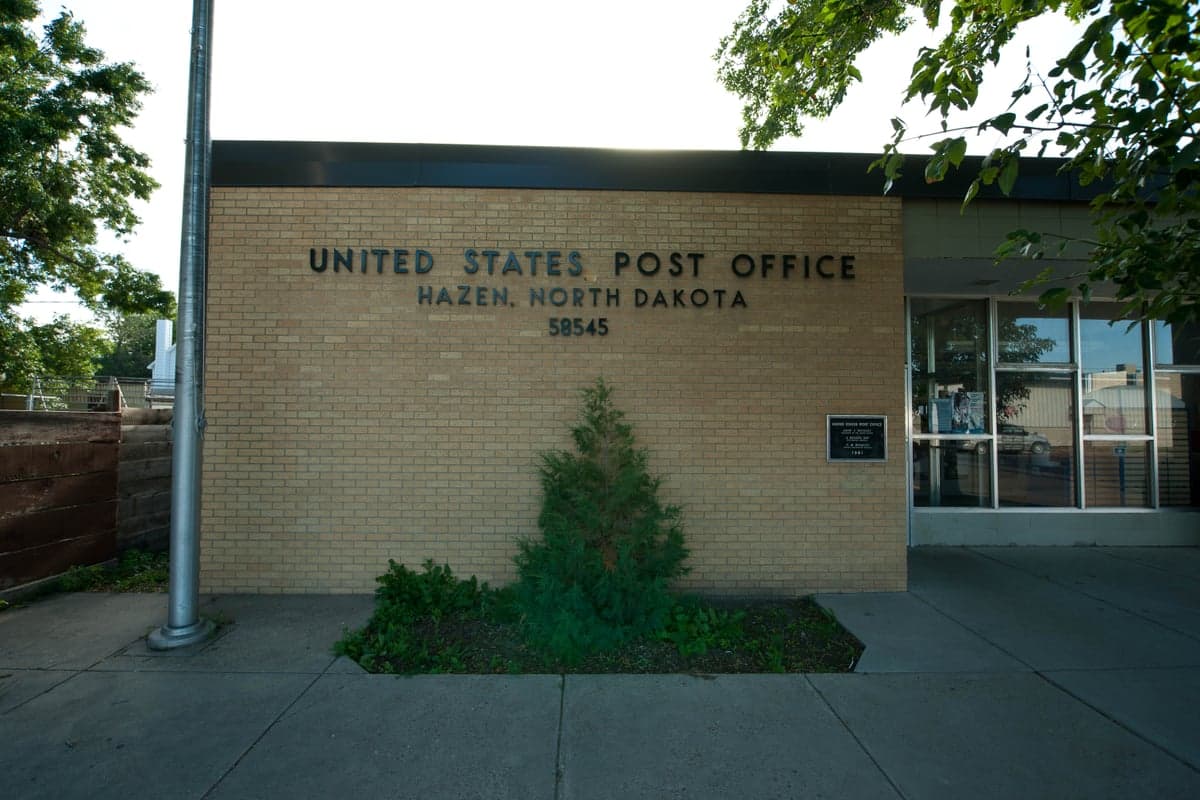
Photo: Wikipedia
Demographics of Hazen, ND
Affluence Level in Hazen, ND
A middle-class area roughly in line with national averages across income, home values, education, and employment.
People of Hazen, ND
The people of Hazen, North Dakota, today number 2,509, forming a tight-knit, predominantly white community with a strong working-class identity rooted in energy and agriculture. The city is notably homogeneous, with 90.5% of residents identifying as white and a foreign-born population of just 0.4%, reflecting limited recent immigration. Distinctive markers include a high rate of homeownership and a practical, self-reliant character shaped by the boom-and-bust cycles of the nearby lignite coal fields. For a conservative-leaning individual or family, Hazen offers a stable, low-crime environment where neighbors know each other and community institutions like the school and church remain central to daily life.
How the city was settled and grew
Hazen was founded in 1913 as a railroad town along the Soo Line, created specifically to serve the agricultural homesteaders breaking the surrounding prairie. The original population was almost entirely Northern European — Germans from Russia, Norwegians, and Scandinavians — drawn by the promise of 160-acre homesteads under the Enlarged Homestead Act of 1909. These early settlers built their first homes in what is now Old Town Hazen, the original grid of streets east of the railroad tracks, where modest wood-frame houses still stand. A second wave arrived during the Great Depression, when the federal government’s Hazen Rural Resettlement Project (1935–1937) relocated struggling farm families from the Dust Bowl into newly built homes in the Resettlement Addition, a planned neighborhood of small, uniform houses south of Main Street. This project cemented Hazen’s identity as a community of hardscrabble survivors, not speculators. By 1950, the population had reached 1,200, and the city’s character was set: overwhelmingly white, Lutheran and Catholic, and dependent on wheat and cattle.
Modern era (post-1965)
The post-1965 era in Hazen was defined not by immigration reform — which had negligible impact here — but by the energy boom triggered by the 1970s oil crisis. The discovery of vast lignite coal deposits led to the construction of the Antelope Valley Station and Freedom Mine in the 1980s, drawing a new wave of domestic migrants from other parts of North Dakota and the Upper Midwest. These workers, predominantly white and male, settled in the Westside Addition, a subdivision of ranch-style homes built in the 1980s west of the original town. A smaller number of Black and Hispanic workers arrived during peak construction periods, but they never formed a lasting enclave; the 2020 census shows Black and Hispanic residents each at just 2.0% of the population. The East Hazen area, near the grain elevators, remained the domain of long-established farming families, while newer subdivisions like Prairie View Estates (built 1995–2005) attracted commuters who work at the coal mines or at the nearby Dakota Gasification Company plant. The college-educated share stands at 29.2%, below the national average, reflecting the dominance of trade and industrial jobs over professional services.
The future
Hazen’s population is slowly aging and shrinking, down from a peak of roughly 2,800 in the 1980s. The city is not homogenizing further — it is already nearly as homogeneous as a North Dakota town can be — but it is tribalizing along economic lines: long-term agricultural families in Old Town and East Hazen versus energy-sector newcomers in Westside Addition and Prairie View Estates. The immigrant communities that exist are negligible and not growing; the 0.4% foreign-born share has held steady for two decades. The next 10–20 years will likely see continued slow decline as younger adults leave for larger cities like Bismarck or Minot, and as the coal industry faces long-term pressure from renewable energy and federal regulations. However, the city’s low cost of living and strong local school system may attract a modest inflow of remote workers or retirees seeking a quiet, affordable life. For a conservative-leaning mover, Hazen offers a predictable, stable community where demographic change is minimal and traditional values remain the norm.
Hazen is becoming a quieter, older version of itself — a place where the energy boom has faded but the community’s core identity endures. For someone moving in now, the city offers a low-drama, low-diversity environment with strong social cohesion, but limited economic opportunity beyond the energy sector and agriculture. It is a good fit for those who value stability, familiarity, and a slower pace of life over the dynamism and diversity of a larger city.

* Values derived from national, state, county, city and local statistics and may differ in a specific area. Last updated: 2026-04-19T05:46:52.000Z
Narrative content on this page is AI-generated and may contain mistakes. Verify any details that matter before acting on them.
ReloMaps may earn a commission from affiliate links at no extra cost to you.

