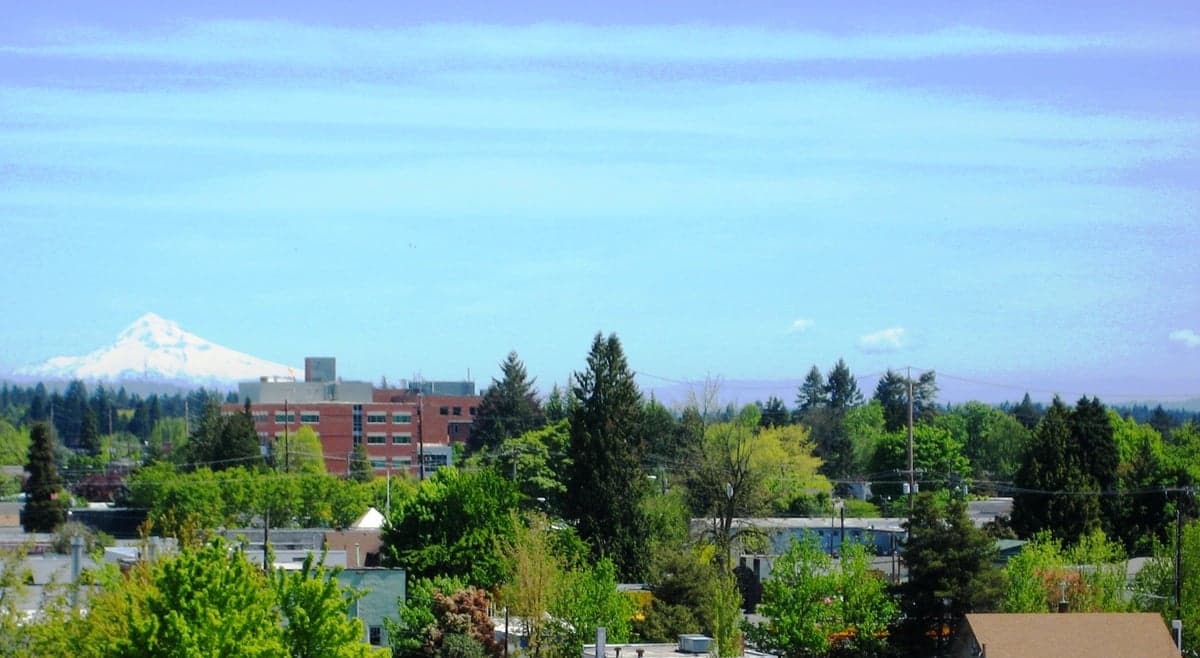
Photo: Wikipedia
Demographics of Hillsboro, OR
Affluence Level in Hillsboro, OR
A middle-class area roughly in line with national averages across income, home values, education, and employment.
People of Hillsboro, OR
The people of Hillsboro, Oregon, today form a diverse, tech-driven community of 107,050 residents, characterized by a majority-minority population where non-Hispanic whites make up 52.4%. The city is a dense suburban hub of Washington County, distinctive for its blend of long-established farming families, a large and growing Hispanic community (25.9%), and a significant Asian (6.9%) and Indian (4.6%) professional class drawn by the semiconductor and tech industries. With 42.0% of adults holding a college degree, Hillsboro’s population is notably educated and increasingly global, yet retains a strong sense of local identity rooted in its agricultural and pioneer past.
How the city was settled and grew
Hillsboro’s population history begins with the 1840s Oregon Trail migrations, when Euro-American settlers claimed Donation Land Claims in the fertile Tualatin Valley. The city was platted in 1850 as the seat of Washington County, drawing a mix of Midwestern farmers, merchants, and a small number of German and Irish immigrants. The original population clustered around the Downtown Hillsboro Historic District, where the county courthouse and early businesses anchored a tight-knit, largely Protestant community. By the early 1900s, Japanese and Filipino laborers arrived to work the region’s berry fields and hop farms, settling in the Orenco Station area—then a company town for the Oregon Nursery Company. This wave was small but significant, establishing the first non-white enclaves. Through the mid-20th century, Hillsboro remained a quiet agricultural center, with population growth driven by natural increase and modest in-migration from other parts of Oregon and the Midwest. The Jackson Bottom and Reedville neighborhoods housed many of these later farming families, who maintained a conservative, rural character that still echoes in local politics today.
Modern era (post-1965)
The 1965 Hart-Celler Act and the rise of Silicon Forest transformed Hillsboro’s population dramatically. Intel’s arrival in the 1970s, followed by other tech firms, triggered a wave of domestic in-migration from California and other states, as well as international professionals. The Tanasbourne neighborhood, developed from the 1980s onward, became the primary landing zone for these newcomers—engineers and managers, many of them white or East/Southeast Asian (Chinese, Vietnamese, Korean), who sought newer housing and proximity to the Sunset Corridor tech campuses. Simultaneously, a large Hispanic population grew from Mexican and Central American immigrants drawn to construction, service, and agricultural work. They concentrated in South Hillsboro and the older Downtown area, where affordable housing and established community networks existed. The Indian-subcontinent population (4.6%) arrived later, from the 1990s onward, primarily as H-1B visa holders and their families in tech, settling in Orenco Station and AmberGlen—master-planned communities built around light rail and walkable design. By 2020, Hillsboro had shifted from a 90% white city in 1980 to a majority-minority one, with the Hispanic share rising steadily and Asian and Indian communities growing through both immigration and high birth rates.
The future
Hillsboro’s population is heading toward further diversification, but with distinct enclave dynamics rather than full homogenization. The Hispanic community is the fastest-growing segment, projected to approach 30% by 2035, driven by both immigration and a younger median age. This growth is concentrated in South Hillsboro and the Downtown core, where Spanish-language businesses and Catholic parishes anchor daily life. The East/Southeast Asian and Indian populations are plateauing, as tech hiring slows and second-generation professionals assimilate into broader suburban patterns, moving to Tanasbourne and Orenco Station but also to newer developments in neighboring Beaverton. The non-Hispanic white population is aging and declining in share, though it remains the largest single group. Over the next 10–20 years, Hillsboro will likely become a city of distinct, stable ethnic neighborhoods—Hispanic South Hillsboro, Asian/Indian Orenco Station, and white-majority Tanasbourne—rather than a fully blended melting pot. This tribalization reflects housing costs, school preferences, and social networks, and it means newcomers will find communities that are welcoming but often self-segregated.
For a conservative-leaning mover, Hillsboro is becoming a place where traditional family values coexist with rapid demographic change. The city’s population is increasingly diverse, educated, and tech-oriented, but its neighborhoods retain distinct identities—from the historic, family-oriented Downtown to the newer, planned communities of Orenco Station. The bottom line: Hillsboro offers a stable, growing economy and strong schools, but the cultural and political landscape is shifting toward a more pluralistic, less uniformly conservative future. Those moving in now should expect a community that values both innovation and its agricultural roots, with a population that is neither homogenizing nor fragmenting, but settling into recognizable enclaves.

* Values derived from national, state, county, city and local statistics and may differ in a specific area. Last updated: 2026-04-24T19:58:36.000Z
Narrative content on this page is AI-generated and may contain mistakes. Verify any details that matter before acting on them.
ReloMaps may earn a commission from affiliate links at no extra cost to you.

